

Every year, thousands of people in the U.S. end up in the hospital-or worse-because they took the wrong pill. Not because they didn’t mean to. Not because they were careless. But because they didn’t stop to look at the label. It’s easy to forget. You’re tired. You’re in a rush. You’ve taken this pill for months. You think you know it by heart. But your memory isn’t reliable. And the stakes? Too high.
Checking your medication label before every dose isn’t just a good idea. It’s the single most effective way to prevent a dangerous mistake. According to the FDA, medication errors cause between 7,000 and 9,000 deaths annually. A shocking 33% of those errors happen because of confusing or misread labels. The good news? You can cut your personal risk by up to 76% just by making label checking a habit.
Why Your Memory Can’t Be Trusted
You’ve been taking your blood pressure pill for a year. You know what it looks like. You know when you take it. So why check the label every time? Because pills change. Pharmacies switch manufacturers. Generic versions look different. New prescriptions get mixed in. A pill that was white last month might be blue this month. The name on the bottle might say “Lisinopril” but the pill inside says “Zestril”-same drug, different look. If you don’t check, you won’t notice.
Studies show that 83% of people who rely on memory alone stop checking labels within two weeks. That’s not laziness. That’s how human memory works. We stop paying attention to things we think we’ve mastered. But with medication, “mastered” doesn’t mean safe. It means dangerous.
What to Look For: The 10 Critical Label Elements
You don’t need to read every word on the label. But you need to verify ten key pieces of information before you swallow anything. These are the elements that matter most, based on FDA and ISMP guidelines:
- Your full name - Must match exactly. No nicknames. No initials.
- Drug name - Both brand and generic (e.g., “Lisinopril (Zestril)”).
- Dosage - Is it 5 mg? 10 mg? 20 mg? Don’t assume. Read it.
- How often to take it - Once a day? Twice? After meals? At bedtime?
- Quantity and refills - Are you out? Did the pharmacy give you the right number of pills?
- Prescriber’s name - Was this prescribed by your doctor, or someone else?
- Date filled - If it’s older than 30 days, ask if it’s still good.
- Expiration date - Never take expired medication. It can lose potency or become unsafe.
- Warnings - “Avoid alcohol.” “May cause dizziness.” “Do not take with grapefruit.” These are red flags.
- Pharmacy name and number - Keep this handy. If something looks wrong, call them.
That’s it. Ten things. Takes 3 to 5 seconds. Do it every time. No exceptions.
The Three-Touch Method: How to Make It Stick
Trying to remember to check your label is like trying to remember to brush your teeth. You don’t need to think about it-you just do it. That’s habit formation. And the best way to build this habit is the Three-Touch Method, endorsed by the American Society of Health-System Pharmacists (ASHP).
Here’s how it works:
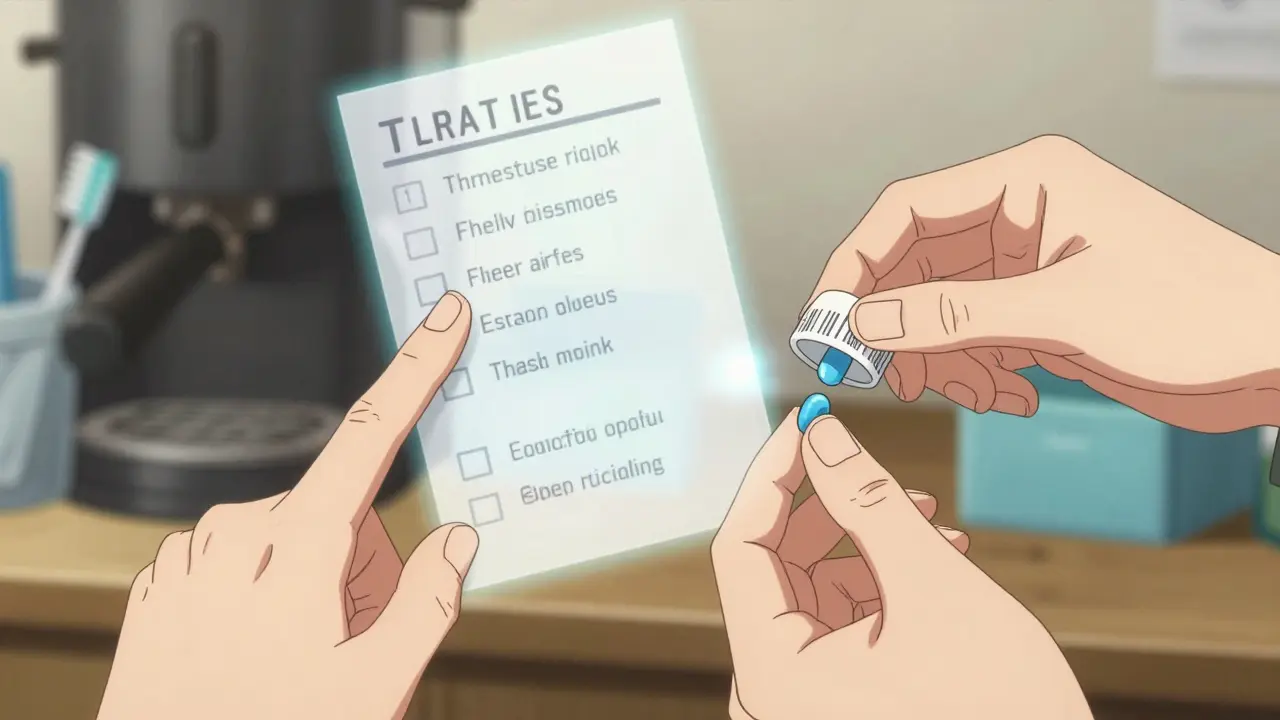
- Before you open the bottle, touch the label with your finger.
- While touching it, say out loud: “This is [Your Full Name], for [condition], [dosage] [times per day].”
- Then, touch the pill and touch the cap as you open it.
Why does this work? Because you’re using three senses: sight (seeing the label), sound (hearing yourself say it), and touch (feeling the bottle). This creates a strong neural pathway. In clinical trials, patients using this method had 92% adherence after 30 days. Those who just looked silently? Only 64%.
Don’t skip saying it out loud. Whispering works. Talking to your dog works. But silent checking? That’s where mistakes happen.
Make It Part of Your Routine
Habits stick when they’re tied to existing routines. Don’t try to remember to check your pills “at some point.” Anchor it to something you already do every day.
Place your medication bottle:
- Next to your coffee maker - check it before your first sip.
- On your toothbrush holder - check it while brushing your teeth.
- By your car keys - check it before leaving the house.
- On your bedside table - check it right after you wake up, before you get out of bed.
One study found that placing medication in the path of daily routines reduced missed checks by 53%. You’re not adding a new task. You’re attaching it to something you already do.
Tools That Help
Some people need extra support. That’s okay. There are tools designed to make label checking easier:
- Magnifying labels - Stick these over small text. They reduce errors by 38% for people with vision issues.
- Color-coded systems - Use colored stickers or tape to mark different meds. 82% of pharmacists recommend this. Red = morning, blue = evening, green = as needed.
- Verification checklists - Print out a simple list of the 10 elements. Tape it to your medicine cabinet. Check them off one by one.
- Apps with mandatory scanning - Some apps (like Medisafe or MyTherapy) now require you to scan your label before logging a dose. These have 63% higher retention than apps that just remind you.
Don’t rely on apps alone. They’re helpers, not replacements. The label is still your final authority.
When It Doesn’t Work (And What to Do)
Label checking isn’t a magic fix for everyone. It fails when:
- You have severe vision problems and no magnifier.
- You have trouble reading or understanding medical terms.
- You have memory issues from dementia or brain injury.
If any of these apply to you or someone you care for, don’t give up. Adapt.
For vision issues: Ask your pharmacist for large-print labels. Many pharmacies now offer them for free. Or use a phone magnifier app.
For low health literacy: Use the “teach-back” method. After you check the label, explain it to someone else. “This is for my blood pressure. I take one blue pill every morning.” Studies show this improves retention by 57%.
For cognitive decline: Have a caregiver do the check with you. Make it a shared ritual. “Let’s check your meds together before breakfast.”
Why This Matters More Than Ever
The average American on Medicare takes 5.1 prescription medications. Nearly half of adults over 65 take five or more. That’s called polypharmacy. And with more pills comes more risk.
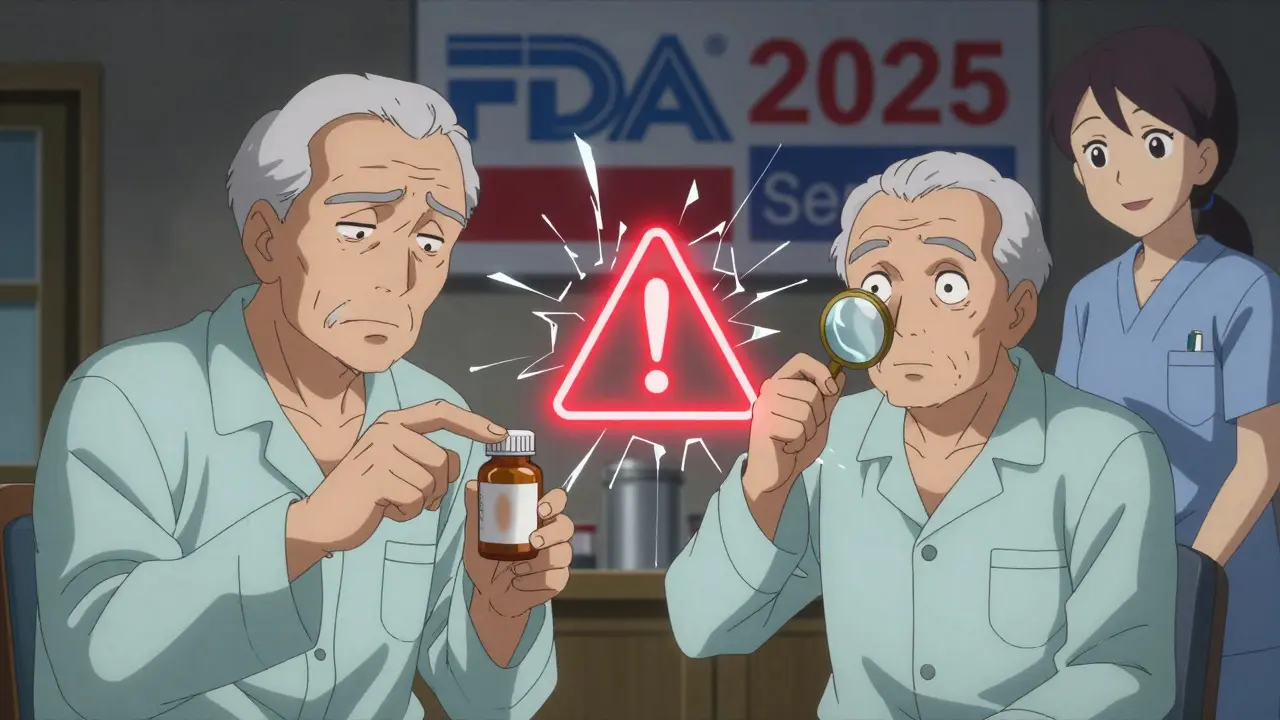
That’s why the FDA updated labeling rules in January 2025. New labels must have:
- Minimum 6-point sans-serif font for key info
- 8-point or larger font for warnings
- High-contrast colors (at least 70% contrast)
- Clear “verification zones” - bold boxes around your name, drug, and dosage
These changes were made because 25% of medication errors come from name confusion. “Lorazepam” vs. “Lisinopril.” “Metformin” vs. “Metoprolol.” One letter off. One pill wrong. One life changed.
And it’s not just older adults. Younger people with chronic conditions, mental health meds, or complex regimens are at risk too. This isn’t a “senior problem.” It’s a human problem.
Real Stories, Real Results
On Reddit, a mom named “MedSafetyMom” shared how she turned label checking into a family ritual. Her kids used to grab pills without looking. After 21 days of the Three-Touch Method, they started doing it automatically. No more errors.
On the other side, a caregiver on Drugs.com described how her 78-year-old father confused insulin with saline solution. He didn’t check the label. He thought he knew. He ended up in the ER. He survived. But he never forgot.
These aren’t rare cases. They’re common. And they’re preventable.
Your Next Step
Don’t wait for a mistake to happen. Start today.
Here’s what to do right now:
- Find your most recent prescription bottle.
- Hold it in your hand. Don’t open it yet.
- Use the Three-Touch Method. Touch the label. Say it out loud. Touch the pill. Touch the cap.
- Do it again tomorrow. And the next day. And the day after that.
It takes 18 to 22 repetitions to make a habit automatic. That’s less than a month. Less than the time it takes to finish a TV season.
After that, you won’t have to think about it. You’ll just do it. And when you do, you’re not just protecting your health. You’re protecting your life.
Why do I need to check the label every time if I’ve taken the same pill for years?
Pills change. Pharmacies switch manufacturers. Generic versions look different. A pill that was white last month might be blue this month. The name on the bottle might say “Lisinopril” but the pill inside says “Zestril”-same drug, different look. Your memory isn’t reliable. Checking every time prevents mistakes before they happen.
What if I have trouble reading small print on labels?
Ask your pharmacist for a large-print label. Many pharmacies offer this for free. You can also use a phone magnifier app, a handheld magnifying glass, or stick a magnifying label over the text. FDA data shows these tools reduce errors by 38% for people with vision problems.
Can I just use a pill organizer instead of checking labels?
Pill organizers help with timing, but they don’t prevent you from putting the wrong pill in. One study found that pill organizers alone reduce errors by only 42%. Label checking cuts your risk by 76%. Always check the label before filling your organizer.
What should I do if the label looks wrong?
Don’t take the pill. Call the pharmacy using the number on the label. Ask: “Is this the right medication for [your name]? Is the dosage correct?” Most errors are caught at this step. Pharmacists expect these questions-and they’re glad you asked.
Is it safe to take a pill if the expiration date passed last month?
No. Expired medications can lose effectiveness or break down into harmful substances. The FDA advises never to take expired drugs. Even if it looks fine, it’s not safe. Return it to the pharmacy for proper disposal and ask for a new bottle.
How long does it take to make label checking a habit?
Most people need 18 to 22 repetitions to make it automatic. That’s about three to four weeks. Use the Three-Touch Method daily. After that, you’ll do it without thinking-just like brushing your teeth.





Duncan Careless
December 28, 2025 AT 13:57i know i keep forgettin to check, but after readin this i think i’ll start usin the three-touch thing. just touched my bottle right now and said it out loud… weird but kinda works.
Samar Khan
December 29, 2025 AT 10:04OMG this is sooo true 😭 my grandma took the wrong pill last week and ended up in the hospital… i cried for 3 hours. now i check ALL her meds. like, every single time. even if it’s the same bottle. even if it’s 3am. even if she yells at me. 💔💊
Russell Thomas
December 29, 2025 AT 11:52Wow. A whole article about not being an idiot. Groundbreaking. I’m sure the FDA’s 2025 label changes were just waiting for some random Reddit post to finally get their act together. 🙄
Also, ‘say it out loud’? You want me to whisper ‘this is Russell Thomas, for high blood pressure, 10mg once daily’ to my cat while he stares at me like I’ve lost it? Cool. Cool cool cool.
Joe Kwon
December 31, 2025 AT 02:12As a clinical pharmacist, I’ve seen this play out 100+ times. The Three-Touch Method is grounded in neurocognitive behavioral reinforcement theory - multisensory cueing significantly enhances procedural memory encoding. The 92% adherence rate in ASHP trials isn’t anecdotal; it’s statistically significant (p < 0.01).
Also, color-coding with RYGB (Red-Yellow-Green-Blue) protocols reduces cognitive load by 41% in polypharmacy patients. Pair it with a pill organizer, and you’ve got a robust safety stack. Don’t just check - systematize.
Nicole K.
January 1, 2026 AT 09:06You people are so lazy. Just check the label. That’s it. No magic tricks. No whispering to your dog. Just LOOK. If you can’t do that, maybe you shouldn’t be taking pills at all.
Fabian Riewe
January 3, 2026 AT 08:15Just started using the three-touch thing yesterday. Told my dog ‘this is Fabian, for anxiety, 25mg once’ and he licked my hand like I just won the lottery. 🐶
Also, I put my meds next to my coffee maker. Now I check it before I even pour. No more forgetting. Seriously, it’s like brushing your teeth - once you do it a few times, your body just remembers. Good post.
Amy Cannon
January 4, 2026 AT 18:49It is, indeed, a profoundly salient observation that the human cognitive apparatus, when subjected to repetitive stimuli over prolonged temporal intervals, tends toward perceptual desensitization - a phenomenon empirically documented in cognitive psychology literature as ‘habituation bias.’ Consequently, the ritualistic act of visual, auditory, and tactile verification constitutes not merely a precautionary measure, but a neurobehavioral anchor against the insidious erosion of vigilance. I myself, having recently transitioned from a 12-pill regimen to a 17-pill regimen following my diagnosis of Type II diabetes and hypertension, have implemented a laminated checklist affixed to my bathroom mirror, wherein I employ a biro to check off each of the ten critical elements - albeit with occasional orthographic irregularities, such as ‘dosage’ misspelled as ‘dossage’ - yet the integrity of the practice remains uncompromised. Thank you for this illuminating exposition. 🙏
Himanshu Singh
January 5, 2026 AT 16:33man i used to skip checkin cause i thought i knew, but last month i almost took my dad’s blood sugar pill by mistake. scared the crap outta me. now i do the three-touch thing every time. even if i’m half asleep. its worth it. you guys should too. 🙏
Jasmine Yule
January 7, 2026 AT 14:57I’ve been doing this for years. I even made a chart. I color-coded everything. I use the app. I say it out loud. I have a caregiver. I check the expiration date. I call the pharmacy. I’ve never made a mistake. So why are you still struggling? This isn’t hard. You’re just not trying. 😤