
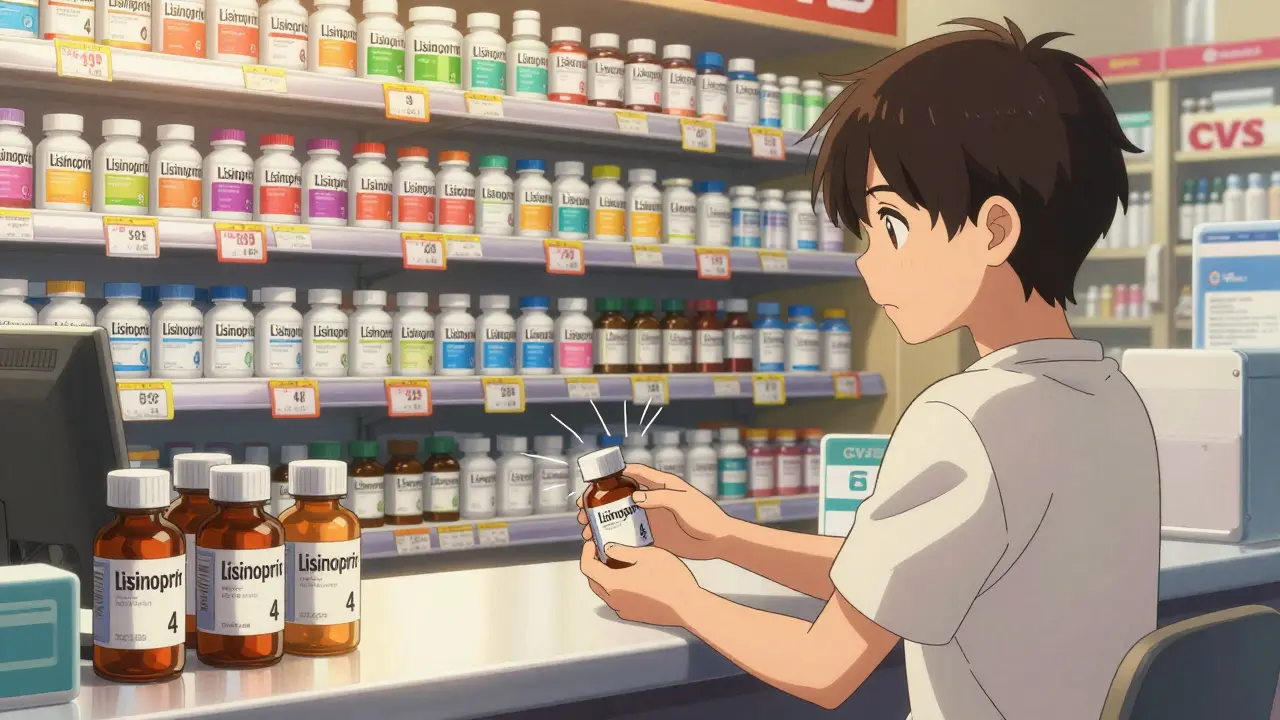
For most people, a prescription for generic lisinopril or metformin is a routine part of life. But if you’ve ever compared what you pay at the pharmacy in the U.S. versus what someone pays in Germany or France, you might have been stunned. In the U.S., you could pay $4 for a 30-day supply. In Europe, the same pill might cost €15-more than three times as much. Yet the same people who pay less for generics in America often pay wildly more for brand-name drugs like Ozempic or Jardiance. Why does this happen? It’s not a mistake. It’s the result of two completely different systems working in opposite directions.
The U.S. Generic Market Works Because It’s Fierce
The U.S. doesn’t have a single buyer for drugs. There’s no national agency setting prices. Instead, there are hundreds of private insurers, Pharmacy Benefit Managers (PBMs), Medicare, Medicaid, and big pharmacy chains like CVS, Walgreens, and Walmart. These players compete fiercely for volume. And when you have dozens of companies all trying to sell the same generic drug-say, atorvastatin-the only way to win is to offer the lowest price.
That’s why generic prices in the U.S. are often below manufacturing cost. Yes, you read that right. Some makers lose money per pill just to stay in the game. But they make it up on volume. Teva, Mylan, and other big generic manufacturers dominate the market. They’ve built supply chains that produce billions of tablets a year. When one company drops its price, the others follow. It’s a race to the bottom-and it works. According to the U.S. Department of Health and Human Services, Americans pay about 33% less for generic drugs than people in 33 other OECD countries.
There’s a catch: when prices drop too low, manufacturers quit. That’s what happened with some antibiotics and older blood pressure meds. A few suppliers left. Then one company snapped up the remaining production capacity and raised prices. That’s why shortages happen. But overall, the system keeps generic prices low. And patients benefit.
Europe’s System Is Built to Control Costs-But Not Through Competition
In Europe, the government is the main buyer. Countries like Germany, France, and the UK don’t let drugmakers set their own prices. Instead, health agencies step in and negotiate. They ask: How effective is this drug? Does it offer real value over cheaper alternatives? What’s the budget impact?
The result? Higher prices for generics. Why? Because there’s less competition. Only about 41% of prescriptions in Europe are for unbranded generics, compared to 90% in the U.S. Fewer players mean less pressure to slash prices. And many European countries use external reference pricing-setting a drug’s price based on what other countries pay. That means if Germany sees France charging €12 for a generic, they won’t go lower than that. It’s a ceiling, not a floor.
There’s also less automatic substitution. In the U.S., pharmacists can swap a brand drug for its generic without asking your doctor. In France, they can’t. In Germany, they can-but only if the patient agrees. These rules slow down the shift to cheaper alternatives. So even when generics are available, they don’t always replace brand-name drugs quickly.

Why the U.S. Pays More for Brand-Name Drugs
Here’s the flip side: if you need a new drug that’s still under patent, you’re likely paying more in the U.S. than anywhere else. A 2023 report from the same U.S. government office found Americans pay 322% more for brand-name drugs than people in other rich countries-after accounting for hidden rebates.
Take Jardiance, a diabetes drug. Medicare negotiated a price of $204 for a month’s supply. In other countries, the average price was $52. That’s nearly four times higher. Stelara, a biologic for psoriasis, cost $4,490 in the U.S. versus $2,822 abroad.
Why? Because the U.S. doesn’t negotiate prices the way Europe does. Before the Inflation Reduction Act, Medicare wasn’t allowed to bargain for drug prices. Drugmakers could set whatever price they wanted-and they did. PBMs took large rebates (often 35-40%) off the list price, but those discounts rarely reached the patient. The list price stayed high. And that’s what the world saw.
The truth? The U.S. has been subsidizing global drug innovation for decades. About two-thirds of all pharmaceutical R&D is funded by American spending. Companies invest in new drugs because they know they can charge high prices here. Then they sell those same drugs overseas at lower prices because those countries won’t pay more.
The Hidden Trade-Off: Innovation vs. Affordability
There’s a quiet agreement between the U.S. and the rest of the world: we pay more for new drugs so you can pay less. That’s how the system has worked since the 1980s. It’s not perfect, but it’s been functional. The U.S. market funds the discovery of cancer drugs, Alzheimer’s treatments, and rare disease therapies. Without those high prices here, many of those drugs might never have been developed.
But that balance is shifting. The Inflation Reduction Act now lets Medicare negotiate prices for 10 high-cost drugs. That’s just the start. By 2027, more drugs will be added. If those negotiations cut U.S. brand-name prices by 25-30%, drugmakers will lose billions in revenue. And they won’t absorb that loss. They’ll raise prices elsewhere.
That’s what experts like Dana Goldman from USC warn about. If the U.S. stops paying the premium, companies will turn to Europe and say: “You’ve been getting a free ride. Now pay more.” Some European countries are already bracing for it. The European Medicines Agency recently admitted their pricing models might need updating to keep access to new medicines.

What This Means for Patients
For most Americans, the system works fine for generics. You get your blood pressure pill for $4. Your diabetes meds cost $10 with insurance. You rarely see the sticker shock of a $1,000 insulin pen because you’re not on it. But if you need a new biologic or a cutting-edge cancer drug, you’re in a different world.
For Europeans, the opposite is true. You pay more for your generic aspirin, but your new cancer drug might be covered with little or no co-pay. Your out-of-pocket costs for most prescriptions are capped. But if you need a drug that’s not yet approved or deemed “not cost-effective” by your country’s health agency, you might wait months-or never get it.
And here’s something most people don’t realize: Americans traveling to Europe often get shocked at how expensive generics are. One Reddit user wrote: “I paid €15 for generic lisinopril in Berlin. Back home, my Walmart price is $4.” Meanwhile, Europeans visiting the U.S. are stunned by the cost of brand-name drugs. A 2024 survey found 78% of European patients think U.S. brand-name pricing is “unjustifiably high.”
The Future: Will the Gap Close?
It’s unlikely the U.S. will suddenly adopt Europe’s system. Too many players, too much complexity. But Europe may have to adapt. If the U.S. cuts brand-name prices through Medicare negotiations, drugmakers will push back by raising prices abroad. That could force countries like Germany or France to loosen their price controls.
On the generic side, the U.S. advantage will probably stay. The market is too competitive, too volume-driven, too fragmented to change. Even if a new law tries to cap prices, the system will find a way to keep pushing them down.
The real question isn’t whether one system is better. It’s whether the current arrangement-where the U.S. pays more for innovation and less for generics-is sustainable. The answer may depend on whether American patients are willing to pay more for new drugs, or whether the government will force prices down-and risk making new medicines harder to find worldwide.
Why are generic drugs cheaper in the U.S. than in Europe?
Generic drugs are cheaper in the U.S. because of intense competition among manufacturers, pharmacies, and Pharmacy Benefit Managers (PBMs). With 90% of prescriptions filled with generics, companies fight for volume by lowering prices-even below cost. In Europe, governments set prices through negotiation and reference pricing, with less competition and only 41% of prescriptions being generics, leading to higher average prices.
Do Americans pay more for brand-name drugs than Europeans?
Yes. Americans pay about 322% more for brand-name drugs than people in other OECD countries, even after accounting for hidden rebates. For example, Medicare’s negotiated price for Jardiance was $204, while the average in other countries was $52. This is because the U.S. lacks centralized price controls and has historically allowed drugmakers to set high list prices.
How do Pharmacy Benefit Managers (PBMs) affect drug prices in the U.S.?
PBMs negotiate rebates of 35-40% off the list price of brand-name drugs from manufacturers. But these discounts are rarely passed to patients at the pharmacy counter. Instead, they go to insurers and PBMs themselves. This keeps list prices artificially high while lowering net costs for insurers. For generics, PBMs help drive down prices by buying in bulk and demanding discounts from manufacturers.
Why doesn’t Europe just copy the U.S. generic pricing model?
Europe’s system is built on government control, not market competition. Countries use external reference pricing and cost-effectiveness reviews to set prices. They fear that letting prices fall too low would lead to shortages, as happened in the U.S. with some older generics. Also, European manufacturers have less incentive to compete aggressively because the market is smaller and more regulated.
Will Medicare drug price negotiations lower U.S. drug prices overall?
Yes-for the 10 drugs selected so far, Medicare’s negotiated prices are already 2.8 times lower than the average in other countries. But this only affects a small number of expensive brand-name drugs. It won’t change generic prices, which are already low. The bigger risk is that drugmakers may raise prices in Europe to make up for lost U.S. revenue, which could eventually raise costs for European patients.
Are generic drug shortages a sign the U.S. system is broken?
Not exactly. Shortages happen when prices fall so low that manufacturers stop making a drug because it’s no longer profitable. When only one company remains, it can raise prices sharply. This isn’t a flaw in the system-it’s a side effect of how competitive markets work. The U.S. still has the lowest generic prices globally, even with occasional shortages.
How does the U.S. fund global pharmaceutical innovation?
The U.S. spends more on brand-name drugs than any other country, generating roughly 40% of global pharmaceutical sales despite having only 4% of the world’s population. This high spending funds about two-thirds of all new drug research. Companies rely on U.S. profits to pay for clinical trials and development. Other countries benefit from these innovations but pay less because they negotiate lower prices.
What’s the difference between list price and net price for drugs?
The list price is what the drugmaker charges pharmacies before any discounts. The net price is what the manufacturer actually receives after rebates, discounts, and fees. In the U.S., list prices for brand-name drugs are often very high, but net prices are much lower due to PBM negotiations. In Europe, list prices are already set low by the government, so there’s little difference between list and net prices.



Radhika M
December 16, 2025 AT 13:19Generics in the U.S. are cheap because there are so many makers fighting for shelf space. It's like a grocery store with 20 brands of cereal-all on sale. The drug companies don't make much per pill, but they sell billions. Simple math.
Europe? Government sets the price like it's a fixed menu. No competition. No discounts. Just... €15 for lisinopril. I get it, they want control. But sometimes control kills affordability.
Philippa Skiadopoulou
December 17, 2025 AT 08:04The U.S. system is a market-driven anomaly. Europe's centralized negotiation avoids the volatility of price wars. While American patients benefit from low generic costs, the absence of price floors risks supply chain fragility. The trade-off is structural, not accidental.
Pawan Chaudhary
December 17, 2025 AT 15:03It’s wild how the system just works, you know? I get my metformin for $3 at Walmart and I don’t even think about it. Meanwhile my cousin in Delhi pays way more for the same thing. We’re lucky. Let’s not break what’s working just because it’s weird to outsiders.
Jonathan Morris
December 18, 2025 AT 09:51This entire narrative is a corporate psyop. The U.S. doesn't 'fund global innovation'-Big Pharma does. And they're not altruistic. They're gaming the system. The Inflation Reduction Act is the first crack in the dam. The 322% markup? That's theft disguised as capitalism. The real scandal isn't European prices-it's that Americans are being fleeced so the rest of the world can get discounts. Wake up.
CAROL MUTISO
December 18, 2025 AT 16:13Oh honey. The U.S. is the world’s drug drug dealer. We’re the ones paying the rent on the R&D mansion while everyone else sips free wine at the patio party.
Generics? Yeah, they’re dirt cheap here-because the system’s a bloodsport. One company drops to $0.02 per pill? Everyone else scrambles to match or die. It’s capitalism on espresso.
But brand names? That’s where the real magic happens. We pay $200 for Jardiance so Germany can pay $52 and still call themselves ‘compassionate.’
It’s like if your neighbor borrowed your car to get to work, then told you, ‘Oh, you’re so generous for owning it!’
Meanwhile, my pharmacist just handed me a $4 bottle of pills and winked. I didn’t even ask for a discount. That’s the American dream, baby. 💸💊
Erik J
December 19, 2025 AT 11:36Interesting how the PBM rebate structure distorts transparency. If list prices are inflated to enable discounts, and those discounts never reach the patient, then the system isn’t optimizing for affordability-it’s optimizing for accounting. The real question is whether the current model incentivizes value or volume.
Martin Spedding
December 20, 2025 AT 06:57Europe pays more for generics? lol. they're just lazy. why dont they just let the market work? also why is everyone so shocked? its not magic. its just capitalism vs bureaucracy. and bureaucracy always loses. except when it wins by being slow.
Chris Van Horn
December 20, 2025 AT 20:50It is not merely a matter of pricing structure-it is a fundamental philosophical divergence between the American ethos of market-driven innovation and the European collectivist ethos of state-controlled rationing. The U.S. system, despite its imperfections, preserves the incentive architecture necessary for pharmaceutical advancement. To emulate Europe is to embrace stagnation under the guise of equity. One must ask: who will fund the next breakthrough if the American payer is no longer the global benefactor? The answer, predictably, is no one.
Virginia Seitz
December 22, 2025 AT 05:51Just got back from Paris. Paid €12 for my blood pressure pills. Felt like I got robbed. Then I got home. Walmart: $4. 😅🇺🇸❤️💊
amanda s
December 24, 2025 AT 04:50Europeans get cheap drugs? Please. They get rationed drugs. They get denied. They get told ‘no’ because some bureaucrat decided it’s ‘not cost-effective.’ Meanwhile, we pay $4 for generics and get access to everything. America wins. End of story.
Steven Lavoie
December 24, 2025 AT 20:01It’s easy to romanticize European healthcare until you need a drug that’s not on their list. I had a friend in Canada wait 11 months for a biologic. Here, she got it in two weeks. The U.S. system is messy, but it gets life-saving drugs to people fast. That’s not nothing.
Naomi Lopez
December 25, 2025 AT 16:34So we’re the world’s drug ATM? Cute. I’ll take my $4 lisinopril and my $1000 insulin, thanks. But yeah, sure, I’ll keep subsidizing your €1 aspirin. My tax dollars love you guys. 💋
Salome Perez
December 26, 2025 AT 14:20The brilliance of the U.S. generic market lies in its decentralized chaos. Unlike the top-down pricing of Europe, where decisions are made by committees and constrained by fiscal ceilings, the American system operates as a dynamic, self-correcting ecosystem. Manufacturers compete not for approval, but for survival. The result? Unmatched efficiency, even at the cost of occasional shortages. The real vulnerability is not in the low prices-it is in the assumption that this model is sustainable without vigilance. Innovation must be rewarded, but access must not be sacrificed.
Josh Potter
December 26, 2025 AT 16:52bro i paid $3 for my generic zoloft last week. then i went to canada and paid $45 for the same thing. i was like… what even is this world? we got the best deal. just sayin.
Victoria Rogers
December 28, 2025 AT 08:32Everyone says the U.S. pays more for brand drugs-but nobody talks about how Europe gets free rides on American innovation. We fund the R&D. They get the drugs. Then they turn around and call us greedy. That’s not fairness. That’s exploitation. And now they want Medicare to cut prices? Good. Let them pay more. Maybe then they’ll stop acting like we’re their personal pharmacy.