
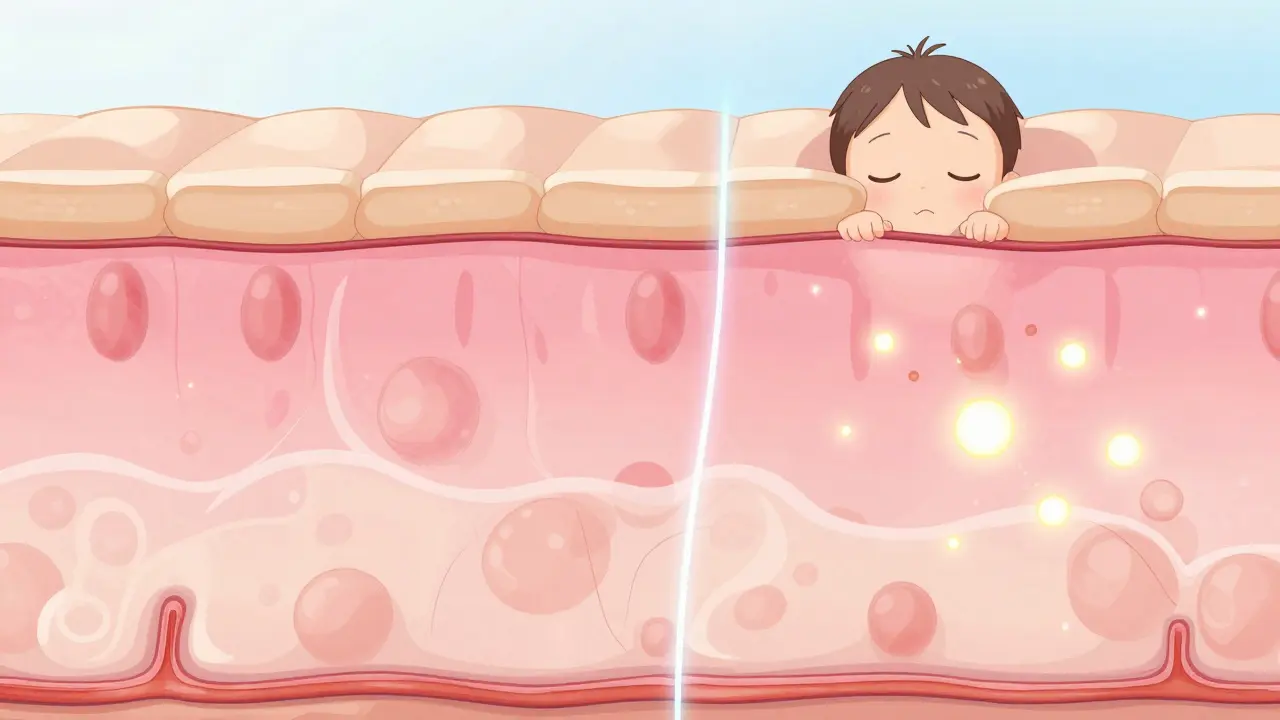
You might think that because a cream stays on the surface of the skin, it's automatically safer than a pill or a syrup. But for kids, that's a dangerous assumption. Children's skin isn't just smaller; it's fundamentally different. Because their skin is thinner and they have a much larger surface area relative to their weight, they can absorb medications into their bloodstream far more quickly than adults. In some cases, applying a potent cream to a large area of a baby's body can be as powerful as giving them a dose of oral steroids. Understanding these risks is the only way to ensure that a simple treatment for eczema or a bug bite doesn't turn into a systemic health issue.
Why Children's Skin is Different
When we talk about pediatric medications, we have to start with the biology of the skin. The outer layer, known as the stratum corneum, is the primary barrier that keeps the outside world out and the inside in. In infants and young children, this barrier is thinner and more permeable. This means they can be 3 to 5 times more likely to absorb a medication systemically than an adult would.
This risk spikes even further if the skin is already damaged. For example, a child with atopic dermatitis (eczema) has inflamed skin that acts like a sponge. Research shows that absorption rates can jump from 3% on healthy skin to as high as 60% on damaged skin when using certain anesthetics. This is why a cream that is perfectly safe for your arm might be risky for a toddler's flared-up rash.
The Danger of "Occlusion"
Many parents have heard that covering a cream with a bandage or plastic wrap helps it work better. This is called occlusion. While it does increase effectiveness, it also increases the absorption rate by a staggering 300% to 500%. For a child, this can push a local treatment into a systemic one, potentially affecting their internal organs. If you are using a strong medication, never wrap the area unless your doctor specifically told you to, as this can lead to serious side effects like the suppression of the adrenal glands.
Understanding Topical Corticosteroids
Topical Corticosteroids (TCs) are the most common skin treatments for children, but they are also the most misused. They are categorized by potency. Low-potency creams, like hydrocortisone, are generally safe for short-term use. However, high-potency steroids (Class I and II) can cause HPA axis suppression, which is when the body's natural cortisol production is shut down because the skin is absorbing too much synthetic steroid.
A 2022 review of over 12,000 pediatric patients found that nearly 16% of children using very potent steroids suffered from this suppression, compared to only 2.3% of those using low-potency versions. The general rule is to use the lowest effective potency for the shortest possible time. Using a high-potency steroid when a mild one would work is a mistake that can lead to long-term hormonal imbalances.
| Steroid Class | Common Examples | Absorption Risk | Primary Concern |
|---|---|---|---|
| Low Potency (VI-VII) | Hydrocortisone | Low (<1%) | Skin thinning (long-term) |
| Moderate Potency | Triamcinolone | Medium | Mild systemic absorption |
| High Potency (I-II) | Betamethasone | High (up to 20%) | HPA axis suppression |
The Risks of Topical Anesthetics and Teething Gels
Not all creams are steroids. Topical anesthetics, like those containing benzocaine or lidocaine, carry their own set of dangers. The most alarming is methemoglobinemia-a condition where the blood cannot effectively carry oxygen. The FDA has issued strict warnings against benzocaine-containing teething products for children under 2. In some cases, oxygen saturation in infants has dropped to 70% within minutes of application.
Even lidocaine, which is generally safer, requires caution. While it's often used for procedural pain (like before a needle), the World Health Organization warns against routine use in infants under 12 months. If too much is absorbed, it can cause seizures. Always stick to the specific dose your doctor provides and never apply these to broken skin without professional guidance.
How to Dose Correctly: The Fingertip Unit (FTU)
Forget the phrase "a pea-sized amount." It's too vague and leads to over-application. Instead, medical professionals use the Fingertip Unit (FTU). One FTU is the amount of cream squeezed from a standard 5mm tube from the tip of the adult finger to the first joint (about 0.5g).
- One FTU covers an area roughly the size of two adult palms.
- Maximum Dose: For a 10kg child, the total daily limit for corticosteroids should not exceed 2g (about 4 FTUs).
- Surface Area: Generally, you should not treat more than 10% of a child's total body surface area at one time.
Safe Storage and Accidental Ingestion
Because creams often smell like fruit or lotions, children are tempted to eat them. According to the American Association of Poison Control Centers, nearly 80% of pediatric topical medication exposures happen when a parent leaves the tube open or accessible after their own use. This is why child-resistant packaging is mandatory for many anesthetics.
Always store medications in a locked cabinet, not on the bathroom counter. If you suspect your child has ingested a cream, look for warning signs: unusual drowsiness, difficulty breathing, or a bluish tint to the skin (cyanosis). These are medical emergencies that require immediate intervention.
Alternative Options for Sensitive Skin
If you're worried about steroid side effects, there are other options. Calcineurin inhibitors, such as tacrolimus or pimecrolimus, are often used for facial lesions. They have a 92% lower risk of causing HPA axis suppression than corticosteroids. While they come with a "black box" warning about theoretical cancer risks, fifteen years of data have shown no confirmed cases of malignancy directly caused by these medications in children.
Practical Safety Checklist for Parents
- Check the potency: Is this a "strong" or "mild" steroid?
- Inspect the skin: Is the skin broken or inflamed? (If yes, absorption will be much higher).
- Measure the dose: Use the Fingertip Unit (FTU) method rather than guessing.
- Avoid wraps: Do not use plastic wrap or heavy bandages unless directed by a doctor.
- Secure the tube: Put the lid on tight and store the cream out of reach immediately.
Can I use my own prescription cream on my child?
No. You should never share prescription topical medications. Adult formulations are often too potent for children's permeable skin, and a dose that is safe for you could cause systemic toxicity or hormonal suppression in a child.
Is hydrocortisone safe for babies?
Low-potency hydrocortisone is generally the safest steroid option, but it should still be used sparingly. Avoid using it on the diaper area or face for extended periods without a doctor's oversight, as these areas are highly prone to absorption.
What is the safest way to soothe a teething baby?
Avoid all benzocaine gels due to the risk of methemoglobinemia. Instead, use non-pharmacological alternatives like chilled (but not frozen) rubber teethers or a clean, cold washcloth.
How do I know if my child has absorbed too much steroid cream?
Signs of HPA axis suppression can be subtle but include stunted growth, weight gain in the face (moon face), or extreme fatigue. If you have been using high-potency steroids on large areas for weeks, consult your pediatrician for a screening.
Why is the 'fingertip unit' better than a 'pea-sized' amount?
A "pea-sized" amount varies wildly depending on who is doing the measuring. The FTU is a standardized medical measurement (approximately 0.5g) that allows doctors to calculate exactly how much medication is being absorbed relative to the child's weight.


Sophia Rice
April 17, 2026 AT 23:15Thanks for sharing this. I totaly didn't know about the fingertip unit thing... I always just guessed with a pea size lol. Glad I saw this befor the next flare up!
Theresa Griffin MEP
April 19, 2026 AT 07:07Strict adherence to dosing guidelines is imperative. Safety must remain the priority.
Rock Stone
April 19, 2026 AT 19:13It's all about staying informed, man. Just takes a bit of patience to get the measurements right and everyone stays healthy. Keep it simple.
Ben Ferguson
April 20, 2026 AT 19:34Oh my goodness, the sheer terror of realizing I might have been applying these creams completely incorrectly all these years is absolutely overwhelming, and when you consider the biological reality that a child's skin is practically a sponge for these chemicals, it really puts into perspective how precarious our daily health decisions can be when we aren't properly educated on the systemic absorption rates that can lead to something as frightening as adrenal suppression! I feel like I've been walking a tightrope without a net, and the revelation about the 300% increase in absorption from simple occlusion is nothing short of a medical horror story that every single parent in this country needs to be screaming from the rooftops right now!
Michael Lewis
April 22, 2026 AT 09:29Stop guessing with your kids' health. Use the FTU method or don't use the cream at all. It's not that hard to follow a standardized measurement if you actually care about avoiding systemic toxicity.
Anna BB
April 22, 2026 AT 22:17It's so interesting how we assume "topical" means "surface only"... but the body is such a complex system!!! I wonder if we forget that the skin is an organ and not just a wrapper... so true!!!
Bonnie Piersall
April 23, 2026 AT 01:31Honestly, some of these high-potency steroids are just nuclear options for a tiny skin rash. It's wild how we just slap stuff on without thinking about the internal fallout. Total game changer to learn about the FTU, really puts a leash on the overkill.