
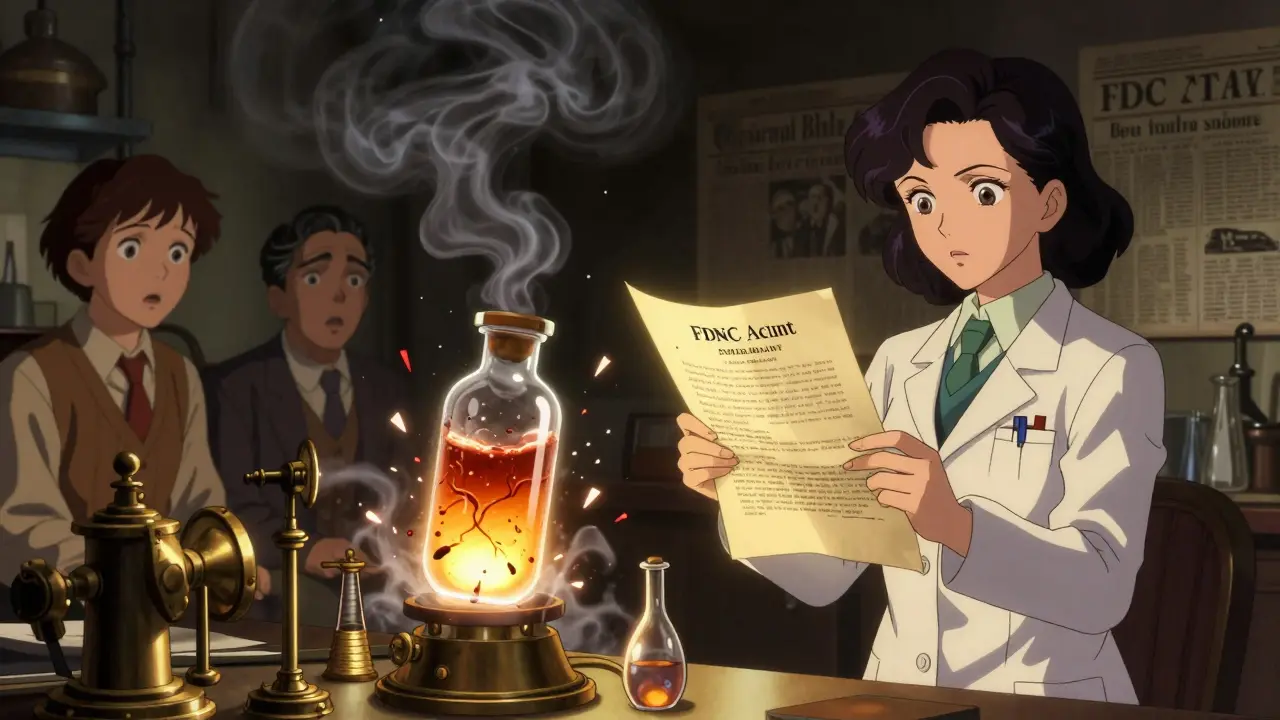
The FD&C Act didn’t start out as a law for generic drugs. In 1938, it was created to stop another public health disaster like the elixir sulfanilamide tragedy-where over 100 people died because a drug company used toxic diethylene glycol as a solvent. Back then, companies didn’t need to prove anything was safe before selling it. The FD&C Act changed that. It gave the FDA the power to require safety data before any new drug hit the market. But even with that change, there was no real path for cheaper, copycat versions of medicines. That didn’t come until nearly 50 years later.
Why Generic Drugs Didn’t Exist Before 1984
After the FD&C Act passed, drug companies had to prove their new medicines were safe. But in 1962, the Kefauver-Harris Amendments added another layer: they had to prove effectiveness too. That meant every new drug, even ones that were exact copies of existing ones, had to go through full clinical trials. If you wanted to make a generic version of aspirin or penicillin, you still had to run expensive human studies-even though the brand-name version had already been proven safe and effective. It made no sense. The cost was so high that only a handful of generics made it to market. By 1984, generics made up just 19% of prescriptions but only 3% of total drug spending. Most people were paying full price for brand-name drugs, even when the active ingredient was identical.
The Hatch-Waxman Amendments: The Game Changer
In 1984, Congress passed the Drug Price Competition and Patent Term Restoration Act-better known as the Hatch-Waxman Amendments. It was named after Senator Orrin Hatch and Representative Henry Waxman, who worked together to fix a broken system. The law didn’t rewrite the FD&C Act. It added a new section: 505(j). That section created the Abbreviated New Drug Application, or ANDA. This was the breakthrough.
Under ANDA, generic manufacturers no longer had to repeat clinical trials. Instead, they had to prove two things: their drug was pharmaceutically equivalent (same active ingredient, strength, dosage form, route of administration) and bioequivalent (it gets into the bloodstream at the same rate and amount as the brand drug). The FDA uses blood tests to measure this. The generic must show that its absorption levels fall within 80-125% of the brand drug’s. That’s it. No more patient trials. No more million-dollar studies. Just science-based proof of equivalence.
How the System Balances Innovation and Competition
Hatch-Waxman didn’t just make generics easier to approve. It also protected brand-name drugmakers. The law gave them a way to get back some of the patent time they lost during FDA review. If a company spent five years getting approval, they could extend their patent by up to five years-though the total patent life couldn’t go beyond 14 years after approval. That kept innovation alive.
But the real spark for generic competition was the 180-day exclusivity window. The first company to file an ANDA and successfully challenge a brand drug’s patent gets six months of exclusive rights to sell its version-no other generics allowed. That’s a huge financial incentive. Companies like Teva, Mylan, and Sandoz built empires on this rule. They didn’t just wait for patents to expire-they actively sued to knock them down. And when they won, they got the market to themselves.
The FDA’s Orange Book became the map for this system. It lists every approved drug, its patent numbers, and its therapeutic equivalence rating. Generic makers use it to know which patents they need to challenge and which drugs they can copy. As of September 2023, the Orange Book listed over 20,000 approved products. That’s the backbone of the entire generic system.
What Goes Wrong? Patent Thickets and Delays
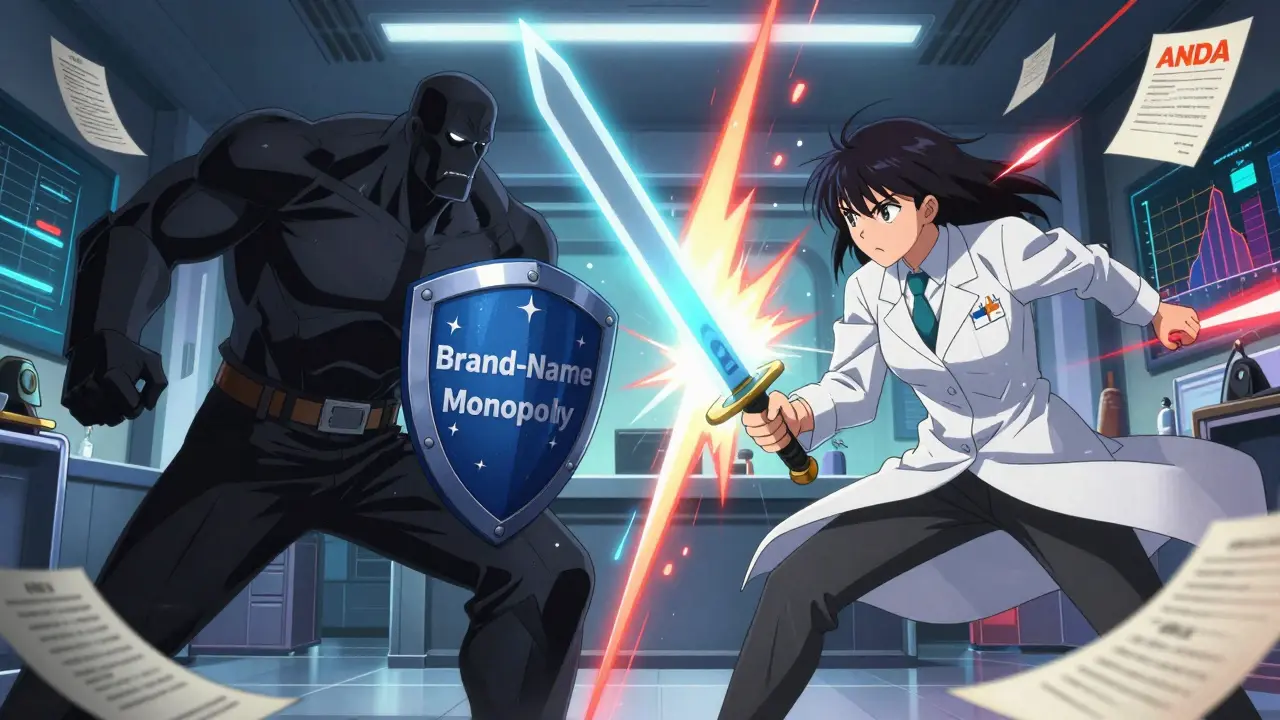
For all its success, the system has loopholes. Brand-name companies learned to game it. One tactic? “Evergreening.” That’s when a company files a string of secondary patents-on things like pill coatings, delivery methods, or dosing schedules-just before the main patent expires. These don’t change how the drug works, but they block generics anyway.
Another trick? Filing citizen petitions with the FDA to delay approval. In 2020, Harvard’s Dr. Aaron Kesselheim found that these petitions were often used to stall generic entry, not to raise real safety concerns. The FDA approved 95% of ANDAs within 10 months by 2022-but some complex drugs, like inhalers and injectables, still face delays. Patent thickets have cut generic entry for these products by 42% compared to simple pills.
Then there’s the issue of “authorized generics.” These are brand-name drugs sold under a generic label by the same company. They’re legal under Hatch-Waxman, but they eat into the 180-day exclusivity window. The FTC called this a problem in its 2021 report. When a brand company launches its own generic version right after the first generic enters, it can crush the challenger’s profits before they even break even.
Regulatory Enforcement and Compliance
Just because a drug is generic doesn’t mean it’s safe by default. The FD&C Act still applies. Every generic manufacturer must follow current Good Manufacturing Practices (cGMP). That means clean facilities, accurate records, and strict quality controls. In 2022, the FDA issued 47 warning letters to generic drug makers. The top two issues? Inadequate quality control (32%) and data integrity problems (28%). One company falsified test results. Another didn’t properly clean equipment between batches. Both are violations of the FD&C Act.
Penalties are serious. Fines can hit $1.1 million per violation. Criminal charges are possible for intentional fraud. The FDA doesn’t just inspect factories-it audits data systems. If your lab’s computer logs show edits made after the fact, that’s a red flag. The law doesn’t care if you’re making aspirin or insulin. If you’re selling it in the U.S., you’re under the FD&C Act.
The Impact: Lower Prices, More Access
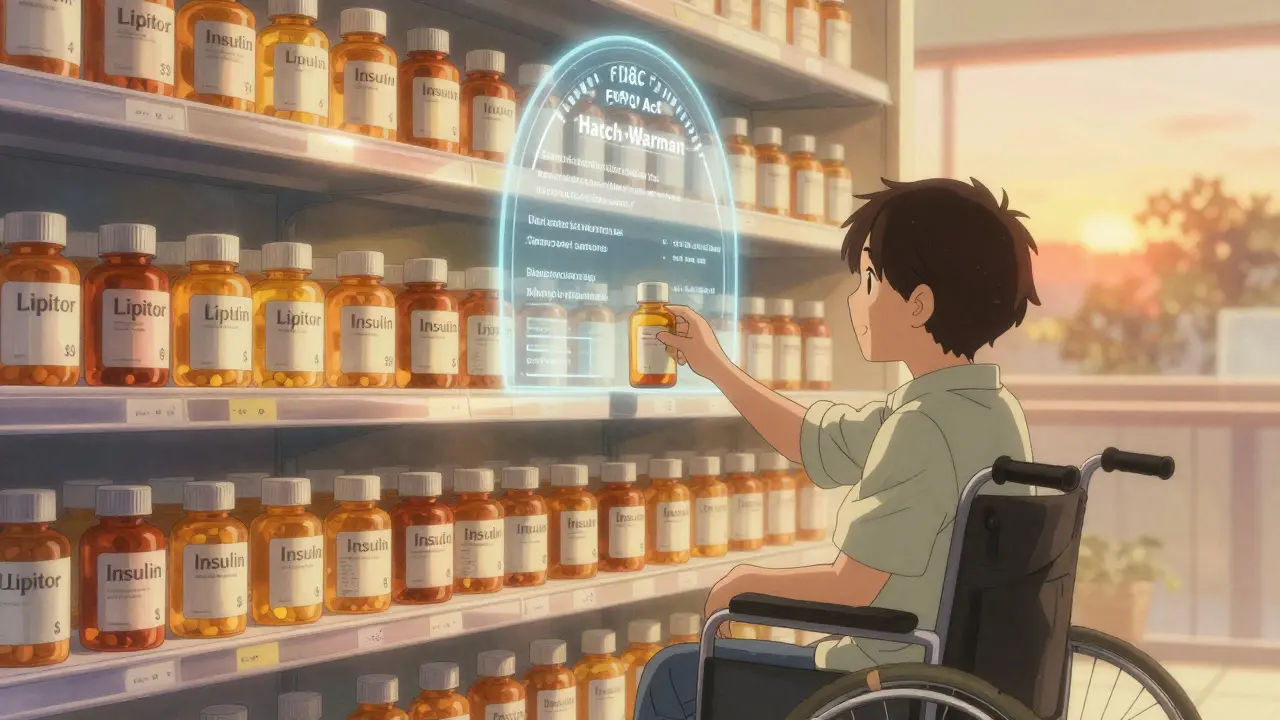
The results speak for themselves. Today, 90% of prescriptions in the U.S. are filled with generic drugs. But they make up only 17% of total drug spending. That’s a $2.2 trillion savings for consumers over the last decade, according to the FTC. A 30-day supply of brand-name Lipitor cost $300 in 2000. The generic version? $4. A generic version of insulin that used to cost $250 now costs $30. That’s not a coincidence. That’s Hatch-Waxman working.
The global generic drug market hit $259 billion in 2022. The U.S. accounted for nearly 40% of that. And it’s still growing. The Congressional Budget Office estimates that keeping this system strong will save the federal government $158 billion between 2023 and 2032. That’s money that goes to Medicare, Medicaid, and VA prescriptions. It’s money that keeps people alive.
What’s Next? Complex Drugs and Modernization
The FD&C Act’s framework for generics is still alive-but it’s being tested. New drug types-like nasal sprays, injectables, and complex biologics-are harder to copy. The FDA’s 2023-2027 plan says modernizing the pathway for these products is a top priority. Draft guidance for nasal sprays and eye drops is expected in mid-2024.
The CREATES Act of 2019 helped by forcing brand companies to sell samples to generic makers so they can test their versions. The 21st Century Cures Act gave the FDA tools to speed up reviews for complex generics. And GDUFA-the Generic Drug User Fee Amendments-has cut review times from over 30 months in the 1990s to under 10 months today. In fiscal year 2022, the FDA approved 98% of priority ANDAs on time.
But the real test is whether the system can keep up with innovation. As drugs get more complex, so do the patents, the manufacturing, and the legal battles. The FD&C Act gave us the foundation. Hatch-Waxman built the house. Now, we’re adding new rooms.
Why This Matters to You
If you’ve ever picked up a generic pill at the pharmacy and paid $5 instead of $50, you’re seeing the FD&C Act in action. It’s not just about laws and regulations. It’s about access. It’s about choice. It’s about whether someone with diabetes can afford insulin, or a senior can take their blood pressure med every month. The FD&C Act, through Hatch-Waxman, made that possible. It turned a broken system into one of the most successful public health policies in American history.
What is the FD&C Act and how does it relate to generic drugs?
The Federal Food, Drug, and Cosmetic Act (FD&C Act), passed in 1938, gave the FDA authority to regulate drug safety. But it didn’t create a path for generic drugs. That came in 1984 with the Hatch-Waxman Amendments, which added Section 505(j) to the FD&C Act. This section created the Abbreviated New Drug Application (ANDA) pathway, allowing generic manufacturers to prove their drugs are equivalent to brand-name drugs without repeating clinical trials.
What is an ANDA and how is it different from an NDA?
An NDA (New Drug Application) is submitted by brand-name companies and requires full clinical trial data to prove safety and effectiveness. An ANDA (Abbreviated New Drug Application) is for generics and only requires proof of pharmaceutical and bioequivalence to an approved brand drug. It skips expensive human trials because the original drug already proved safety and efficacy.
How does the FDA determine if a generic drug is bioequivalent?
The FDA uses pharmacokinetic studies in healthy volunteers to measure how quickly and how much of the drug enters the bloodstream. The generic must show that its maximum concentration (Cmax) and total exposure (AUC) fall within 80-125% of the brand drug’s values, with a 90% confidence interval. This ensures the generic behaves the same way in the body.
What is the Orange Book and why is it important for generics?
The Orange Book, officially called Approved Drug Products with Therapeutic Equivalence Evaluations, is published by the FDA. It lists all approved drugs, their active ingredients, dosage forms, and patent information. Generic manufacturers use it to identify which patents they need to challenge and which brand drugs they can legally copy. It’s the roadmap for generic approval.
Why do some generic drugs still take years to come to market?
Even with the ANDA pathway, delays happen. Brand companies often file multiple secondary patents (evergreening) or submit citizen petitions to delay approval. Complex drugs like inhalers or injectables are harder to copy, and the FDA needs more time to review them. Patent litigation can also hold up approval for years. The 180-day exclusivity period can also be blocked if the first generic applicant doesn’t meet all requirements.
What role does GDUFA play in the generic drug system?
The Generic Drug User Fee Amendments (GDUFA) let the FDA collect fees from generic manufacturers to fund faster reviews and better inspections. First passed in 2012 and renewed in 2017 and 2022, GDUFA set performance goals-like approving 90% of priority ANDAs within 10 months. By 2022, the FDA hit 98%, cutting review times from over 30 months in the 1990s to under 10 months today.
Are generic drugs as safe and effective as brand-name drugs?
Yes. The FDA requires generics to meet the same strict standards for quality, strength, purity, and stability as brand-name drugs. They must be bioequivalent, meaning they work the same way in the body. Studies show generics perform just as well in real-world use. The difference is cost-not effectiveness.
What happens if a generic drug manufacturer violates the FD&C Act?
Violations can lead to warning letters, import bans, or criminal prosecution. Common issues include failing to follow current Good Manufacturing Practices (cGMP), falsifying data, or inadequate quality control. In 2022, the FDA issued 47 warning letters to generic manufacturers. Fines can reach $1.1 million per violation, and executives can face jail time for intentional fraud.



Adewumi Gbotemi
January 12, 2026 AT 10:44This is why I can afford my meds. My grandma takes generics for her blood pressure and pays less than a cup of coffee. No fancy branding, just science. Simple as that.
Jennifer Littler
January 13, 2026 AT 06:43The ANDA pathway under 505(j) represents a paradigm shift in regulatory efficiency-eliminating redundant preclinical and clinical endpoints while maintaining bioequivalence thresholds (80-125% AUC and Cmax) ensures therapeutic equivalence without compromising safety. The Orange Book’s therapeutic equivalence codes (TE codes) are critical for formulary decisions and substitution protocols in clinical practice.
Sean Feng
January 13, 2026 AT 09:52Generic drugs are just as good as brand name. End of story. Why are we even talking about this
Priscilla Kraft
January 13, 2026 AT 19:28So happy to see this breakdown! 🙌 The Hatch-Waxman Act is one of those quiet heroes of public health. I work in pharmacy and see daily how generics change lives-people who skip doses because of cost? Gone. Now they take insulin like it’s nothing. And the FDA’s cGMP inspections? Non-negotiable. If a lab fakes data, they should be shut down. Period. 💊
Vincent Clarizio
January 13, 2026 AT 23:15Let’s be real-the FD&C Act was never meant to be a marketplace democratizer. It was a reactive fire drill after 100 people died from a poison-laced elixir. What we got instead was an accidental revolution: a legal architecture that turned pharmaceutical monopolies into competitive markets. The 180-day exclusivity window? That’s not a loophole-it’s the spark. It turns lawyers into pharmacists, patent clerks into market disruptors. And now we’re stuck with a system where a company can patent the color of a pill and delay a $4 generic for five years. We didn’t fix capitalism-we just gave it a prescription pad.
Sam Davies
January 15, 2026 AT 04:10Oh look, another think piece on how the US government somehow accidentally made healthcare affordable. Bravo. Meanwhile in the real world, people are still paying $150 for a 30-day supply of metformin because the ‘generic’ is actually an authorized generic from the same company that owns the brand. Genius. 🙃
Christian Basel
January 16, 2026 AT 03:17ANDA bioequivalence thresholds are statistically valid but clinically oversimplified. Cmax and AUC don’t capture tissue distribution or metabolite kinetics. For drugs with narrow therapeutic indices-like warfarin or levothyroxine-this can lead to suboptimal outcomes. The system works for aspirin, not for complex pharmacokinetics.
Alex Smith
January 16, 2026 AT 18:24So you’re telling me the same FDA that shut down a factory for falsifying insulin test results is also the one that approved 98% of ANDAs on time? That’s not a contradiction-it’s a miracle. Someone’s doing something right. And yet, we still let pharma companies game the system with patent thickets and citizen petitions like it’s a board game. If we want real change, we need to stop treating drug pricing like a negotiation and start treating it like a public health emergency. Which, honestly, it is.