
Military Medication Degradation Calculator
Medication Stability Calculator
Estimated Potency Remaining
Degradation Insights
Critical Threshold 50% potency loss: Epinephrine loses half its effectiveness in 30 minutes above 30°C.
Critical Threshold 42% loss: Insulin lost 42% potency after 6 hours at 48°C.
Critical Threshold 50% loss: Vaccines lose half their effectiveness above 8°C after a few hours.
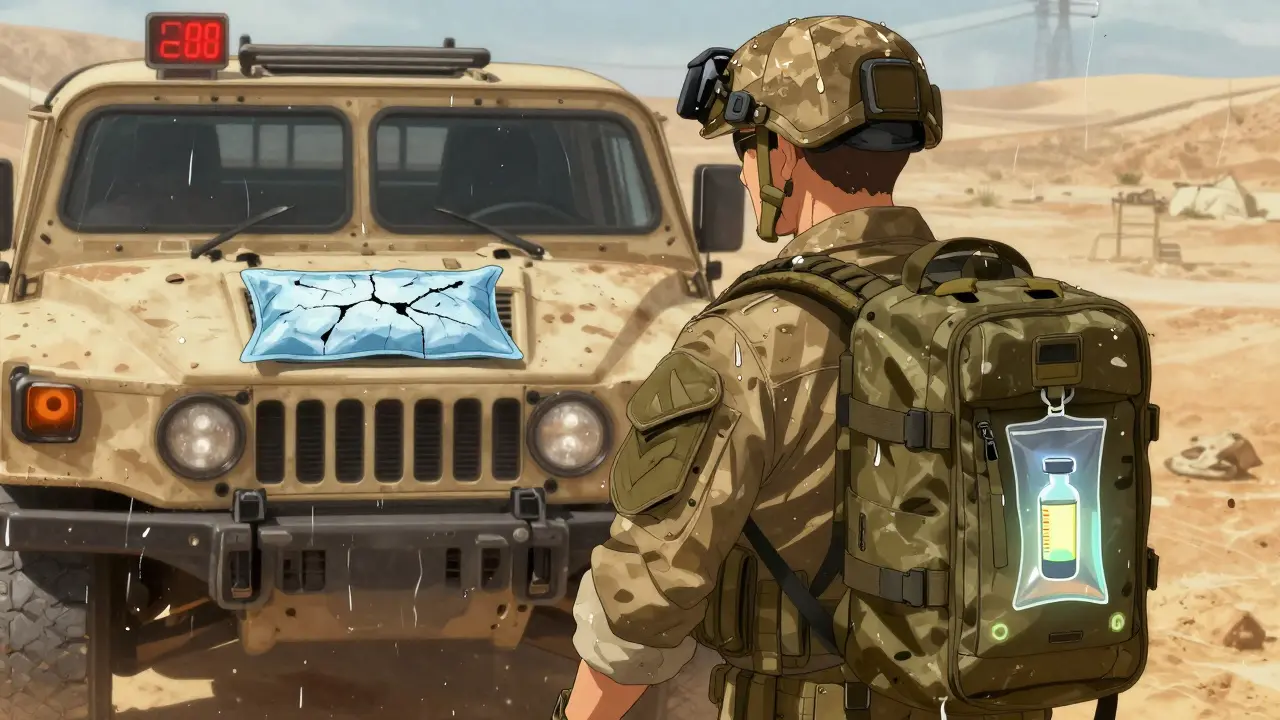
When soldiers are deployed to hot, remote areas, their medications don’t just sit on a shelf. They ride in trucks, get carried in backpacks, and sometimes sit in the open sun for hours. And if that medication gets too hot? It can stop working. Not just slow down. Not just lose a little strength. It can drop to half its potency in under 30 minutes. For a soldier relying on an epinephrine auto-injector during a heat stroke, or a vaccine that’s supposed to protect against anthrax, that’s not a risk-it’s a mission failure waiting to happen.
What Happens When Medicines Get Too Hot?
Most people think medicine is stable. You buy it, store it in your bathroom cabinet, and use it months later. But military medications are different. They’re temperature-sensitive medical products (TSMPs)-vaccines, insulin, epinephrine, antibiotics-that break down fast when exposed to heat. The U.S. Army’s own data shows that vaccines like Yellow Fever, Rabies, and even COVID-19 can lose up to 50% of their effectiveness if stored above 8°C (46°F) for just a few hours. In places like Iraq or Afghanistan, where ground temperatures hit 50°C (122°F), that’s not a hypothetical. It’s daily reality.
Insulin is especially fragile. A 2024 survey of 327 deployed medics found that 83% of medication compromise incidents involved insulin or epinephrine. Why? Because heat changes the chemical structure. Insulin molecules clump together. Epinephrine solutions become less stable. Even if the vial looks fine, the medicine inside might not work. One medic from Camp Arifjan described finding a vial of insulin that had been sitting in a vehicle for six hours at 48°C. The label was intact. The liquid looked clear. But when tested, it had lost 42% of its potency. No one knew until a soldier had a diabetic episode.
How the Military Tries to Keep Meds Cold
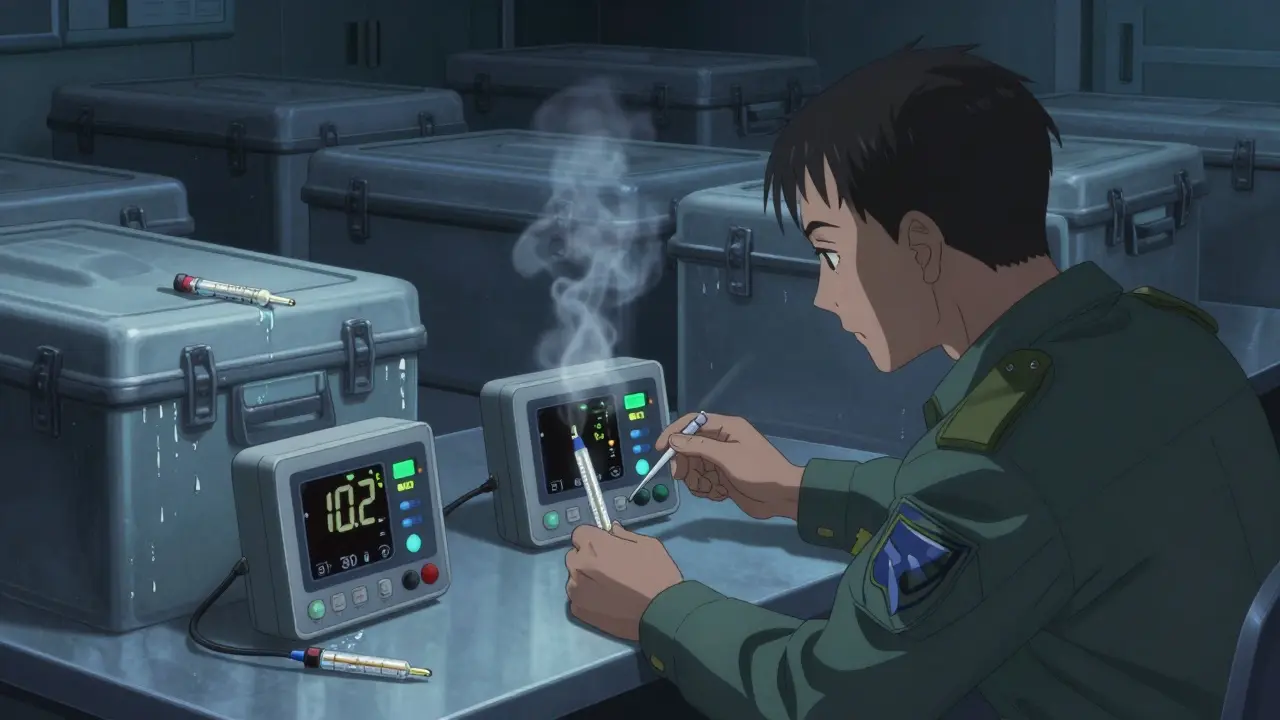
The military doesn’t leave this to chance. Since 2022, every shipment of temperature-sensitive meds must include a digital recorder-like a Temp-Tale device-that logs every minute of temperature changes. These aren’t simple stickers. They’re calibrated to NIST standards, accurate within ±0.5°C. Each refrigerated unit, whether it’s in a field hospital or a Humvee, must have two temperature monitors: one digital, one manual. And someone has to check both every six hours-or twice a day if the digital system is working.
Storage rules are strict. Refrigerated meds? Must stay between 2°C and 8°C. Frozen? Between -50°C and -15°C. Ultra-cold vaccines like some mRNA ones? Need -90°C to -60°C. No exceptions. The Army’s Cold Chain Management Principles (April 2025) say manufacturers’ instructions override all general rules. If the label says “store at 4°C,” then 4°C it is-even if the field manual says 2-8°C is okay.
Transport is just as controlled. Shipping boxes use phase-change materials-special gels that stay cold longer than regular ice. Some units have modified MRE coolers with these gels, keeping meds at 4°C for 12 hours in 45°C heat. A 2024 report from CENTCOM showed these systems reduced temperature excursions by 68% compared to older methods. But even then, 23% of forward units still had at least one breach in 2023. Why? Because logistics breaks down when the generator fails, the truck breaks down, or the medics are too busy treating casualties to check the log.
The Human Cost of Delays
It’s not just about storage. It’s about access. In extreme heat, medics can’t just grab a medication and go. They have to stop, check the temperature log, confirm the meds are safe, then administer them. The Army’s Field Manual 4-02 from 2023 found that during heat operations above 35°C (95°F), the average delay in giving emergency meds like epinephrine jumped from 12 minutes to 47 minutes. That’s not a delay-it’s a death sentence for someone in anaphylactic shock.
One medic on Reddit, posting under the username SpecOpsPharmD, described how his unit started using insulated backpacks with reusable gel packs. They’d pre-chill them in a fridge before a mission, then strap them to their gear. The packs kept meds at 4°C for 8 hours-even in 40°C heat. It wasn’t perfect, but it cut down on wasted meds and saved lives. Other units have tried burying meds in the sand at night, using evaporative cooling with wet cloths, even placing insulin in body pouches next to the skin. These aren’t official procedures. But when the system fails, soldiers improvise.
Why Paper Logs Are a Problem
Before 2024, every unit had to manually log temperatures twice a day. That meant a medic had to walk to the storage unit, open it, check the thermometer, write it down, and sign it. It took 45 minutes a day-per unit. Multiply that across dozens of forward operating bases, and you’re talking hundreds of hours wasted every month. In a combat zone, that’s time that should be spent treating patients or training.
The December 2024 update to CENTCOM’s CCOP-03 policy eliminated paper logs. Now, every TSMP shipment has a digital tracker that sends real-time alerts if temps go out of range. If a fridge hits 10°C at 3 a.m., the system pings the pharmacy, the logistics officer, and the unit commander. Response time? Average 28 minutes. That’s a huge upgrade. But it’s not foolproof. Generator failures still cause 37% of refrigeration breakdowns. And if the satellite link drops? The system goes dark.
What’s Being Done to Fix This?
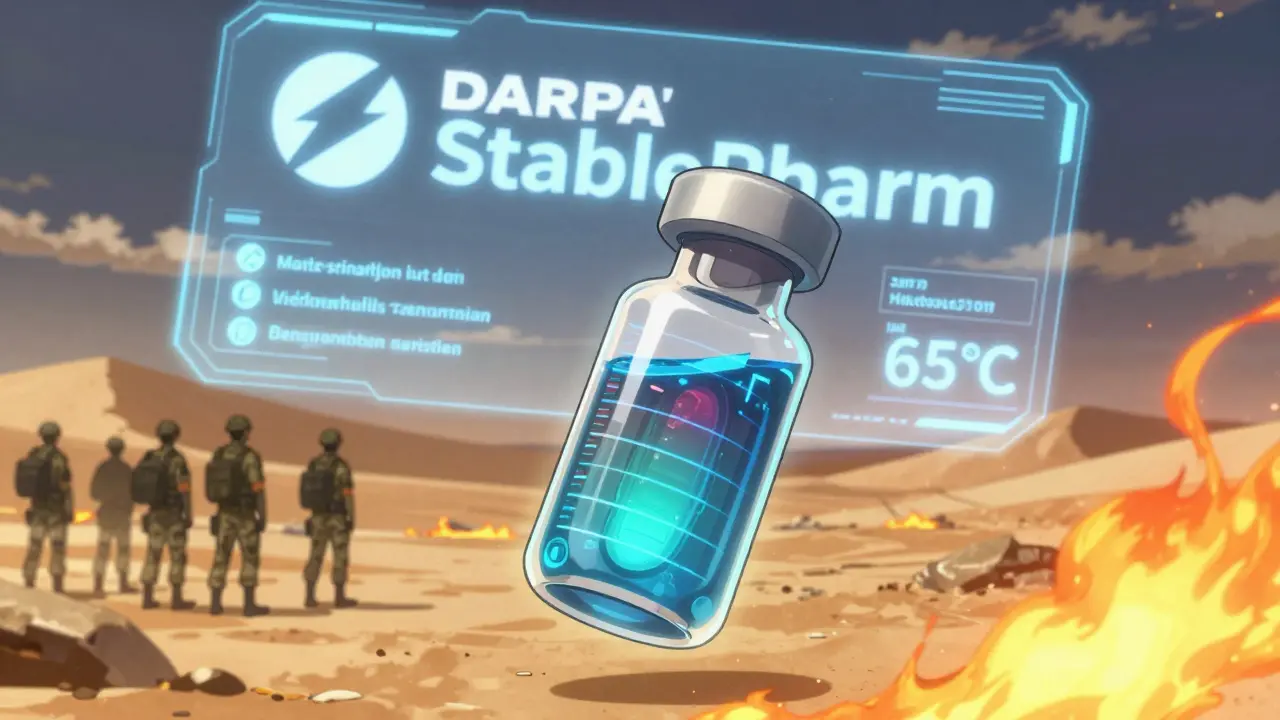
The military isn’t waiting for better weather. It’s changing the medicine itself. The Defense Advanced Research Projects Agency (DARPA) launched StablePharm in 2023-a $28 million project to create vaccines and antibiotics that stay stable at up to 65°C (149°F). Early results? Some antibiotics now last 40% longer in heat. That’s huge. Right now, antibiotics like ciprofloxacin and doxycycline lose potency after 48 hours above 30°C. That’s why 18% of antibiotics sent to Middle Eastern theaters showed reduced efficacy in 2024, according to Walter Reed’s study.
By 2028, the Army expects 75% of all military medications to have IoT sensors built into their packaging. Think of it like a Fitbit for medicine. Each vial tells you where it’s been, how hot it got, and whether it’s still good. The Defense Health Agency is already testing AI models that predict temperature excursions before they happen. At Fort Bragg, early tests cut losses by 22% in just three months.
The Big Picture: Readiness Is at Stake
Every time a vaccine fails because it got too hot, it’s not just one soldier who’s at risk. It’s the whole unit. If 12% of troops don’t develop immunity to Yellow Fever because their vaccines degraded, they can’t deploy to certain regions. That means missions get canceled. Troops get repositioned. Resources get wasted. The RAND Corporation warned in 2024 that without major investment in heat-stable drugs, medication efficacy could drop by 15-20% by 2030. In places like the Sahel or the Horn of Africa-where temperatures are rising faster than anywhere else-that’s not a prediction. It’s a countdown.
The military spends $1.2 billion a year on medical logistics. Nearly half a billion of that goes just to keeping meds cold. That’s more than the entire annual budget for some small countries. And yet, every year, millions of dollars in meds get thrown out because they got too warm. It’s not waste-it’s preventable failure.
The solution isn’t just better fridges. It’s better drugs. Better sensors. Better training. And above all, better respect for the science behind what’s in those vials. A soldier’s life doesn’t depend on how many bullets they carry. It depends on whether the medicine they carry still works.
Can military medications be stored in regular refrigerators?
No. Regular refrigerators don’t meet military standards. They fluctuate in temperature, lack dual monitoring systems, and aren’t calibrated to NIST standards. Military units must use thermostatically controlled units that maintain 2°C to 8°C with both digital and manual verification. Even if a civilian fridge is set to 4°C, it can’t be trusted in a deployment setting.
What happens if a temperature excursion occurs?
Any temperature excursion outside the 2°C-8°C range for refrigerated products must be documented immediately. The meds are quarantined, tested for potency if possible, and reported to the pharmacy and logistics command. If potency is compromised, the meds are destroyed. Units must submit a root cause analysis and corrective action plan within 24 hours. Repeated excursions can trigger inspections, training recalls, or even operational restrictions.
Are all vaccines equally affected by heat?
No. Some are far more sensitive. Vaccines for Rabies, Yellow Fever, and Smallpox degrade rapidly above 8°C. mRNA vaccines like those for COVID-19 and MPOX are especially fragile, needing ultra-cold storage. In contrast, some bacterial vaccines like Typhoid and Anthrax are more heat-stable, but still require strict control. Epinephrine auto-injectors are not vaccines, but they’re among the most vulnerable-heat changes their chemical delivery mechanism, not just potency.
Do soldiers carry their own meds, or are they stored centrally?
It depends. Routine meds like antibiotics or blood pressure pills are stored centrally in unit medical kits. But emergency meds-epinephrine, insulin, naloxone-are often carried personally by soldiers with medical conditions. These personal auto-injectors are kept in insulated pouches and must be checked daily. The military requires soldiers to report any damage or exposure to heat, even if it’s just sitting in a vehicle for an hour.
Is there a difference between military and civilian medication storage rules?
Yes. Civilian pharmacies typically rely on a single monitoring system and allow minor, temporary excursions with minimal documentation. The military requires dual verification (manual + digital), immediate reporting of any deviation, and mandatory corrective action. The standard is stricter because mission readiness depends on every dose working. A civilian patient might get a weaker pill. A soldier might die.



Random Guy
February 9, 2026 AT 03:04Ryan Vargas
February 10, 2026 AT 13:49Simon Critchley
February 10, 2026 AT 14:43Andrew Jackson
February 12, 2026 AT 05:35Patrick Jarillon
February 13, 2026 AT 22:34Kathryn Lenn
February 14, 2026 AT 02:17Chima Ifeanyi
February 15, 2026 AT 06:43Ritteka Goyal
February 15, 2026 AT 11:52Monica Warnick
February 17, 2026 AT 05:25Frank Baumann
February 17, 2026 AT 17:19Scott Conner
February 18, 2026 AT 17:19