

Antibiotic Phototoxicity Risk Calculator
Calculate Your Phototoxicity Risk
When you're taking antibiotics like doxycycline or ciprofloxacin, your skin becomes more sensitive to sunlight. It's not just about getting a sunburn - it's about phototoxicity, a serious reaction that can cause painful blisters, deep redness, and even long-term skin damage. This isn't rare. About 1 in 5 people who take these drugs and don’t protect themselves end up stopping their treatment because of how bad it gets. The good news? You can avoid it completely - if you know exactly what to do.
What Exactly Is Phototoxicity?
Phototoxicity happens when certain antibiotics absorb UV light, especially UVA rays (315-400 nm), and trigger a chemical reaction in your skin. Think of it like your skin turning into a solar panel. Instead of generating electricity, it generates inflammation. Symptoms show up fast - within minutes to hours after sun exposure. You might see redness that looks worse than a normal sunburn, swelling, blistering, or dark spots that stick around for months. It doesn’t matter if it’s a cloudy day. UVA rays penetrate clouds and even glass. Sitting by a window or walking to your car can be enough to trigger a reaction.Which Antibiotics Are the Biggest Risk?
Not all antibiotics do this. Some are safe. Others? Not even close. Here’s what the data shows:- Doxycycline - Highest risk among tetracyclines. At doses over 100 mg/day, phototoxicity jumps sharply. This is the most common one people get burned by.
- Ciprofloxacin - Moderate risk. About 2.1 out of every 1,000 people on this drug will have a reaction each month.
- Levofloxacin - Lower risk than ciprofloxacin. Around 0.8 reactions per 1,000 patient-months.
- Moxifloxacin - Lowest risk among fluoroquinolones. The chemical structure (that methoxy group at C-8) makes it much less likely to react with light.
- Minocycline - Much safer than doxycycline. Only about 1 in 100 people on minocycline have phototoxic reactions.
- Sulfonamides - Nearly no risk. If you’re worried, this class is your safest bet.
If you're on doxycycline for Lyme disease or pneumonia, you’re in the high-risk group. Switching isn’t always possible - but protection is.
The Four Essential Steps to Prevent Phototoxicity
1. Use SPF 50+ Sunscreen - And Reapply Correctly
SPF 30? That’s not enough. Studies show SPF 30 only blocks about 55% of the UVA rays that cause phototoxic reactions. SPF 50+ blocks 92%. That’s a huge difference. You need a broad-spectrum sunscreen - meaning it protects against both UVA and UVB. Apply it 15 to 30 minutes before going outside. Don’t wait until you’re already in the sun. And here’s where most people mess up: they don’t reapply. Sunscreen breaks down under sunlight, sweat, and even just time. The FDA and dermatology guidelines say: reapply within one hour if you’re outside. If you’re swimming or sweating heavily, reapply every 40 to 80 minutes. Many patients think “water-resistant” means “all-day protection.” It doesn’t.2. Wear UPF 40+ Clothing - Not Just Any Shirt
A white cotton T-shirt? It only blocks about 60-80% of UV radiation. That’s UPF 5-10. You’re still getting burned. Look for clothing labeled UPF 40 or higher. UPF 50+ blocks 98% of UV rays. Dark, tightly woven fabrics work best. Polyester blends often outperform cotton. You don’t need to look like a lab coat - there are stylish, breathable UPF-rated shirts, hats, and even swimsuits now. A wide-brimmed hat (at least 3 inches) cuts facial UV exposure by 95%. A baseball cap? Only 45%. That’s not enough if you’re outside for more than 10 minutes.3. Take Your Antibiotic in the Evening
This one’s simple, and it works. If you take your antibiotic in the evening - ideally 2 to 3 hours before bed - your blood levels peak while you’re asleep. That means when the sun is strongest, your drug concentration is lowest. A 2017 study with 142 patients found this strategy cut phototoxic reactions by 37% for fluoroquinolones like ciprofloxacin. It’s not magic. It’s timing. For doxycycline, take it right after dinner. For ciprofloxacin, take it at bedtime. Don’t take it in the morning unless you’re never going outside again.4. Avoid Sun Exposure Between 10 a.m. and 4 p.m.
This is the golden rule of sun safety. UV radiation is strongest during these hours. Even if you’re wearing sunscreen and a hat, limiting direct exposure is the best layer of defense. Plan outdoor walks for early morning or after sunset. If you work outside, ask your doctor if a non-phototoxic antibiotic is an option. A 2021 survey of dermatologists found that 28% changed prescriptions for outdoor workers because of phototoxicity risk. Don’t assume your job doesn’t matter - it does.
Why Most People Still Get Burned
You’d think this would be easy to follow. But here’s the truth: only about 39% of patients stick to the guidelines. Why? Confusion. Many think sunscreen lasts all day. Others don’t know their shirt offers almost no protection. A University of Michigan survey found 68% of patients didn’t know when to reapply sunscreen. Another study showed patients on long-term antibiotics - like for acne - still had breakthrough reactions 62% of the time, even when they thought they were being careful. That’s because phototoxicity isn’t just about one sunny day. It’s about cumulative exposure. Every walk to the mailbox, every lunch break outside, every drive with the window down adds up.New Tools That Actually Help
Technology is stepping in. Apps like UV Lens (used by over 12 million people) give real-time UV index alerts and personalized reminders based on your medication. In a 2023 trial, patients using the app improved adherence by 52%. That’s huge. Some electronic health systems - like Epic - now flag when a doctor prescribes doxycycline to someone with an outdoor job. The system pops up a warning: “Patient has high sun exposure. Consider photoprotection counseling.” That’s not just tech - that’s prevention built into care.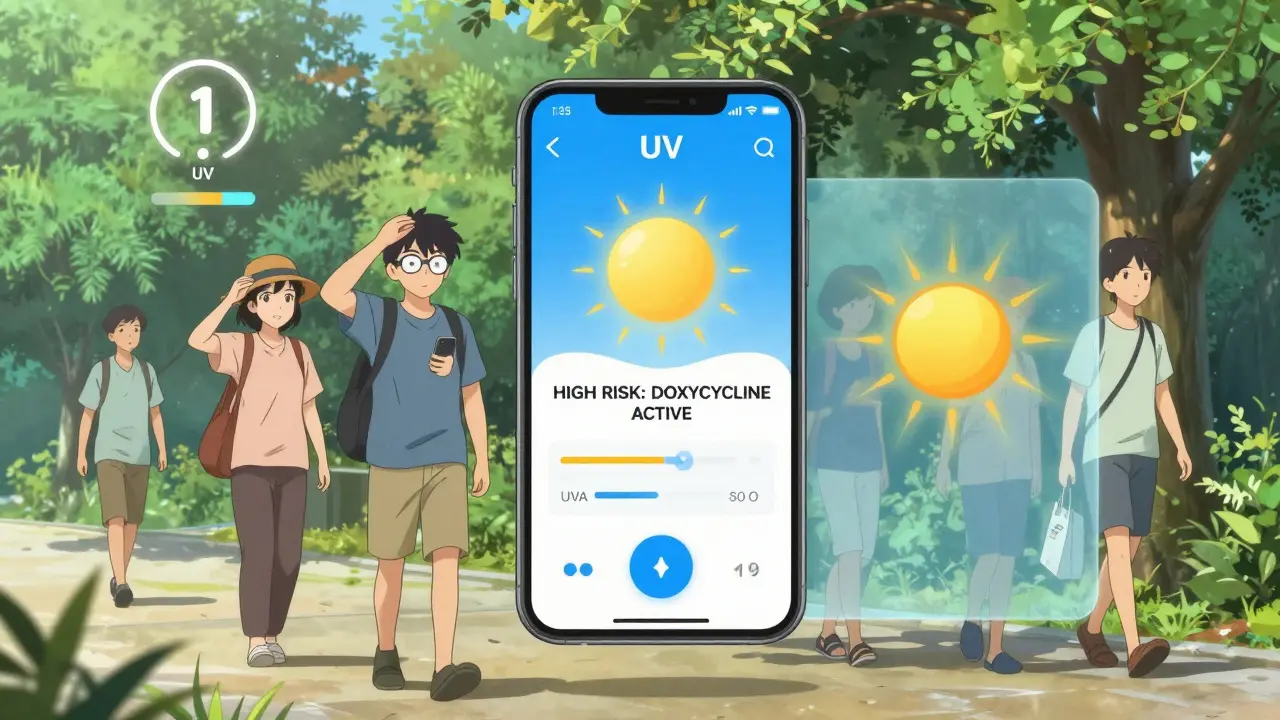
What About New Antibiotics?
The future is looking better. New antibiotics like gepotidacin, currently in Phase III trials, show no phototoxicity. The European Medicines Agency now requires all new antibiotics to pass the 3T3 Neutral Red Uptake Phototoxicity Test before approval. That’s stopped three drugs from reaching market. But here’s the catch: 22% of all outpatient antibiotic prescriptions in 2023 were still for phototoxic drugs. That means millions of people are still at risk. Prevention isn’t going away. It’s more important than ever.Final Thoughts: It’s Not Just About Sunscreen
Phototoxicity isn’t a minor side effect. It’s a real threat that can derail treatment, cause lasting skin damage, and even raise long-term cancer risk. But it’s completely preventable. You don’t need to live in the dark. You just need to be smart. Use SPF 50+, wear UPF clothing, take your pill at night, and avoid midday sun. Do all four - and you’ll be fine. Skip even one, and you’re gambling with your skin.If you’re on antibiotics and plan to be outside - even briefly - treat your skin like it’s made of glass. Because right now, it is.
Can I still go outside if I’m on doxycycline?
Yes, but you must take full precautions. Use SPF 50+ sunscreen, wear UPF 40+ clothing, a wide-brimmed hat, and avoid being outside between 10 a.m. and 4 p.m. Taking doxycycline in the evening also lowers your risk. Without these steps, even short exposure can cause severe reactions.
Is sunscreen alone enough to prevent phototoxicity?
No. Sunscreen is critical, but it’s not enough. Studies show that relying only on sunscreen leaves you vulnerable because it degrades under sunlight and sweat. Clothing with UPF 40+ blocks 98% of UV rays, and avoiding midday sun cuts exposure by over 70%. The best protection combines sunscreen, clothing, timing, and shade.
Why does doxycycline cause phototoxicity but not minocycline?
It comes down to chemical structure. Doxycycline absorbs UVA light more readily, triggering a stronger reaction in the skin. Minocycline has a slightly different molecular shape that makes it less likely to interact with UV light. That’s why minocycline has about 6 times lower phototoxicity risk than doxycycline.
Should I stop taking my antibiotic if I get a sunburn?
Don’t stop without talking to your doctor. Stopping antibiotics early can lead to treatment failure, antibiotic resistance, or recurring infection. Instead, protect yourself more aggressively and contact your provider. They may switch you to a safer antibiotic, adjust the dose, or prescribe a protective supplement like β-carotene.
Do I need to worry about phototoxicity with short courses of antibiotics?
Yes. Phototoxic reactions can happen after just one day of sun exposure. Even a 7-day course of doxycycline for pneumonia can cause serious burns if you’re not protected. The reaction is dose-dependent on UV exposure, not how long you’ve been on the drug. So if you’re outside at all, protect yourself from day one.



Melissa Starks
March 16, 2026 AT 12:07Okay but let’s be real - I’ve been on doxycycline for acne for 8 months and I’ve never had a single burn. I’m out hiking every weekend, gardening, sitting on my porch at noon… and I just wear a hat and slap on sunscreen like I do for any other day. Maybe I’m lucky? Or maybe the ‘1 in 5’ stat is exaggerated? I’ve talked to like 15 people on this med and only 2 had issues. Maybe it’s more about how much you actually *do* with your skin? Like, if you’re just walking to your car? Probably fine. But if you’re lifeguarding? Yeah, go all in. But don’t scare people into thinking they’re gonna melt. I’m not even doing the evening thing and I’m fine. Just… be smart, not paranoid.
Lauren Volpi
March 16, 2026 AT 12:31Wow. So now we’re telling people they can’t go outside unless they’re dressed like a UV-proof robot? SPF 50+, UPF 40+, no sun between 10-4, take meds at night? What’s next? You have to sign a waiver before you breathe in sunlight? This reads like a pharmaceutical ad disguised as medical advice. I’ve seen people get ‘phototoxicity’ from sitting near a window with a curtain. We’re turning a minor risk into a full-blown cult of sun avoidance. I’m not taking my antibiotic at 10pm just so I can ‘avoid’ the sun. I’m taking it when I can remember it - usually with breakfast. And I’ll take my chances.
Kal Lambert
March 18, 2026 AT 02:39Good breakdown. Key point: sunscreen alone isn’t enough. UPF clothing blocks more than SPF. And timing matters. Taking doxycycline at night lowers peak blood levels during peak UV. Simple. Effective. No hype. Just science. Do the four things. You’ll be fine. No need to overthink it.
cara s
March 19, 2026 AT 15:29While the information presented is both comprehensive and empirically grounded, I find myself compelled to interrogate the underlying epistemological assumptions of the preventive framework outlined. The conflation of phototoxicity with a binary paradigm of ‘safe’ versus ‘unsafe’ exposure neglects the nuanced, context-dependent nature of dermal photoreactivity. Furthermore, the recommendation to adhere strictly to temporal boundaries (10 a.m.–4 p.m.) may inadvertently reinforce a form of environmental determinism - one that presumes uniform physiological response across diverse phenotypes, geographic latitudes, and ambient UV indices. For instance, in regions such as the Pacific Northwest, where ambient UVA irradiance is frequently attenuated by cloud cover and atmospheric scattering, the imposition of such rigid temporal constraints may constitute an overcorrection. Additionally, the assertion that ‘even short exposure can cause serious burns’ warrants critical scrutiny, as it risks pathologizing routine diurnal activity. Perhaps a more calibrated, risk-stratified approach - incorporating individual phototype, medication half-life, and real-time UV monitoring - would yield superior clinical outcomes while preserving patient autonomy.
Amadi Kenneth
March 20, 2026 AT 04:12Wait… so now they’re telling you to take your antibiotic at night? Who’s controlling the clocks? Who decided that? I’ve heard this before - with the fluoride in the water, the 5G towers, the vaccines… they’re always trying to control what you do. And now THIS? ‘Take it at 9 PM’? What if I work nights? What if I’m on a different time zone? What if the hospital gives it to me at 8 AM? This smells like Big Pharma pushing a ‘schedule’ so they can sell more UPF shirts and SPF 50+ sunscreen. And don’t get me started on the ‘UV Lens app’ - that’s a tracking tool. They’re watching you. They want to know when you go outside. They want to know if you’re compliant. They’re building a database. This isn’t medicine - it’s surveillance. And don’t tell me I’m crazy. I’ve seen the documents.
Shameer Ahammad
March 21, 2026 AT 01:29It is, without a doubt, an egregious oversight on the part of the medical community that patients are not routinely educated on the phototoxic potential of fluoroquinolones prior to prescription. The fact that 68% of patients are unaware of reapplication protocols indicates a systemic failure in patient counseling. Moreover, the assertion that ‘minocycline is six times safer’ is statistically valid but ethically incomplete: why is doxycycline still the first-line choice in Lyme disease when alternatives exist? The pharmaceutical industry’s inertia in favor of older, cheaper agents - despite superior safety profiles - is a moral failing. Furthermore, the suggestion that ‘even a 7-day course’ can induce severe reactions is not hyperbole - it is a documented clinical reality. I implore clinicians: when prescribing doxycycline, do not assume patient literacy. Provide written, multilingual, pictorial instructions. Do not rely on verbal cues. The cost of noncompliance is not merely discomfort - it is scarring, psychological trauma, and potential long-term carcinogenesis. This is not optional education. It is standard of care.
Alexander Pitt
March 22, 2026 AT 04:08SPF 50+ is good. UPF clothing is better. Evening dosing works. Avoid midday sun. That’s it. No apps needed. No special hats. Just do the four things. Done.
Manish Singh
March 22, 2026 AT 05:58I live in India - monsoon season, then 45°C heat, then back to monsoon. I’ve been on doxycycline for a week last year. Didn’t get burned. Why? I wore a cotton dhoti, stayed in shade after noon, and used a local sunscreen brand (Biotique) that had zinc oxide. No fancy UPF gear. No apps. Just common sense. I think the advice here is solid - but the tone feels very American. In places like ours, people don’t have 10 different sunscreens or UPF shirts. They use whatever’s available. Maybe the real takeaway is: protect your skin however you can. A scarf, a tree, a hat - it all helps. Don’t let perfect be the enemy of good.
Nilesh Khedekar
March 23, 2026 AT 06:22So… you’re telling me I can’t go to the beach for 2 weeks? I’m on cipro for a UTI - and I just got a vacation booked. Are you serious? And why is everyone so scared of the sun? I’ve been in the sun since I was 5. My skin’s tough. Also - did you know that vitamin D is made by sunlight? Are we just gonna avoid it forever? What’s next? ‘Don’t breathe air - it’s full of oxygen and that causes free radicals!’ This is just fear-mongering. I’m taking my pill at noon. I’m going to the beach. I’ll use sunscreen. And I’m not turning into a ghost. Stop overcomplicating everything.
Robin Hall
March 24, 2026 AT 12:46Let me ask you this: if phototoxicity is so preventable, why are there no mandatory warning labels on antibiotic packaging? Why is there no FDA requirement for patient education handouts? Why is this not a black-box warning? The fact that this is left to ‘personal responsibility’ is a failure of regulatory oversight. The pharmaceutical industry profits from both the drug and the sunscreen. The system is designed to shift liability to the patient. I’ve reviewed the FDA adverse event reports - phototoxicity is underreported by at least 70%. And the ‘UV Lens app’? That’s not prevention - it’s data harvesting. They’re collecting your location, your medication use, your sun exposure patterns. This isn’t healthcare. It’s surveillance capitalism disguised as public safety.
jared baker
March 25, 2026 AT 19:06Just use sunscreen, wear a hat, don’t sit out at noon. Done.