
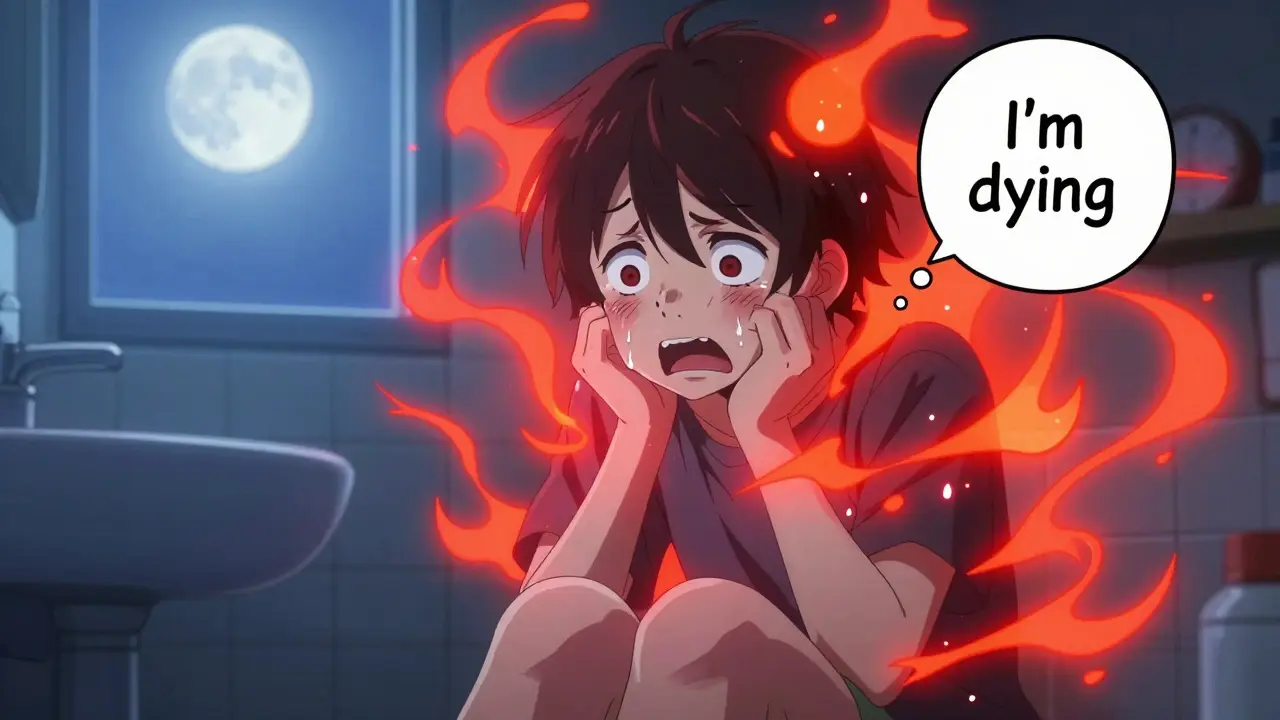
When your heart pounds out of nowhere, your chest tightens like a vice, and you’re sure you’re having a heart attack - but there’s no heart problem - that’s a panic attack. It’s not just stress. It’s your body screaming danger when there’s none. And if this happens often, without warning, you might be dealing with panic disorder.
What Exactly Is a Panic Attack?
A panic attack isn’t just feeling nervous. It’s a full-body emergency response that hits fast and hard. Within minutes, you might feel:- Heart racing at over 120 beats per minute
- Sweating so much your clothes stick to your skin
- Trembling so badly you can’t hold a cup
- Shortness of breath - like you’re drowning in air
- A choking sensation, even though nothing’s in your throat
- Chest pain that feels like a heart attack
- Dizziness, nausea, or numbness in your hands and feet
- Fear you’re losing control - or that you’re about to die
These symptoms peak within 10 minutes, then start to fade. But the fear lingers. You start wondering: “Will it happen again? Where? When?” That’s when panic disorder takes root.
According to the NHS, nearly every person who experiences panic attacks reports heart palpitations. Eight out of ten fear they’re dying. Nearly nine in ten worry they’re losing control. And 75% of people with panic disorder have had at least one attack that sent them to the emergency room - convinced it was a heart issue.
Agoraphobia: The Invisible Prison
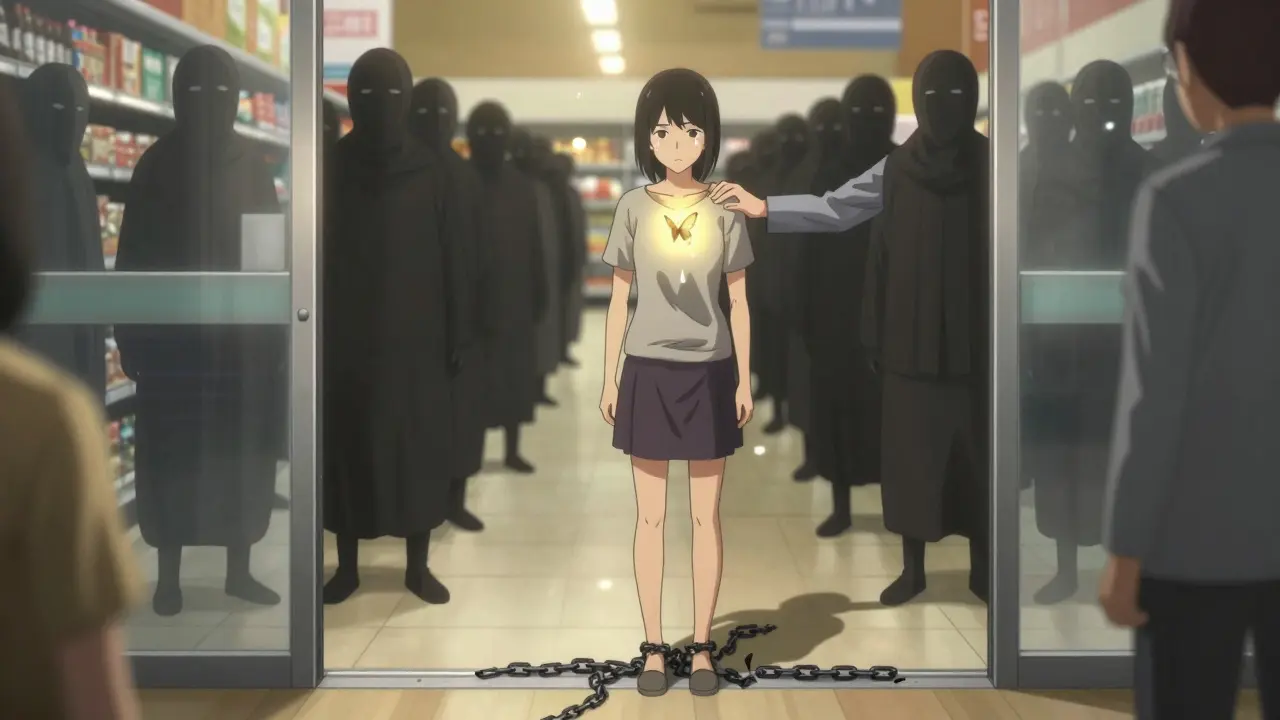
Panic attacks don’t just happen. They change your life. And that’s where agoraphobia comes in.Agoraphobia isn’t just fear of open spaces. It’s fear of being trapped - somewhere you can’t escape if panic strikes. You start avoiding:
- Public transport - because you can’t get off if you feel sick
- Crowded stores - because there’s no exit
- Being alone outside - because no one will know you’re in trouble
- Open fields, bridges, tunnels - places where help feels far away
By the time someone seeks help, 30-50% have developed agoraphobia. One woman in Edinburgh stopped leaving her house for 18 months after her third panic attack in a supermarket. She didn’t leave until her therapist walked her to the front door - then to the bus stop - then onto the bus - with breathing exercises and reassurance at every step.
It’s not laziness. It’s survival. Your brain has learned: “If I go there, I’ll panic. If I panic, I’ll die.” So it tells you: “Stay home.” And home becomes a cage.
Why Does This Happen?
No one wakes up with panic disorder. It builds. And science shows it’s not “just in your head.”Your brain’s alarm system - the amygdala - is overactive. Brain scans show it lights up 25% more in people with panic disorder when they see threatening faces. Meanwhile, your stress chemicals - especially norepinephrine - flood your system. In 70% of cases, this system stays stuck in high gear.
Genetics play a role too. If a close relative has panic disorder, your risk jumps by 30-48%. But it’s not just biology. Life events matter. Sixty-five percent of first-time panic attacks follow major stress: a breakup, job loss, death of a loved one, even childbirth.
And then there’s anxiety sensitivity - the fear of fear itself. If you think your racing heart means you’re about to collapse, you’re more likely to spiral. People who score high on anxiety sensitivity tests are nearly five times more likely to develop full-blown panic disorder.
How Is It Treated? The Proven Path
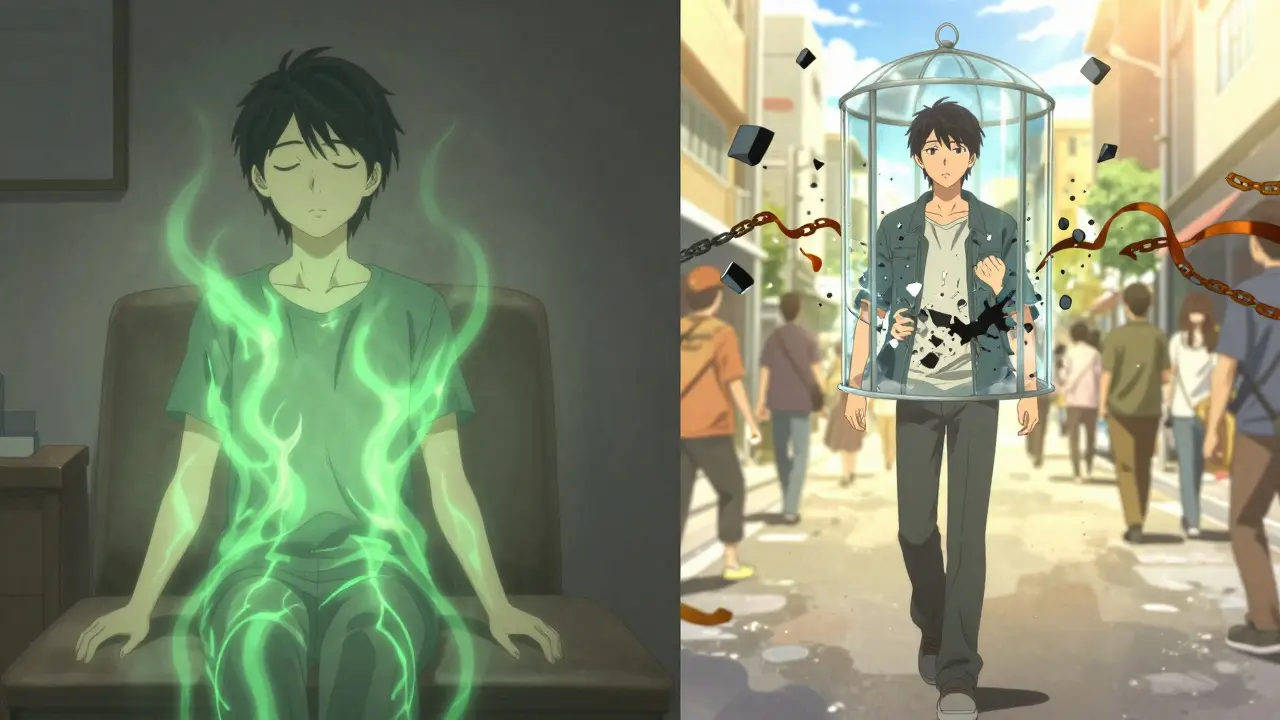
The good news? Panic disorder is one of the most treatable anxiety disorders. And you don’t need to live in fear forever.Cognitive Behavioral Therapy (CBT): The Gold Standard
CBT isn’t just talking. It’s rewiring your brain. In 12-15 weekly sessions, you learn:- Cognitive restructuring: When your heart races, you don’t say, “I’m dying.” You say, “This is panic. It’s scary, but it’s not dangerous.”
- Interoceptive exposure: You deliberately trigger symptoms - spin in a chair to feel dizzy, breathe through a straw to feel short of breath - to prove your body can handle it.
- In vivo exposure: You slowly face avoided places. First, stand outside. Then, walk to the mailbox. Then, sit in a parked car. Then, drive to the corner store.
Studies show CBT works for 70-80% of people. After treatment, most report 50-70% fewer panic attacks. And the gains last. Unlike pills, CBT teaches you skills that stick.
Medication: A Tool, Not a Cure
SSRIs like sertraline and paroxetine are first-line medications. They don’t stop panic attacks instantly. But after 6-12 weeks, 60-75% of users see big improvements. They help your brain reset its alarm system.But they’re not perfect. About 40% of people gain weight. Some feel emotionally flat. One Reddit user said: “I stopped panicking - but I stopped feeling joy too.”
Benzodiazepines like alprazolam work fast - but they’re risky. Thirty to forty percent of long-term users become dependent. They’re for emergencies only - not daily use.
The Best Combo: Therapy + Medication
When CBT and SSRIs are used together, remission rates jump to 85%. That’s the highest success rate in anxiety treatment. Especially if you’re avoiding places, depressed, or have had panic attacks for years.But here’s the catch: if you stop therapy and only rely on pills, 60% relapse within six months. The medication masks the symptoms. CBT changes the thinking. You need both.
What About New Treatments?
The field is evolving. In May 2023, the FDA approved the first digital therapy for panic disorder: CalmWave. It’s a prescription app that delivers CBT with real-time heart rate feedback. In a 24-week trial, 62% of users no longer met criteria for panic disorder.Another breakthrough? D-cycloserine. A tiny dose taken before a therapy session boosts learning. In one study, it improved treatment response by 28%. It’s not a magic pill - but it helps the brain absorb therapy faster.
And telehealth is changing access. In 2023, 28% of anxiety treatments were delivered online. For someone too scared to leave the house, a video call with a therapist can be life-changing.
The Hidden Problem: Delayed Diagnosis
Most people wait years before getting help. The Anxiety and Depression Association of America found that people with panic disorder wait an average of 7.2 years to see a specialist. Why?- They think it’s a heart problem - and go to the ER
- They think it’s “just anxiety” - and ignore it
- They’re ashamed - and don’t tell anyone
One man in Glasgow went to five different doctors over five years. Each time, he was told: “It’s stress.” He finally got diagnosed after collapsing during a panic attack in a pharmacy - and his pharmacist recognized the symptoms.
Don’t wait. If you’ve had more than one unexplained panic attack - especially if you’ve started avoiding places - talk to your GP. Ask for a referral to cognitive behavioral therapy. Don’t wait for it to get worse.
What Helps Beyond Therapy and Meds?
Treatment works best when you support it with daily habits:- Breathe slowly: 4 seconds in, 6 seconds out. It calms your nervous system.
- Move your body: Walking, swimming, yoga - even 20 minutes a day reduces panic frequency.
- Limit caffeine: It’s a trigger. One coffee a day can double your panic risk.
- Sleep well: Poor sleep = lower panic threshold.
- Don’t isolate: Even if you’re scared, text a friend. Connection is medicine.
And remember: recovery isn’t linear. Some days you’ll feel fine. Other days, a loud noise or a crowded room will send you spiraling. That’s normal. Progress isn’t about never feeling panic - it’s about knowing you can handle it.
What’s the Long-Term Outlook?
The Harvard Longitudinal Anxiety Project found that 65% of people who get proper treatment achieve lasting remission. That’s more than two out of three.But 25% have relapses - usually after major life stress: divorce, job loss, illness. That’s why maintenance matters. Quarterly check-ins with your therapist. Keeping your breathing techniques sharp. Knowing your triggers. Planning ahead.
Panic disorder doesn’t have to define you. It’s not a life sentence. It’s a condition - and like any condition, it can be managed.
Can panic disorder go away on its own?
Rarely. While some people experience fewer attacks over time, panic disorder rarely resolves without treatment. Avoidance behaviors tend to worsen. Without therapy, the fear of panic becomes stronger than the panic itself. Studies show that 60% of people who don’t get treatment still have symptoms five years later.
Is agoraphobia the same as being housebound?
No. Agoraphobia is fear of situations where escape feels hard or help isn’t available. Some people with agoraphobia never leave their homes. Others will go out - but only to safe places, like a nearby grocery store they know well. It’s not about being lazy or reclusive - it’s about survival. Treatment helps rebuild confidence step by step.
Can I treat panic disorder with just breathing exercises?
Breathing exercises help calm symptoms, but they don’t fix the root cause. Panic disorder is fueled by catastrophic thoughts - like “My heart is racing, I’m going to die.” Breathing helps you survive the attack, but CBT helps you stop fearing it. Think of breathing as a life jacket - CBT is learning to swim.
Do I have to take medication forever?
No. Many people taper off SSRIs after 6-12 months of stable improvement - especially if they’ve done CBT. But stopping too soon without building coping skills leads to relapse. Your doctor will help you decide based on symptom severity, side effects, and how well you’re managing without meds.
Can children get panic disorder?
Yes. While it most often starts in late teens or early adulthood, children as young as 10 can develop panic disorder. In kids, symptoms may show up as stomachaches, refusal to go to school, or clinginess. Early intervention with CBT tailored for children is highly effective.
What should I do if someone I know is having a panic attack?
Stay calm. Don’t say “Calm down” - it doesn’t work. Instead, say: “You’re safe. I’m here. This will pass.” Help them focus on their breath: “Breathe with me - in for four, out for six.” Don’t rush them. Don’t leave them alone. Afterward, encourage them to talk to a professional. Your presence matters more than you know.




becca roberts
March 18, 2026 AT 12:47So let me get this straight - you’re telling me my 3 a.m. heart-racing, sweat-drenched, ‘am I dying?’ episodes are just my amygdala throwing a tantrum? And I don’t need to call 911? I’ve been going to the ER for five years thinking I was a walking cardiac case. My cardiologist just shrugged and said ‘stress.’ Thanks for validating my existential dread, OP.
Also, the CalmWave app? I’m downloading it right after this comment. If I can panic while scrolling through my phone, maybe my phone can panic back at me. Fair trade.
Andrew Muchmore
March 19, 2026 AT 17:17CBT works. Done 12 weeks. No meds. Still do the breathing. Still avoid malls. But I drove to the coast last week. Alone. No panic. Just me and the ocean. That’s the win.
Paul Ratliff
March 21, 2026 AT 05:24lol i thought i was the only one who thought my heart was gonna explode during a panic attack. turns out its just my brain being dramatic. also caffeine is the devil. switched to decaf and my attacks dropped by like 70%. no joke.
SNEHA GUPTA
March 22, 2026 AT 17:18There is a profound philosophical tension here - between the biological imperative to survive and the cognitive distortion that equates physiological arousal with existential threat. Panic disorder is not merely a disorder of the nervous system, but a crisis of meaning. When the body screams danger, and the mind has no narrative to contain it, the self fractures. Therapy does not cure panic - it restores the story.
And yet, we reduce it to apps and breathing. We commodify survival. We forget that healing is not efficiency - it is reintegration.
Gaurav Kumar
March 24, 2026 AT 01:43USA thinks everything can be fixed with an app or a pill. In India, we don’t need CBT. We have yoga, meditation, and family. Also, panic attacks? We call it ‘nervous breakdown’ and just chill with chai and a good Bollywood movie. No fancy therapy needed. Also, why is everyone so obsessed with Western medicine? 🤷♂️
Nicole Blain
March 24, 2026 AT 20:12me: *sweating, shaking, heart in throat*
also me: *texting friend* hey can u come over? im having a panic attack again lol
friend: on my way with pizza and a blanket 🍕❤️
the real treatment is people who don’t ask ‘why are you like this’ but just show up.
Kathy Underhill
March 26, 2026 AT 07:46Agree with the CBT emphasis. Medication helped me stabilize. But the real shift came when I stopped fighting the sensations and started observing them. Not as threats. As weather. Temporary. Passing. I still get them. But now I don’t need to flee. Just breathe. Wait. Let it move through.
It’s not about elimination. It’s about relationship.
Srividhya Srinivasan
March 28, 2026 AT 06:26OF COURSE the FDA approved an app! What did you expect? Big Pharma doesn’t want you to heal - they want you to PAY. The real cure? Stop eating processed food. Stop watching news. Stop scrolling. Your body is not malfunctioning - it’s REACTING to a world that’s designed to break you. CBT? That’s just a Band-Aid on a bullet wound. The system is the illness. And they’re selling you a subscription to your own suffering.
Also - did you know that 97% of panic disorder patients were exposed to Wi-Fi before age 12? Coincidence? I think not.
Prathamesh Ghodke
March 29, 2026 AT 00:47Bro, I used to have panic attacks every time I had to talk to my boss. Then I started doing 5-minute walks every morning - no phone, just me and the birds. Slowly, the world stopped feeling like a trap. CBT helped, sure. But what really changed me? Walking. Just walking. And not rushing.
Also, your therapist doesn’t have to be a licensed professional. Sometimes it’s your neighbor who asks, ‘You good?’ and actually waits for the answer.