

It is 2026, and the battle for patient access to medication often happens long before a pill reaches a patient's hand. For healthcare providers, prior authorization is a utilization management strategy requiring approval from insurance payers before certain medications are covered has become a daily administrative hurdle. While the process was originally designed in the 1980s to control costs, it now creates significant friction, especially when securing approval for generic medications. You might wonder why a low-cost, widely available generic drug requires such rigorous scrutiny. The answer lies in formulary preferences, quantity limits, and the complex algorithms used by pharmacy benefit managers (PBMs) to manage their risk.
According to the American Medical Association, nearly 93% of physicians report that prior authorization requirements have increased over the past five years. This surge in bureaucracy forces providers to spend an average of 16.1 hours per week handling these requests-time that could otherwise be spent with patients. Understanding how to navigate this system efficiently is no longer optional; it is essential for maintaining practice viability and ensuring your patients receive timely care.
Why Generics Require Prior Authorization
You might assume that because generic drugs are cheaper and therapeutically equivalent to brand-name drugs, they would sail through the approval process. In reality, generics make up about 28% of all prior authorization requests. This happens primarily due to three specific triggers: therapeutic interchange restrictions, quantity limitations, and duration limits.
First, consider therapeutic interchange. Insurance plans maintain a Preferred Drug List (PDL). If a plan prefers one generic manufacturer over another, or if they prefer a different class of generic drug entirely, prescribing the non-preferred option triggers a review. For example, if a patient has a documented adverse reaction to the formulary-preferred generic metformin, you must prove why the alternative generic is medically necessary.
Second, quantity limits play a huge role. If a standard plan limits a medication to a 30-day supply but you prescribe a 90-day refill to improve adherence, the system flags it. Similarly, duration limits apply to drugs like proton pump inhibitors (PPIs). Most guidelines suggest PPIs are safe for eight weeks of therapy. If you prescribe them for chronic use, such as for Barrett's esophagus, you must provide documentation justifying the extended duration.
| Trigger Type | Description | Example Scenario |
|---|---|---|
| Therapeutic Interchange | Payer prefers a different generic or drug class | Prescribing sitagliptin after metformin intolerance without proof of failed trials |
| Quantity Limits | Request exceeds standard supply amount | Requesting a 90-day supply when the plan covers only 30 days |
| Duration Limits | Long-term use exceeds guideline recommendations | Continuing omeprazole beyond 8 weeks for GERD management |
| Off-Label Use | Drug used for indication not on FDA label | Using a generic antidepressant for neuropathic pain |
The Technical Process: From Submission to Approval
Securing approval requires more than just submitting a request; it demands precise clinical documentation. The Centers for Medicare & Medicaid Services (CMS) mandates that Medicaid programs process urgent requests within 24 hours and standard requests within 14 calendar days. Commercial insurers typically take 5 to 10 business days, though electronic systems have improved this significantly.
To get approved, your submission must include chart notes, laboratory results, and diagnostic tests like MRIs or radiographs. For generics specifically, you must demonstrate why the requested generic is necessary. If a patient had GI issues with the preferred generic, you need to document that specific adverse event. Vague statements like "patient didn't tolerate the first drug" are often rejected. Instead, specify "patient experienced severe nausea and vomiting with Metformin ER 500mg." Specificity wins approvals.
Submission methods vary by payer. As of 2024, 78% of commercial insurers require electronic submission through portals like CoverMyMeds or Surescripts. Only 22% still accept fax submissions, and phone requests are rare. Electronic prior authorization systems have reduced processing times by 35-50% compared to old fax-based methods. If you are still using fax, you are likely facing unnecessary delays.
Auto-Approval Pathways and AI Integration
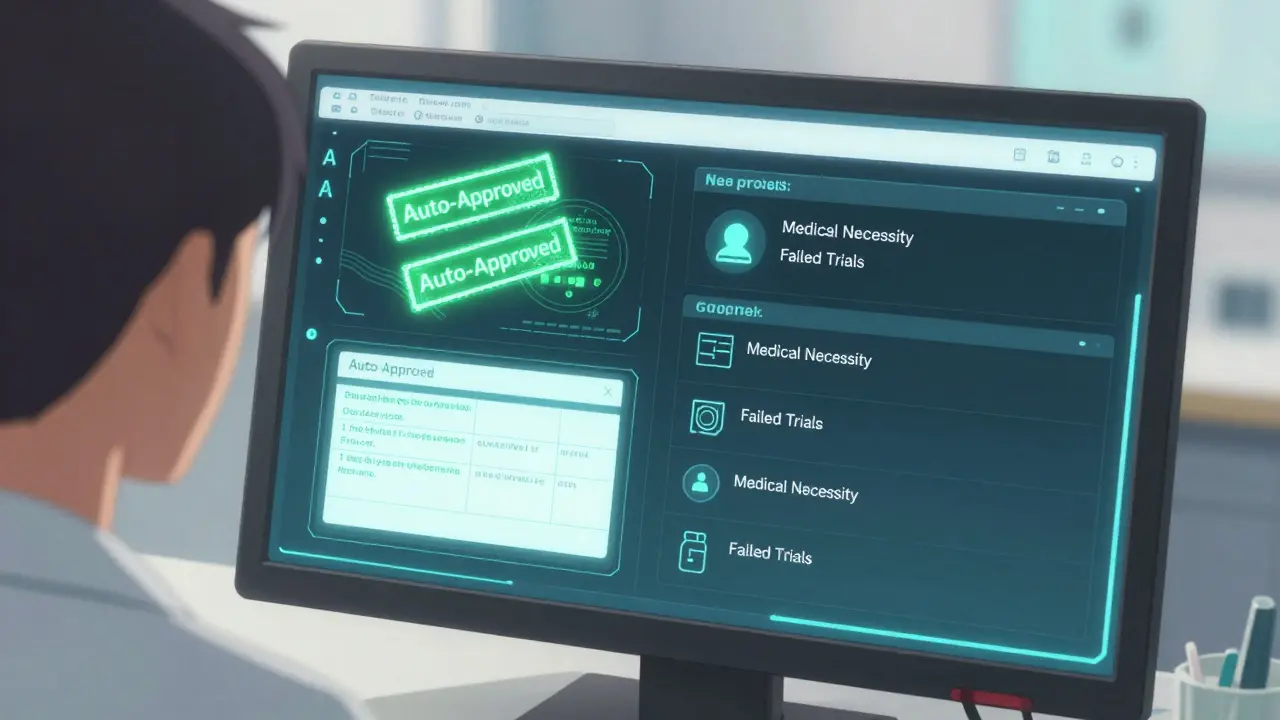
The landscape is shifting rapidly toward automation. Judi Health reports that 41% of prior authorization requests for generics are auto-approved when quantity limits aren't exceeded and documentation requirements are met. This means if your electronic health record (EHR) integrates seamlessly with the payer’s adjudication system, many routine requests never see a human reviewer.
By 2026, industry analysts predict that 75% of prior authorization decisions for generics will be made through AI-assisted review systems. These systems scan your documentation for keywords and data points that match national guidelines. To optimize for these bots, ensure your templates include clear headings like "Medical Necessity," "Failed Trials," and "Adverse Reactions." AI systems look for structured data, not narrative paragraphs.
Express Scripts reported a 40% increase in auto-approvals for generics in 2023 alone. This trend benefits providers who maintain clean, standardized records. However, if your documentation is messy or missing key elements, the AI may flag it for manual review, extending the wait time from minutes to days.
Comparing Insurance Types: Medicaid vs. Commercial
Not all payers operate the same way. Understanding the differences between Medicaid, Medicare Part D, and commercial insurance can help you tailor your approach.
Medicaid fee-for-service programs require prior authorization for select generics based on their Preferred Drug Lists (PDLs) in 67% of cases. Medicare Part D plans do so in 89% of cases, while commercial insurance plans hit 93%. The higher rate in commercial plans reflects their stricter cost-containment strategies.
A key advantage for generics is speed. GoodRx data shows that prior authorization for generics is typically approved faster (1-3 business days) compared to brand-name medications (3-7 business days). This is because the clinical evidence for generics is well-established, reducing the need for extensive peer-to-peer reviews. However, denials still happen. The AMA reports that denial rates for generics average 18.7%, with the most common reasons being lack of required documentation (42%) and failure to demonstrate medical necessity (38%).
| Insurance Type | PA Requirement Rate for Generics | Avg. Processing Time | Key Constraint |
|---|---|---|---|
| Medicaid FFS | 67% | 24 hrs (urgent) / 14 days (standard) | Strict PDL adherence |
| Medicare Part D | 89% | 5-10 business days | Step therapy requirements |
| Commercial Insurance | 93% | 1-3 business days (electronic) | High volume of auto-reviews |

Practical Strategies for Providers
Efficiency is the name of the game. The AMA recommends establishing a dedicated prior authorization team within your practice. Experienced medical assistants handle 78% of routine requests under physician supervision. This frees up doctors to focus on clinical decision-making rather than paperwork.
Use standardized documentation templates. Capital Rx reports that providers who use these templates see 32% faster approval times for generic medications. Your template should include sections for:
- Patient diagnosis and ICD-10 codes
- Previous treatments tried and failed
- Specific adverse reactions to preferred alternatives
- Laboratory or diagnostic results supporting current prescription
Build relationships with payer representatives. Knowing who to call when a request gets stuck can save days of waiting. Additionally, use automated tracking systems to monitor the status of each request. MGMA data shows that inconsistent documentation requirements between payers frustrate 89% of providers. Maintaining a payer-specific checklist helps mitigate this issue.
Challenges and Pitfalls to Avoid
Despite improvements, the system remains flawed. One major pitfall is the "bridge prescription" dilemma. About 56% of physicians report having to provide bridge prescriptions while waiting for approval. This exposes patients to out-of-pocket costs and potential safety risks if they cannot afford the medication during the wait period. National Community Pharmacists Association surveys found that 83% of pharmacists have seen patients unable to pay for generics while awaiting PA approval.
Another challenge is the complexity of manufacturer restrictions. Dr. Paul Fischer, Chief Medical Officer at GoodRx, notes that some PBMs implement restrictions on which generic manufacturers they cover. This means switching between two generic versions of the same drug might trigger a new prior authorization. Always check the specific manufacturer code on the formulary before prescribing.
Finally, be aware of the Improving Seniors' Timely Access to Care Act of 2023. This law requires Medicare Advantage plans to respond to 90% of prior authorization requests within 24 hours for urgent cases and 72 hours for standard cases. If a payer misses these deadlines, you have grounds for an expedited appeal. Keep track of submission timestamps to enforce these rights.
How long does prior authorization for generics take?
For commercial insurers, electronic prior authorization for generics typically takes 1-3 business days. Medicaid programs must process urgent requests within 24 hours and standard requests within 14 calendar days. With the rise of AI-assisted reviews, many routine requests are auto-approved instantly.
What documentation is needed for generic prior authorization?
You must submit chart notes, laboratory results, and diagnostic tests. Crucially, you need to document why the requested generic is necessary, including any adverse reactions to preferred alternatives or failures of previous therapies. Specificity is key to avoiding denial.
Why do generic drugs require prior authorization?
Generics require prior authorization mainly due to formulary preferences, quantity limits, and duration restrictions. Insurers want to ensure patients use the most cost-effective options and avoid long-term use of medications unless medically justified.
Can I appeal a denied prior authorization for a generic?
Yes. If a prior authorization is denied, you can file an appeal. Provide additional clinical evidence, such as peer-reviewed studies or updated lab results, to support medical necessity. For Medicare Advantage plans, you can also cite the Improving Seniors' Timely Access to Care Act if response times were violated.
What is the difference between prior authorization for generics and brand-name drugs?
Prior authorization for generics is generally faster (1-3 days) and has lower denial rates compared to brand-name drugs (3-7 days). This is because generics have established safety profiles, whereas brand-name drugs often require more extensive justification for cost-effectiveness.