
Medication Synchronization Calculator
Your Current Medication Schedule
Medication Synchronization Benefits
Your Potential Savings
Time Savings
You could save approximately 0 hours per year.
Pharmacy Visits
Current: 0 visits/year
With Medication Sync: 0 visits/year
Reduction: 0 visits/year
Missed Doses
Current: 0 doses/month
With Medication Sync: 0 doses/month
Reduction: 0 doses/month
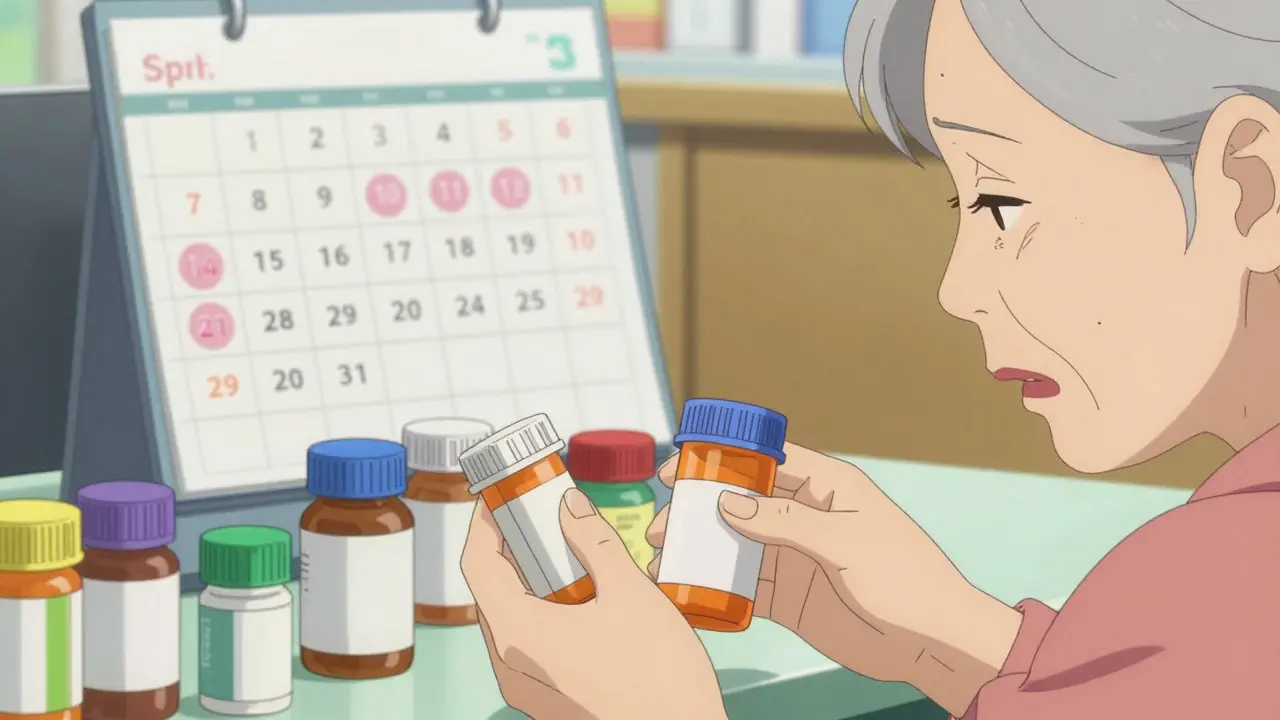
Every year, millions of people miss doses of their medications because juggling multiple refill dates is too confusing. This gap in therapy can lead to serious health issues, but there's a simple solution: medication synchronization is a pharmacy service designed to align all your prescription refills to a single monthly date. This approach prevents gaps in therapy and improves adherence. First developed in 1995 by a California pharmacist, it addresses the issue where medication non-adherence costs healthcare systems over $300 billion annually in the US alone.
What is medication synchronization?
Medication synchronization (or "med sync") is a structured pharmacy service that aligns all your maintenance medications to one monthly pick-up date. It's not just about convenience-it's a proven strategy to stop missed doses. Imagine taking pills for diabetes and high blood pressure, with refills due on different days. Without synchronization, you might forget one prescription, run out, and skip doses. That's dangerous. Med sync fixes this by making all refills due on the same day each month. The National Community Pharmacists Association (NCPA) calls it "one of the most effective practice models for community pharmacies to improve patient outcomes while demonstrating value to payers."
How does it work?
Pharmacists follow five clear steps to set up medication synchronization. First, they check state regulations-some places have rules about early refills or partial fills. Next, they identify eligible patients. This usually means people managing chronic conditions like diabetes, heart disease, or asthma. Then, the pharmacist explains the benefits and gets your consent. After that, they reconcile your medications: separating maintenance drugs (like daily blood pressure pills) from as-needed ones (like inhalers for asthma attacks). Finally, you and your pharmacist agree on an anchor date-a specific day each month when you pick up all your meds.
- Know Your State's Insurance Regulations - Different states have varying rules about early refills and partial fills. Pharmacists must understand these to avoid legal issues.
- Identify Eligible Patients - Focus on those with multiple chronic conditions, elderly, or busy professionals.
- Patient Outreach - Explain the benefits and get consent.
- Medication Reconciliation - Separate maintenance meds from PRN drugs.
- Choose an Anchor Date - Pick a convenient monthly date for pick-up.

Who benefits most?
Medication synchronization works best for people with complex medication needs. If you take three or more long-term medications, this service is a game-changer. Elderly patients who struggle with driving to the pharmacy benefit greatly. Busy professionals who can't squeeze in multiple pharmacy trips also see huge improvements. Take Sarah, a 62-year-old in Edinburgh managing diabetes, hypertension, and cholesterol. Before med sync, she had refill dates spread across the month. She missed doses twice a week. After synchronization, her pharmacy visits dropped from 12 to 4 per year. She now picks up all her meds on the first Monday of each month. Her pharmacist even calls her monthly to check on side effects or new prescriptions.
Benefits and challenges
Here's how medication synchronization compares to traditional refill systems:
| Aspect | Traditional System | Medication Synchronization |
|---|---|---|
| Refill Schedule | Multiple dates each month | Single monthly date |
| Pharmacy Visits | 12+ per year | 4-5 per year |
| Missed Doses | High due to scheduling conflicts | Reduced by 15-25% |
| Pharmacist Interaction | Limited to refills | Monthly check-ins |
| Stress Level | High | Low |
But there are challenges. Not all medications fit the system. As-needed drugs like inhalers or short-term antibiotics can't be synchronized. Insurance can also be tricky-some plans don't cover early refills during the initial synchronization phase. The American Society of Health-System Pharmacists (ASHP) notes that "the last thing anyone wants after the pharmacy gets a patient's multiple medication refill pickups finally synchronized is an expired prescription that disrupts the whole system." This happens when doctors write prescriptions for less than 90 days. But pharmacies solve this by working directly with doctors to adjust prescriptions.

How to get started
Asking your pharmacist about medication synchronization is easy. Just say: "I take multiple medications and want to simplify my refills. Can we synchronize them?" Your pharmacist will review your prescriptions, check eligibility, and explain the process. They'll likely ask about your preferred pick-up day and any concerns. For example, if you work late, they might schedule your anchor date for Saturday mornings. If you're on Medicare Part D, they'll verify coverage for partial fills during synchronization. The Academy of Managed Care Pharmacy (AMCP) states this service "improves adherence" and is "one tool that may improve adherence." It's free in most cases and covered by insurance.
Real-world impact
Numbers don't lie. A 2022 National Community Pharmacists Association survey of 1,200 patients using med sync showed 87% satisfaction rates. Seven out of ten reported better medication adherence. Most importantly, pharmacy visits dropped from an average of 12.4 per year to just 4.2. For elderly patients, the benefits are even clearer. ASHP case studies found caregivers of seniors saw a 40% reduction in missed doses after synchronization. One patient in Glasgow shared: "My pharmacist calls me every month to review my meds-it's like having a medication coach." This proactive care prevents hospitalizations. The Congressional Budget Office projects synchronization programs could save Medicare $4.2 billion annually by 2027 by reducing medication-related hospital stays.
Can all my medications be included in medication synchronization?
No. Only maintenance medications for chronic conditions are included. As-needed drugs like inhalers for asthma attacks, short-term antibiotics, or pain relievers for occasional headaches don't fit the system. Your pharmacist will review each prescription to separate what can be synchronized. For example, if you take daily blood pressure pills and a monthly asthma inhaler, only the blood pressure meds will sync. The inhaler stays on its own refill schedule.
What if I need a refill before my anchor date?
You can still get a refill early if needed. For example, if you're traveling and run out of medication, your pharmacist can provide a partial refill. However, this might temporarily disrupt the synchronization cycle. Your pharmacist will adjust future refills to get back on track. They'll also document why the early refill was needed, which helps insurance understand the situation. Always check with your pharmacist before picking up extra medication.
Does insurance cover medication synchronization?
Yes, most insurance plans cover the service itself at no extra cost. However, some plans have rules about early refills during the initial synchronization phase. For instance, Medicare Part D might not cover a partial refill for a 30-day supply if it's too early. Pharmacists solve this by documenting the "one-time short fill for adherence purposes" on your prescription. This helps insurance approve the refill. Always confirm coverage details with your pharmacist before starting.
How long does it take to set up medication synchronization?
The setup usually takes 1-2 weeks. Your pharmacist first reviews your prescriptions and checks eligibility. They then contact your doctor to adjust any prescriptions that need 90-day supplies. If your doctor agrees, the synchronization starts immediately. During the first cycle, you might receive slightly less medication than usual to align with the anchor date. This is normal and temporary. After that first month, all refills will sync perfectly.
What if my doctor won't write a 90-day prescription?
Pharmacists often handle this directly. They'll call your doctor's office to explain the synchronization benefits and request a 90-day prescription. Many doctors are happy to comply once they understand the impact on adherence. If the doctor insists on 30-day supplies, the pharmacist can still synchronize refills but may need to do "partial fills" during the initial phase. This means you get a small amount of medication now and the rest later to align with the anchor date. The American Medical Association states this is a common solution and works well for most patients.






Mark Harris
February 7, 2026 AT 01:12Med sync has been a total game-changer for me! I used to juggle multiple refill dates and forget doses all the time. Now it's all on one day-so simple and stress-free. Seriously, talk to your pharmacist about this service. It's a lifesaver.
Ritu Singh
February 7, 2026 AT 13:24Medication synchronization represents a significant step forward in healthcare management, particularly for individuals with complex medication regimens. By aligning all refills to a single date, it not only enhances adherence but also promotes a more systematic approach to chronic disease management. This service is a testament to the power of thoughtful healthcare design.
Savannah Edwards
February 8, 2026 AT 17:06I've worked with countless patients who've benefited from medication synchronization, and the results are truly life-changing. One particular case involved a 72-year-old woman with diabetes and hypertension. Before synchronization, she was missing doses regularly due to conflicting refill schedules. After implementing med sync, her pharmacy visits dropped from 12 to 4 per year, and her blood sugar and blood pressure stabilized. It's not just about convenience-it's about improving health outcomes and reducing the risk of complications. This service is a shining example of how small changes can have a massive impact on patient care.
Mayank Dobhal
February 10, 2026 AT 15:45Med sync keeps my grandma's medications in check-no more missed doses.
Marcus Jackson
February 10, 2026 AT 20:28Actually, studies show med sync reduces hospitalizations by 15-25% for chronic conditions. It's a no-brainer if you're on multiple meds. Just ask your pharmacist.
Natasha Bhala
February 11, 2026 AT 09:21this service is a lifesaver for me. no more juggling refills. just one day a month. :)
Jesse Lord
February 12, 2026 AT 03:08My patients love med sync. It's simple and effective. Just talk to your pharmacist about setting it up. It's been a game-changer for so many people.
AMIT JINDAL
February 13, 2026 AT 14:38As a pharmaceutical expert, I can tell you that medication synchronization is the future of healthcare! :D It's revolutionary! But only if implemented correctly. Many pharmacies still don't know how to do it right. But once they do, it's a game-changer. Trust me, I know what I'm talking about. :)
Gouris Patnaik
February 15, 2026 AT 00:19In India, this service is not widely available. Why should we adopt foreign solutions when we have our own healthcare systems? It's unnecessary and overcomplicated. We don't need this.
Catherine Wybourne
February 15, 2026 AT 17:07Oh, another 'simple solution' from the US. In the UK, we've had this for years. It's not rocket science. :P But hey, better late than never, I suppose.
Ashley Hutchins
February 17, 2026 AT 06:14People who don't use med sync are just lazy. It's so easy to set up. I've been doing it for years with no issues. If you can't manage it, you're not trying hard enough.