
Imagine reaching for your coffee mug in the morning. Your hand starts to shake, not because you’re tired, but because your brain isn’t sending the right signals. You try to button your shirt, but your fingers feel stiff and slow. This isn’t just clumsiness; it’s Parkinson’s disease, a progressive neurodegenerative disorder that affects movement control. First described by James Parkinson in 1817, this condition remains one of the most challenging chronic conditions to manage today. With approximately 1 million Americans living with the disease as of 2023, understanding its motor symptoms, medication options, and impact on daily life is crucial for patients and their families.
Understanding the Core Motor Symptoms
The diagnosis of Parkinson’s relies heavily on observing specific physical changes. The American Parkinson Disease Association (APDA) identifies four cardinal features that doctors look for. If you have two or more of these, it forms the clinical basis for a diagnosis. These aren’t just minor quirks; they are fundamental shifts in how your body moves.
- Tremor: Often called a "pill-rolling" tremor, this shaking usually starts in one hand, foot, or leg. It happens when you’re resting and often stops when you move intentionally. About 70% of people show this symptom first.
- Rigidity: Your muscles become stiff. Doctors call this "cogwheel rigidity" if it feels jerky, or "lead-pipe rigidity" if it’s constant resistance. It makes simple movements like turning your head feel heavy.
- Bradykinesia: This Greek term means "slow movement." It’s the most universal symptom. You might notice your face looks less expressive (hypomimia), you blink less, or you struggle with fine tasks like writing or buttoning clothes.
- Postural Instability: Balance issues usually appear later in the disease, often after 5-10 years. This significantly increases the risk of falls.
Beyond these four, many people experience other motor challenges. Dystonia, which causes twisting muscle spasms, affects 15-20% of patients, especially those with young-onset Parkinson’s. A stooped posture appears in up to 80% of cases, while micrographia-handwriting that gets progressively smaller-affects nearly half of all patients. Even speech can change; hypophonia (a soft voice) occurs in 89% of patients, making conversation difficult in noisy rooms.
Medications and Treatment Strategies
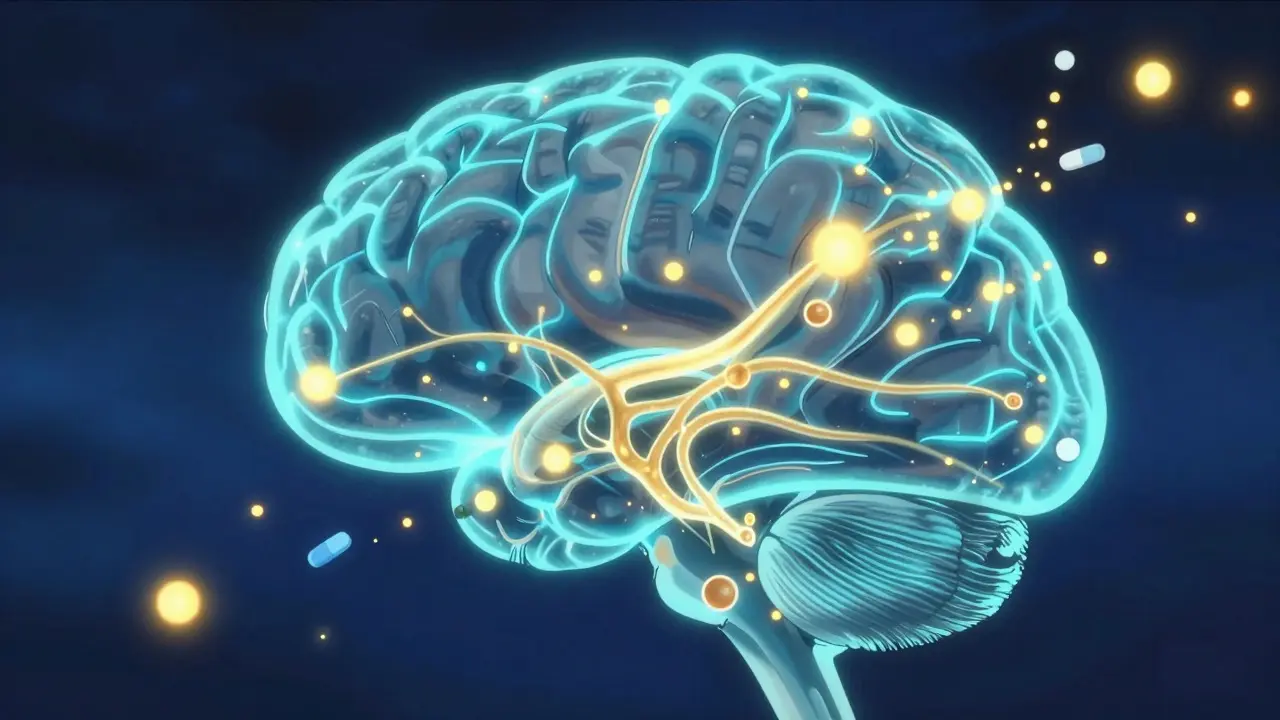
There is no cure for Parkinson’s yet, but medications can dramatically improve quality of life by addressing the root cause: the loss of dopamine-producing neurons in the substantia nigra region of the brain. The goal of treatment is to replace or mimic dopamine to restore smoother movement.
| Medication Type | How It Works | Typical Use Case | Key Consideration |
|---|---|---|---|
| Levodopa (L-DOPA) | Converts into dopamine in the brain | Gold standard for moderate to severe symptoms | Long-term use may lead to motor fluctuations or dyskinesias (involuntary movements) |
| Dopamine Agonists (e.g., Pramipexole, Ropinirole) | Mimics dopamine’s effect on receptors | Often used first in younger patients to delay Levodopa side effects | May cause sleepiness, swelling, or impulse control issues |
| MAO-B Inhibitors | Prevents breakdown of existing dopamine | Early-stage mild symptoms | Generally well-tolerated but less potent than Levodopa |
Levodopa remains the most effective drug, helping 70-80% of patients initially. However, after about five years, up to 50% of users develop complications like "wearing off" periods where the medication stops working before the next dose, or dyskinesias. For this reason, doctors often prescribe dopamine agonists first for younger patients (under 60) to preserve Levodopa’s effectiveness for later stages. When medications no longer provide sufficient control, roughly 30% of patients consider Deep Brain Stimulation (DBS) surgery after a decade of disease progression. DBS involves implanting electrodes in the brain to regulate abnormal signals, offering significant relief for tremors and rigidity.
Navigating Daily Living Challenges
The real test of Parkinson’s management happens outside the clinic. Simple tasks that once took seconds can now take minutes. Studies show that dressing takes 2.3 times longer and buttoning a shirt takes 3.1 times longer for patients compared to age-matched controls. Here’s how to adapt to common daily hurdles:
Mobility and Gait
Walking speed typically drops by 30-40%, and step length decreases by 25-35%. This imbalance leads to falls; about 68% of patients fall at least once a year. To counter this:
- Use visual cues: Place tape strips on the floor to help you remember to take larger steps.
- Engage in targeted exercise: Physical therapy focusing on balance can improve walking speed by 15-20% and reduce fall risk by 30% within 12 weeks.
- Address arm swing: Decreased arm swing affects 75% of patients. Conscious effort to swing arms can improve bilateral coordination and stability.
Sleep and Rest
Turning over in bed becomes a major challenge due to bradykinesia, affecting 65% of patients within five years of diagnosis. Akathisia (an urge to keep moving) disrupts sleep in 15-25% of cases. Creating a safe sleeping environment with padded rails and easy-access clothing can reduce nighttime frustration and injury risk.
Communication and Swallowing
Voice volume often drops by 5-10 decibels, making you hard to hear. Speech therapy techniques like LSVT LOUD can help retrain vocal strength. More critically, swallowing difficulties (dysphagia) affect 35% of early-stage and 80% of advanced-stage patients. This isn’t just inconvenient; aspiration pneumonia from swallowed food particles accounts for 70% of Parkinson’s-related deaths. Eating slowly, sitting upright, and choosing softer foods can mitigate this risk.

Non-Motor Symptoms That Matter
While motor symptoms get the attention, non-motor issues deeply impact quality of life. Sexual dysfunction affects 50-80% of male patients but is rarely discussed. Depression and anxiety are also prevalent, often preceding motor symptoms. Addressing these requires a holistic approach, including counseling and sometimes antidepressants, alongside motor treatments. Ignoring mental health can worsen physical symptoms, creating a vicious cycle of fatigue and immobility.
Proactive Care and Future Outlook
Managing Parkinson’s is a marathon, not a sprint. The Hoehn and Yahr scale describes five stages of progression, from unilateral symptoms (Stage 1) to wheelchair dependence (Stage 5). While no current medication modifies the disease’s underlying progression, research into alpha-synuclein targeting therapies offers hope for the future. For now, the best strategy is proactive adaptation.
Work closely with a multidisciplinary team: neurologists for medication adjustments, physical therapists for mobility, speech therapists for communication, and dietitians for nutritional support. Early intervention is key. Don’t wait until you’re falling frequently to start physical therapy. Don’t ignore swallowing issues until choking becomes a regular occurrence. By understanding the mechanics of your symptoms and leveraging available tools, you can maintain independence and dignity for as long as possible.
What is the most common first symptom of Parkinson’s?
The most common presenting symptom is a resting tremor, often described as a "pill-rolling" motion in the hand. It affects about 70% of patients at diagnosis. However, some people may first notice stiffness (rigidity) or slowness of movement (bradykinesia).
Can Parkinson’s disease be cured?
Currently, there is no cure for Parkinson’s disease. Treatments focus on managing symptoms by replacing dopamine or stimulating brain circuits. Research into disease-modifying therapies, such as alpha-synuclein inhibitors, is ongoing but not yet available for clinical use.
How does Levodopa work, and why do side effects occur?
Levodopa converts into dopamine in the brain, directly addressing the chemical deficit. Side effects like dyskinesias (involuntary movements) or "wearing off" episodes often develop after 5-10 years because the brain’s ability to store and release dopamine smoothly diminishes over time.
What should I do if I’m having trouble swallowing?
Swallowing difficulties (dysphagia) are serious due to the risk of aspiration pneumonia. Consult a speech-language pathologist immediately. In the meantime, eat slowly, sit fully upright, avoid mixing solids and liquids in the same bite, and consider thicker consistencies for drinks if recommended by a professional.
Is Deep Brain Stimulation (DBS) suitable for everyone?
No, DBS is not for everyone. It’s typically considered for patients who have had Parkinson’s for at least 5-10 years, still respond well to Levodopa, but suffer from severe motor fluctuations or tremors that meds can’t control. Cognitive impairment or severe depression may disqualify candidates.
How can exercise help with Parkinson’s symptoms?
Exercise is one of the few interventions shown to potentially slow functional decline. Targeted physical therapy can improve walking speed by 15-20% and reduce fall risk by 30%. High-intensity interval training, boxing classes designed for Parkinson’s, and tai chi are particularly beneficial for balance and coordination.
Why does my handwriting get smaller?
This is called micrographia, caused by bradykinesia (slowness of movement) and reduced amplitude in fine motor skills. As the disease progresses, the brain struggles to initiate and sustain the small, precise movements needed for writing, resulting in letters that shrink progressively across the page.
What is the average age of onset for Parkinson’s?
The average age of onset is 60 years. However, about 4% of cases are diagnosed before age 50, known as young-onset Parkinson’s. Symptoms can occasionally appear even earlier, though this is rare.