
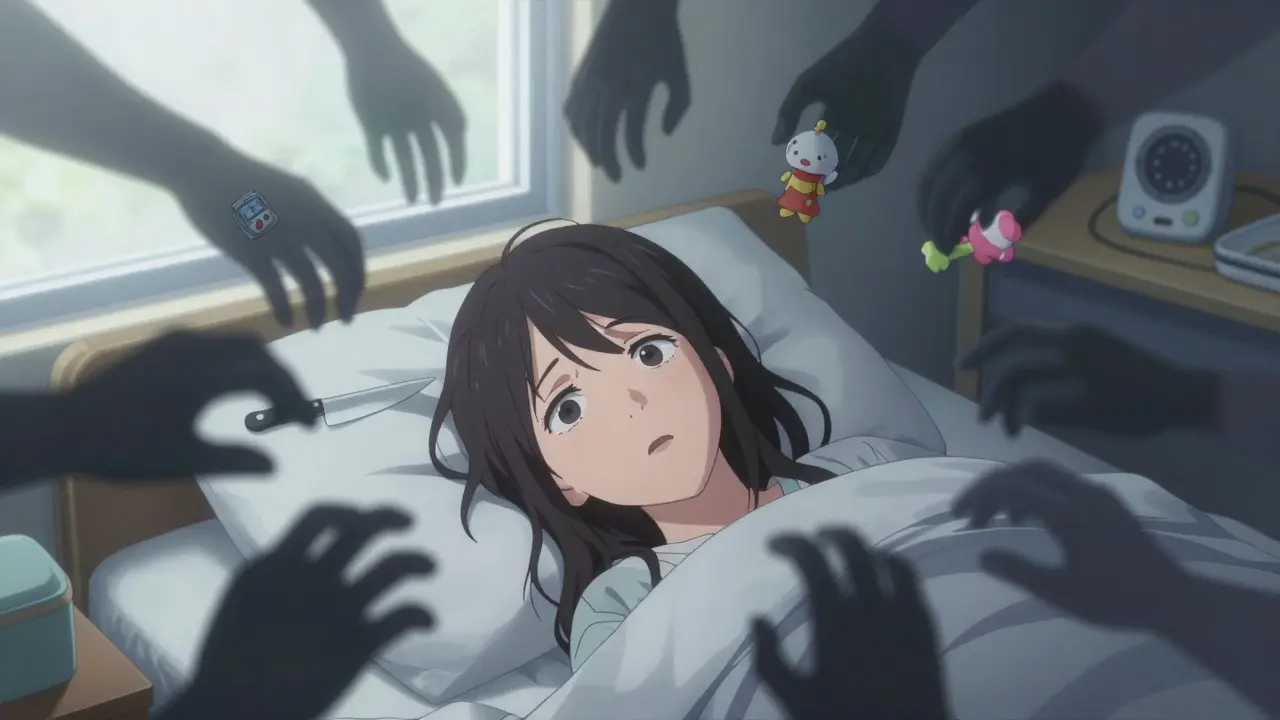
Imagine waking up and immediately fearing you’ve left the stove on-even though you know you turned it off. Or having a vivid image of hurting someone you love, and feeling like you’re a monster for even thinking it. These aren’t just random bad thoughts. For people with obsessive-compulsive disorder (OCD), they’re relentless, terrifying, and impossible to shake. And here’s the twist: having these thoughts doesn’t mean you’ll act on them. In fact, the people who experience them the most are often the ones who care the most about doing the right thing.
What Exactly Are Intrusive Thoughts in OCD?
Intrusive thoughts are sudden, unwanted ideas, images, or urges that pop into your mind. Everyone gets them. Maybe you’ve had a fleeting thought about yelling at your boss, or wondered what would happen if you jumped in front of a train. Most people brush them off. But for someone with OCD, these thoughts stick. They feel dangerous. Immoral. Proof that something’s wrong with them. The brain doesn’t distinguish between imagining something and actually doing it. So when a person with OCD thinks, “What if I pushed my child in front of a car?”, their brain treats it like a real threat. That triggers panic. And panic leads to compulsions-mental or physical acts meant to undo the thought. Maybe they mentally repeat a prayer. Maybe they check the baby monitor 20 times. Maybe they avoid holding their child altogether. These thoughts fall into common themes:- Contamination (25% of cases): Fear of germs, chemicals, or dirt. Handwashing until skin bleeds.
- Harm (20-25%): Fear of hurting yourself or others-intentionally or by accident. Often the most misunderstood.
- Symmetry and order (15-20%): Needing things arranged perfectly. Counting steps, aligning objects, redoing tasks until they feel “just right.”
- Taboo thoughts (10-15%): Sexual, religious, or identity-related obsessions. Someone might fear they’re secretly gay, or that they’ve blasphemed, even if they deeply believe otherwise.
Why ERP Therapy Is the Gold Standard
For decades, people with OCD were told to talk through their fears. To understand them. To reason their way out. That doesn’t work. In fact, it often makes things worse. The real solution? Exposure and Response Prevention (ERP). ERP isn’t about facing your fears once and feeling better. It’s about rewiring your brain-slowly, deliberately, and with support. Developed in the 1960s by Dr. Victor Meyer and refined by Dr. Edna Foa in the 1980s, ERP is the only treatment backed by decades of research to consistently reduce OCD symptoms. Here’s how it works:- Exposure: You’re guided to face the thing you fear-without doing your usual compulsion. If you’re afraid of germs, you touch a doorknob. If you fear harming someone, you hold a kitchen knife. If you’re scared your thoughts mean you’re gay, you read a gay dating app homepage.
- Response Prevention: You don’t wash your hands. You don’t check the stove. You don’t mentally pray. You sit with the anxiety.
What ERP Looks Like in Real Life
One patient, a 28-year-old teacher, had a fear that she’d accidentally poison her students. She’d spend hours checking the lunchroom fridge, re-reading food labels, and avoiding cooking classes. Her ERP plan started small: she touched a lunch tray (anxiety level 30/100), sat with it for 10 minutes without checking, then moved to touching a used napkin (70/100). After six weeks, she ate a meal in the school cafeteria without checking the food. After four months, she was back to teaching without panic. Another man, a father of two, feared he was a pedophile because he had fleeting thoughts about children. He avoided parks, family gatherings, even his own kids. His ERP involved watching a video of kids playing, then sitting quietly with the discomfort. No mental reassurance. No Googling “am I a pedophile.” He did this daily for three months. The thoughts didn’t disappear-but the fear around them did. ERP doesn’t erase thoughts. It changes your relationship to them.
Why Other Treatments Often Fail
Many people try medication first. SSRIs like fluoxetine or sertraline help about half of OCD patients-but side effects like nausea, weight gain, or emotional numbness lead 30% to quit. And without ERP, symptoms usually bounce back when the pills stop. Traditional talk therapy? It can backfire. Talking about the thought over and over reinforces it. “Why did I think that?” “What does it mean?” “Is this normal?” These questions feed the cycle. Mindfulness helps some people manage stress, but it’s not a cure. It doesn’t teach you to stop compulsions. ERP does. And here’s the hard truth: only 10% of therapists in the U.S. are trained in ERP. Most general counselors don’t know how to do it right. That’s why so many people suffer for years-sometimes decades-before getting the right help.The Rise of Digital Tools and New Hope
In 2023, the FDA approved the first digital therapeutic for OCD: the nOCD app. It guides users through ERP exercises with built-in tracking, reminders, and therapist support. A 2022 study in JAMA Psychiatry found it reduced symptoms by 55% in mild cases. Telehealth has also opened doors. In 2025, 45% of OCD patients receive ERP remotely-up from just 5% before the pandemic. Still, only 60% of insurance plans cover it equally to in-person visits. New research is even more promising. Stanford University used AI to analyze brain scans and predict who would respond best to ERP-with 78% accuracy. The FDA has also approved transcranial magnetic stimulation (TMS) for treatment-resistant OCD, with a 2023 New England Journal of Medicine study showing 45% of patients improved. And for the first time, the DSM-5-TR (2022) officially recognizes “Pure O”-OCD with no visible compulsions, just mental rituals. That means more people are finally being diagnosed correctly.
What Keeps People From Getting Help
Stigma is the biggest barrier. Sixty percent of people with OCD fear telling their employer. One in three wait over 10 years for a correct diagnosis. Many believe they’re just “too anxious” or “overly perfectionist.” Others think they’re going crazy. But here’s what no one tells you: you’re not broken. Your brain is just wired differently. You’re not dangerous. You’re not evil. You’re not alone. The International OCD Foundation reports that 85% of people who join support groups say they finally feel understood. That’s powerful. Because healing doesn’t just happen in therapy rooms. It happens when you say out loud, “I have these thoughts too.”Where to Start If You Think You Have OCD
If you’re reading this and thinking, “That’s me,” here’s what to do next:- Don’t self-diagnose. Talk to a doctor or mental health provider who knows OCD.
- Ask if they use ERP. If they say “I do CBT,” ask, “Do you specialize in exposure and response prevention for OCD?”
- Use trusted resources. The International OCD Foundation (IOCDF) and the OCD Center of Los Angeles offer free screening tools and provider directories.
- Start small. Even writing down your thoughts without judging them is a step.
- Be patient. ERP takes weeks to show results. Don’t quit when it’s hardest.





Marilyn Ferrera
January 1, 2026 AT 00:44Everyone gets intrusive thoughts-but OCD isn’t just ‘being picky.’ It’s your brain hijacking your morality and turning it into a torture device. ERP isn’t ‘facing fears’-it’s retraining your amygdala to stop screaming fire when there’s smoke.
Martin Viau
January 1, 2026 AT 19:26ERP? Sounds like a cult. My cousin tried that and ended up in a psych ward because they made him hold a knife while watching baby videos. Who the hell designs this stuff? I’d rather take pills and numb it out.
Harriet Hollingsworth
January 2, 2026 AT 02:28You say ‘you’re not broken’-but you’re wrong. You’re not broken-you’re sick. And sick people need treatment, not pep talks. This post is dangerously romanticizing a neurological disorder as if it’s a quirky personality trait. Stop saying ‘you’re not evil.’ You’re not evil because you’re not responsible for your brain’s malfunction. That’s the point.
Deepika D
January 2, 2026 AT 17:58Let me tell you something-I’ve been doing ERP for 18 months now, and I still have thoughts about accidentally running over my dog. But here’s the thing: I don’t flinch anymore. I don’t check the driveway. I don’t replay the moment. I just… breathe. And it’s not magic. It’s muscle memory. Your brain is like a muscle-it forgets fear if you stop feeding it. I used to cry in the shower every night. Now I laugh at my own thoughts. That’s not healing-that’s freedom. And yes, it’s brutal. But you’re worth the pain. You’re worth the 3 a.m. panic attacks. You’re worth the 1000th time you sit with the anxiety and don’t run. I’m still here. So are you.
Bennett Ryynanen
January 3, 2026 AT 16:35Bro. I had Pure O for 7 years. Thought I was a murderer because I imagined stabbing my roommate. I Googled ‘am I a psychopath?’ 300 times. Then I found ERP. First week? I cried for 4 hours holding a butter knife. Felt like I was gonna die. Now? I cook dinner. Every night. Without checking the knife. I’m not ‘fixed.’ But I’m not a prisoner anymore. If you’re reading this and scared? You’re not alone. Just start small. Touch the doorknob. Don’t wash. Breathe. I’m rooting for you.
Chandreson Chandreas
January 5, 2026 AT 05:06ERP is like doing push-ups for your brain 😊
It hurts at first, but you get stronger.
And yeah, the thoughts don’t vanish.
But the fear? That fades.
One day you’ll realize you didn’t check the stove… and you didn’t care.
That’s the win.
Stay patient. Stay kind to yourself. You got this 💪❤️
Darren Pearson
January 7, 2026 AT 03:48The assertion that ERP is the 'gold standard' is empirically unsubstantiated in the broader context of neuropsychological interventions. While peer-reviewed literature supports its efficacy in controlled trials, real-world applicability is confounded by therapist fidelity, patient compliance, and comorbid conditions. Moreover, the overreliance on behavioral paradigms neglects the neurochemical underpinnings of OCD, which are demonstrably modulated by serotonergic agents. One must question the hegemony of ERP when pharmacological adjuncts yield comparable remission rates in longitudinal studies.
Stewart Smith
January 7, 2026 AT 05:09Wow. So we’re just supposed to sit there and let our brains scream at us? Cool. I’ll just sit on a beach and think about my worst fears while sipping a piña colada. 🤡
Meanwhile, the guy who actually did ERP? He’s probably out there living his life. And I’m still here, Googling ‘how to stop thinking about death’ at 2 a.m. Again.
Aaron Bales
January 7, 2026 AT 14:57ERP isn’t for everyone. But if you’ve tried everything else and you’re still trapped? It’s the only thing that actually rewires the loop. No fluff. No platitudes. Just exposure. No reassurance. Just sitting. It’s hard. But it’s the only thing that works. And if you’re reading this-you already know that.
Brandon Boyd
January 7, 2026 AT 19:52My therapist told me to hold a razor while thinking about cutting myself. I did it for 10 minutes. I didn’t die. I didn’t lose control. I just… sat there. And the fear? It didn’t vanish. But it got quieter. Now I hold razors to shave. And I don’t cry after. That’s not courage. That’s just practice. You don’t have to be brave. You just have to show up. Even if you’re shaking.
Branden Temew
January 9, 2026 AT 16:31So… we’re supposed to believe that thoughts are just thoughts? Like, if I think about murdering my boss, that’s just my brain being weird? What if I *do* it? Then what? Is that just ‘bad wiring’ too? Or are we pretending OCD is just a glitch and not a warning? I get ERP works. But it feels like telling a drowning person to ‘just stop swimming.’