
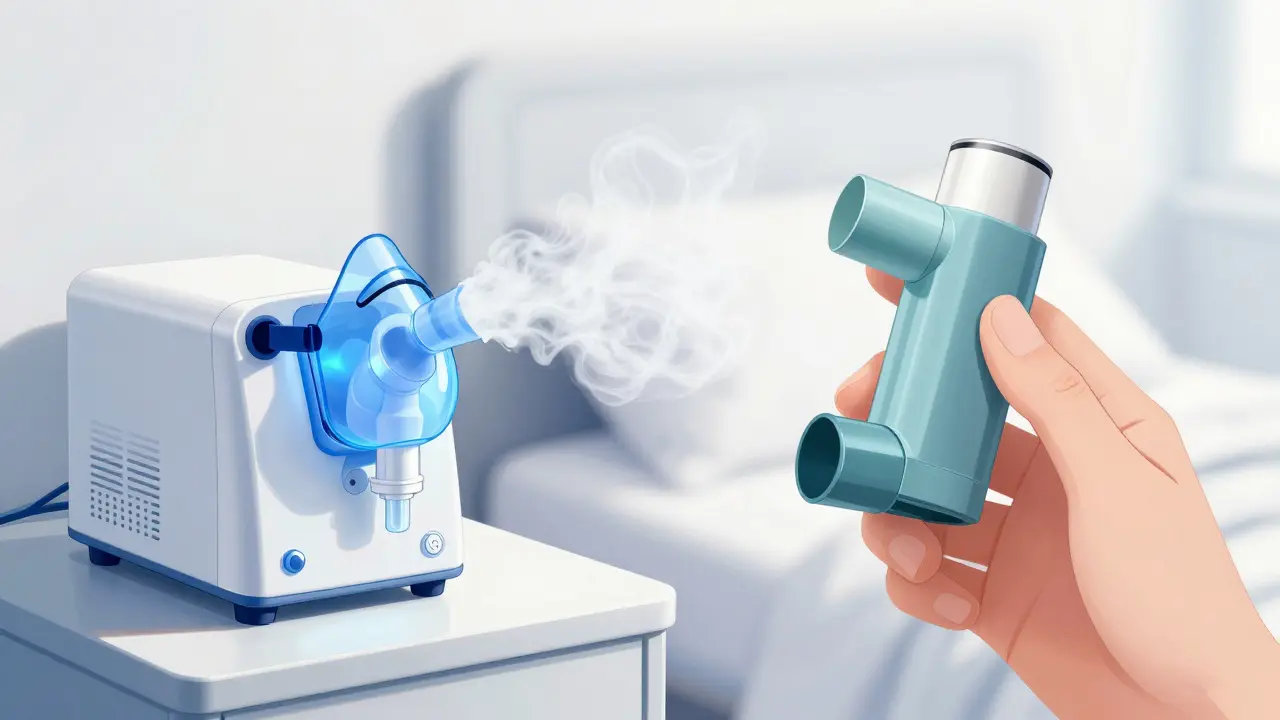
When you're struggling to catch your breath during an asthma attack or managing chronic COPD, the way you get medicine into your lungs matters just as much as the medicine itself. You've probably seen both: the handheld, pocket-sized puffers and the larger, humming machines that create a mist. Many people assume that the big machine is "stronger" or more effective because it feels more intense, but the clinical reality is often different from the perception.
Choosing between these two isn't about which one is objectively "better" in a vacuum, but which one fits your age, your ability to coordinate your breathing, and where you actually need to use it. While both aim to deliver medication to the deep tissues of the lungs, they do it through entirely different mechanical processes.
Quick Look: Nebulizers vs. Inhalers
If you need a fast answer, here is the baseline: Nebulizers are essentially medication pumps that turn liquid into a mist, requiring zero coordination from the patient. Metered-Dose Inhalers (or MDIs) deliver a pre-measured spray of medicine that requires a specific inhalation technique to work correctly.
| Feature | Nebulizer | MDI with Spacer |
|---|---|---|
| Treatment Time | 5-15 minutes | 2-5 minutes |
| Portability | Low (Requires power/bulk) | High (Pocket-sized) |
| User Coordination | None required | Low (with spacer) |
| Typical Cost | $100-$200 | $30-$50 |
| Lung Deposition | Moderate to High | 70-80% (with spacer) |
How Nebulizers Work: The Mist Method
A Nebulizer is a device that uses an air compressor to force liquid medication through a small nozzle, creating an aerosol mist. You breathe this mist in slowly through a mouthpiece or a face mask. Because the process is slow, it's ideal for people who can't take a deep, fast breath on command.
These devices are a lifesaver for infants, toddlers under 5, and elderly patients with cognitive impairments. Since the medication is delivered continuously over several minutes, the patient doesn't need to "time" their breath with a button press. However, they aren't perfect. Conventional jet nebulizers can be inefficient, with up to 70% of the medication wasted as you breathe out. Newer breath-assisted models are better, reducing that waste to about 30-40% by using one-way valves.
One major downside is the maintenance. If you don't clean the nebulizer cup and mouthpiece daily with soapy water and disinfect them weekly (a 1:3 vinegar solution is common), you risk growing mold. Inhaling mold spores can lead to serious lung infections, especially for those with weakened immune systems.
The Science of Inhalers: Precision and Speed
The most common type of inhaler is the Metered-Dose Inhaler. This device uses a propellant-specifically Hydrofluoroalkane (HFA)-to push a precise dose of medicine out in a quick burst. The goal is to get the medicine past the throat and deep into the bronchioles.
Here is the catch: using an MDI alone is surprisingly difficult. The American Thoracic Society notes that 70-80% of adults struggle with the coordination required to press the canister and inhale at the exact same moment. When you miss the timing, most of the medicine hits the back of your throat instead of your lungs, which can lead to side effects like oral thrush (candidiasis) if you're using corticosteroids.
This is why a Spacer is a game-changer. A spacer is a holding chamber that catches the spray. Instead of a single high-velocity blast, the medicine floats in the chamber, allowing you to breathe it in slowly. When you add a spacer, the success rate for correct technique jumps to 90-95%, and lung deposition efficiency climbs to 70-80%.

The Perception Gap: What Patients Feel vs. What Data Shows
There is a strange phenomenon in respiratory care: patients often feel that nebulizers are more effective than inhalers, even when the clinical data says otherwise. A study published in PubMed involving patients and healthcare providers found that over 60% of patients perceived nebulizers as more powerful. Why? Because you can see the mist and feel the air flowing. It feels like more is happening.
However, the numbers tell a different story. Research from the American Academy of Family Physicians showed that patients using MDIs with spacers actually saw a greater increase in peak-flow rates (180 L/min vs 145 L/min for nebulizers). They also spent significantly less time in the emergency room and had lower relapse rates at 14 and 21 days. Even though nebulizers deliver more total medication, the lungs can only absorb so much; the extra drug often just ends up as waste.
Which One Should You Choose?
The decision usually comes down to three factors: age, coordination, and environment.
- For Infants and Young Children: Nebulizers are often the gold standard because they require zero effort from the child. That said, MDIs with spacers and masks are also highly effective and much faster.
- For Acute Emergencies: In a severe crisis where a patient is struggling for every breath, a nebulizer allows for the delivery of high doses of medication without requiring the patient to perform a complex task.
- For Daily Management: MDIs with spacers win on almost every front. They are portable, cost significantly less, and finish in a fraction of the time. Imagine the difference between a 2-minute treatment you can do in your car versus a 15-minute session tethered to a wall outlet.
If you're an adult who can use a spacer, the Global Initiative for Asthma (GINA) suggests that MDIs with spacers should be your first choice due to the lower risk of infection and the sheer speed of administration.

Common Pitfalls and Pro Tips
Regardless of the device, a few common mistakes can ruin the treatment. If you use an MDI, always prime it before the first use with 4-6 test sprays to ensure the dose is accurate. If you use a nebulizer, never skip the disinfection cycle; a moldy machine is worse than no machine.
For those looking for a middle ground, Dry Powder Inhalers (DPIs) are another option. They don't use propellants and instead rely on a strong, quick inhalation to pull the powder into the lungs. These are great for people who hate the taste of propellant but require a bit more lung strength than an MDI with a spacer.
Are nebulizers more powerful than inhalers?
Not necessarily. While nebulizers deliver a larger volume of medication over a longer period, clinical studies show that MDIs with spacers provide equivalent or even superior improvements in lung function (peak-flow rates) for most patients. The perception of "power" comes from the visible mist, not necessarily better clinical outcomes.
Can a child use an inhaler instead of a nebulizer?
Yes, provided they use a spacer and a mask. Children under 5 often struggle with the coordination of a standard inhaler, but a spacer allows them to breathe the medication in naturally. Many pediatricians recommend this as a faster, more portable alternative to nebulizers.
Why is a spacer so important for MDIs?
Without a spacer, a large percentage of the medication hits the back of the throat and is swallowed rather than inhaled. Spacers slow down the particles and hold them in a chamber, increasing lung deposition from about 10-20% up to 70-80%, and reducing the risk of side effects like oral thrush.
How often should I clean my nebulizer?
The mouthpiece and nebulizer cup should be washed with warm, soapy water after every single use. Once a week, you should perform a deep disinfection using a 1:3 vinegar solution or another approved disinfectant to prevent the growth of mold and bacteria.
Which method has a lower risk of infection?
MDIs with spacers generally have a lower risk of infection. Nebulizers require more manual cleaning and use liquid reservoirs that can become breeding grounds for bacteria or mold if not maintained perfectly, whereas inhalers are self-contained and sterile.
Next Steps for Better Breathing
If you're unsure which device is best for your specific condition, start by tracking your current usage. Are you struggling to coordinate your breath? Are you finding it hard to carry your machine to work or school? Note these hurdles and bring them up with your doctor.
For those already using an MDI, your next goal should be ensuring you have a high-quality spacer and that your technique is correct. A simple check-up with a respiratory therapist can often identify a timing error that, once fixed, makes your medication significantly more effective.






Ben hogan
April 11, 2026 AT 02:26The sheer banality of comparing mechanical delivery systems is almost offensive, but I suppose some people need their hand held through the basic physics of aerosolization. It's a quaint exercise in mediocrity, really.
Doug DeMarco
April 11, 2026 AT 23:43Totally agree with the bit about spacers! They are a total game changer for anyone who struggles with the timing. Just get one and you're golden! 😊✨
Chad Miller
April 13, 2026 AT 17:07honestly why do peopl even use nebulizers anymore its just wastefull and lazzy tbh plus the cleaning part is a joke no one does it right lol
Julie Bella
April 14, 2026 AT 21:32OMG u guys!! Cleaning your gear is NOT a joke, it's a MORAL OBLIGATION to not breathe in mold!! 😱 If u don't clean it ur basically asking for a lung infection and its just plain irresponsable!! 😡
Simon Stockdale
April 16, 2026 AT 18:05I dont care what some fancy study says cause when I was in the ER they gave me a nebulizer for a reason and its way more powerful than some tiny plastic puffer made in a factory somewhere far away from here and we need to start making these things in America again if we want them to actually work for the hard working people of this country who dont have time to mess around with spacers and timers!!
Franklin Anthony
April 18, 2026 AT 07:11the propellants in these things are probably just another way for them to keep us dependent on the pharma system and maybe just a little bit of mind control in the mist lol but hey stay safe everyone
Victor Parker
April 19, 2026 AT 16:38Exactly!! They don't want you to know the truth about what's really in those canisters 🙄 Trust me, the industry is rigged against us 😷
emmanuel okafor
April 21, 2026 AT 11:37we all just want to breathe and it is good to know there are many ways to find peace in the lungs
Suchita Jain
April 23, 2026 AT 11:10It is quite regrettable that some individuals exhibit such a lack of discipline regarding their hygiene. One must adhere to the strictest cleaning protocols to maintain one's health, as negligence is simply unacceptable in a civilized society.
Camille Sebello
April 24, 2026 AT 22:21So rude!! Stop judging people's habits... though the vinegar tip is actually solid!!!
Sarina Montano
April 26, 2026 AT 07:47The chemical dance between the propellant and the drug is honestly a marvel of pharmacology, but the sheer physics of the spacer-essentially creating a stagnant cloud for the lungs to vacuum up-is where the real magic happens. It transforms a clumsy, high-velocity jet into a gentle, absorbable mist that actually reaches the distal airways instead of just coating the oropharynx in a sticky residue. Most people don't realize that the 'throat hit' they feel is actually a failure of delivery, not a sign of potency. If you've ever felt that bitter taste in the back of your throat, you've essentially just wasted a dose of medication on your tongue. Switching to a spacer isn't just a 'tip,' it's a fundamental shift in how the drug interacts with your anatomy. It's the difference between throwing a bucket of water at a wall and using a spray bottle to water a plant. One is chaotic and wasteful; the other is precise and effective. Even for those who think they have the coordination, the variance in timing is often too high for consistent delivery. When you look at the peak-flow data, it's clear that efficiency beats intensity every single time. It's all about the surface area and the residence time of the particles in the lungs. If the particles are too large or moving too fast, they just bounce off the walls of the airway. The spacer optimizes the particle size for maximum penetration. This is why the clinical outcomes are so much better despite the 'feeling' of a nebulizer being stronger. It's a classic case of sensory perception betraying clinical reality.
Thabo Leshoro
April 27, 2026 AT 12:30The deposition rates... are very interesting!!! Using a spacer helps the meds hit the target!!!