

Using a pill organizer seems simple-pop your pills into compartments labeled Morning, Afternoon, Night, and you’re done. But for thousands of people each year, this routine turns dangerous. In the U.S. alone, medication errors cause over 7,000 deaths annually, and nearly a quarter of those happen because of improper pill organizer use. The problem isn’t the device-it’s how it’s used. A pill organizer can save your life… or end it. Here’s how to use one safely, without accidentally overdosing.
Understand What a Pill Organizer Can and Can’t Do
Pill organizers are designed for solid oral medications: tablets, capsules, and some chewables. They’re not for everything. Liquid medicines, insulin, nitroglycerin, or anything that needs refrigeration should never go in one. Moisture, heat, and light can ruin them. Storing these in a bathroom organizer? That’s a recipe for weakened pills or failed doses. Kaiser Permanente warns that humidity from showers can degrade medications up to 47% faster. Keep your organizer in a cool, dry place-like a bedroom drawer, not the bathroom cabinet.Also, don’t put as needed (PRN) meds like painkillers, anxiety pills, or sleep aids into your daily compartments. This is one of the most common causes of overdose. People forget which doses are scheduled and which are optional. If you take your regular morning pill and then grab what looks like the same pill for pain later, you could double-dose. Memorial Sloan Kettering Cancer Center found that 38% of accidental overdoses from organizers come from mixing PRN meds with scheduled ones. Keep those in their original bottles, right next to your organizer.
Choose the Right Organizer for Your Meds
Not all pill boxes are created equal. A basic 7-day, once-a-day organizer costs under $5 and works fine if you take one pill per time slot. But if you’re on four meds in the morning, two at lunch, and three at night? You need a 7-day, 4-compartment box. Look for clear labeling-some even have Braille or large print for low vision. Avoid cheap plastic ones with flimsy lids; they can pop open and spill pills.Electronic organizers with alarms cost $25-$100, and they’re worth it if you often forget doses. Some models now track when you open a compartment and send alerts to caregivers if you miss a dose. Hero Health’s latest version even flags multiple openings within four hours-a red flag for accidental double-dosing. Medicare now covers these for people with four or more chronic conditions, so check if you qualify.
Child-resistant features matter too. If you have kids or grandchildren visiting, make sure your organizer meets ASTM F3130-15 standards. A 2023 Amazon review analysis showed 17% of 1-star ratings cited accidental double-dosing because labels were unclear or lids were too easy to open. Safety isn’t optional.
Fill It Correctly-One Med at a Time
This is where most people mess up. Don’t dump all your pills into a pile and start filling. That’s how you mix up similar-looking tablets. The correct method is simple but takes discipline:- Wash your hands with soap for at least 20 seconds. Clean hands prevent contamination.
- Gather all your medication bottles and your current written list from your doctor or pharmacist. Never rely on memory.
- Place your organizer on a clean, flat surface. Keep the original bottles open and nearby.
- Take ONE medication at a time. Open its bottle, read the label again, count out the correct dose for ONE day, and place it in the right compartment.
- Repeat for each medication. Don’t rush. The NHCHC Health Management Toolkit recommends at least 15 minutes for filling a weekly organizer-and 5 extra minutes for every medication after the first five.
- After filling each compartment, visually check: Is this the right pill? Is this the right day and time?
Dr. Jane Smith, Chief Pharmacist at Memorial Sloan Kettering, says this method cuts double-dosing errors by 63%. Why? Because your brain focuses on one thing at a time. Switching between meds increases confusion. One pill at a time isn’t just a tip-it’s a rule.
Never Skip the Verification Step
Filling the organizer isn’t the end. You must verify before you take each dose. That means looking at the pill in your hand and matching it to your written list, the bottle label, and the compartment label. Thirty-one percent of overdoses happen because people skip this step. They assume they filled it right. They don’t check.Set phone alarms for each dose time. WebMD found this reduces verification errors by 44%. But alarms aren’t enough. When the alarm goes off, pause. Don’t grab the first pill you see. Look at the compartment. Read the label on the bottle beside it. Confirm the name, dose, and time. If it doesn’t match, stop. Don’t guess.
Keep a simple log: Write down the date and time you filled your organizer. Note any changes-like a new prescription or a dose adjustment. A 2023 Reddit thread from r/MedicationAdherence showed 49 overdose cases came from people filling organizers with outdated labels. If your doctor changed your blood pressure med from 10mg to 5mg last week, but you filled your box with the old 10mg pills? That’s a dangerous mistake.
Store It Right-And Keep the Original Bottles
Never throw away your original medication bottles. They’re your backup. If you’re unsure what’s in a compartment, the bottle has the exact name, dose, and manufacturer. Most errors happen when people lose the bottles and rely only on the organizer. Hero Health’s 2023 survey found 68% of medication errors occurred because users didn’t have the original bottles handy.Store your organizer away from direct sunlight, heat, and moisture. Don’t leave it on the kitchen counter near the stove. Don’t put it in the car during summer. Most pills degrade above 86°F (30°C). If you’re traveling, carry your organizer in your bag-not checked luggage. And always bring your original bottles with you. If you’re hospitalized or see a new doctor, they need to see what you’re actually taking.
Update It When Your Meds Change
Your pills don’t stay the same forever. Doctors change doses, add new meds, or stop old ones. Every time your prescription changes, update your organizer immediately. Don’t wait until your next refill. If you’re prescribed a new antibiotic for a week, don’t just toss it into a compartment without adjusting your schedule. That’s how people accidentally take two antibiotics at once-or miss a critical dose.Set a weekly reminder: Every Sunday morning, sit down with your bottles and your list. Check for changes. If your doctor added a new med, you need to refill the organizer. If you stopped one, remove it completely. Even if you’re only taking it for five days, don’t leave empty compartments-mark them with tape or a sticker. Ambiguity kills.

Watch Out for Look-Alike Pills
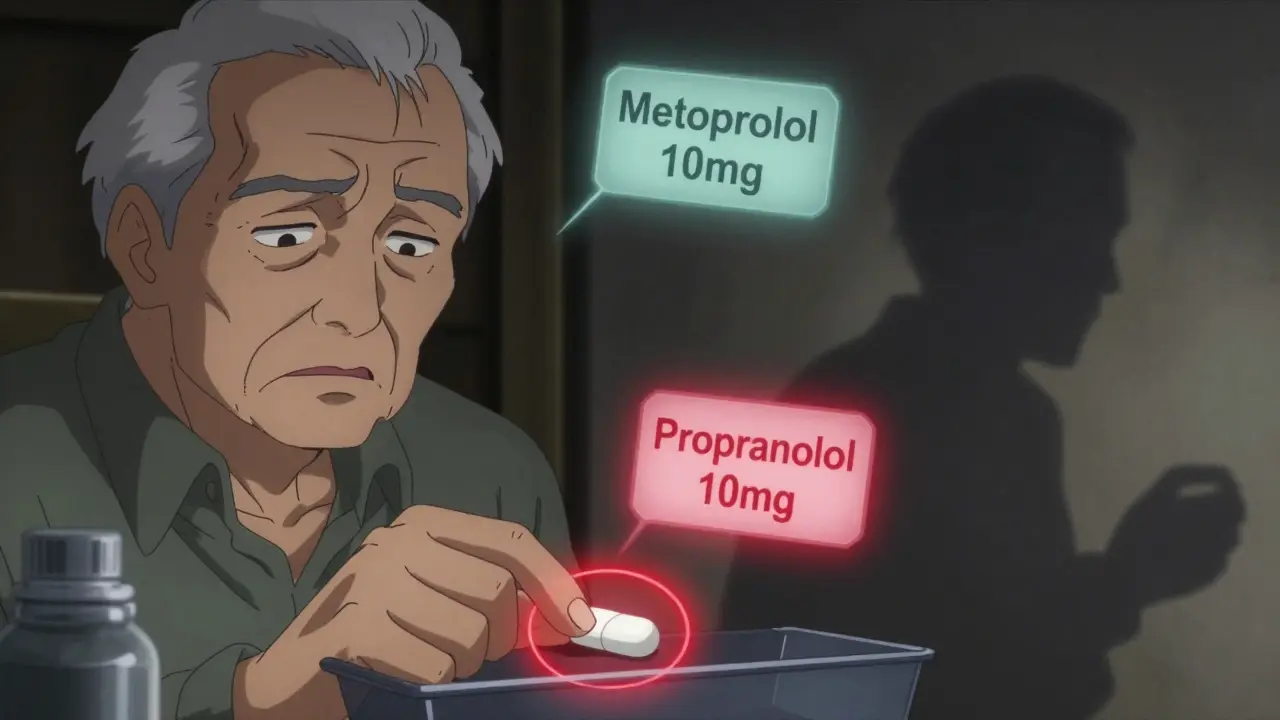
Some pills look almost identical. Metoprolol and propranolol. Clonazepam and lorazepam. One letter, one number, one color difference-and they do completely different things. Sixty-three percent of users in NHCHC’s 2025 survey struggled with this. The fix? Use color-coded pill splitters or separate organizers for look-alike meds. Some pharmacies now offer pre-filled organizers with color-coded compartments. Ask your pharmacist. They can help you avoid confusion before it happens.When to Skip the Organizer Entirely
Not everyone needs one. If you take only one or two meds a day, a simple pillbox might be overkill. If you’re on complex regimens with many PRN meds, refrigerated drugs, or injectables, an organizer can create more risk than help. Some people do better with pharmacy blister packs-those sealed, date-stamped strips your pharmacist prepares. They’re tamper-proof and hard to misread. But they’re inflexible. If your meds change often, an organizer gives you more control.Bottom line: If you’re unsure, talk to your pharmacist. In the U.S., 68% of pharmacies now offer free filling services with pharmacist verification. That’s a 52% drop in errors compared to self-filling. Take advantage of it. You’re not being lazy-you’re being smart.
What Happens When You Get It Right
When done properly, pill organizers are one of the most effective tools for medication safety. Memorial Sloan Kettering found patients who used them correctly had 32% fewer missed doses and 18% less accidental double-dosing. A caregiver on YouTube shared that after following the one-med-at-a-time method, her mother’s hospital visits dropped from four a year to just one. That’s not luck. That’s protocol.The goal isn’t just to remember your pills. It’s to take the right pill, at the right time, in the right dose-every time. That’s how you stay safe. That’s how you avoid overdose. That’s how you take control.
Can I put all my pills in one organizer?
No-not all of them. Only solid oral pills that don’t need special storage. Never put liquids, refrigerated drugs, or as-needed (PRN) medications like painkillers or sleep aids into your organizer. These should stay in their original bottles. Mixing them increases overdose risk.
Is it safe to store a pill organizer in the bathroom?
No. Bathrooms are too humid. Steam from showers can damage pills, making them less effective or even unsafe. Store your organizer in a cool, dry place like a bedroom drawer or kitchen cabinet away from the sink or stove. Kaiser Permanente and Hero Health both warn against bathroom storage.
How often should I refill my pill organizer?
Most people refill weekly-ideally on the same day each week, like Sunday morning. This builds a routine. If you take meds daily, refill once a week. If you’re on a monthly schedule, refill monthly. Always check your prescription list first. Never refill using old bottles without verifying current doses.
What should I do if I accidentally take a double dose?
Call your pharmacist or doctor immediately. Don’t wait for symptoms. Some medications are safe in small overdoses; others aren’t. Keep your medication list handy so you can tell them exactly what you took and when. If you feel dizzy, nauseous, or confused, seek emergency care. Prevention is better than reaction-always verify before taking a pill.
Can children accidentally open a pill organizer?
Yes-if it’s not child-resistant. Look for organizers that meet ASTM F3130-15 standards. These require a specific push-and-turn mechanism that’s hard for small hands to open. If you have kids or visitors with children, always lock your organizer or keep it out of reach. Over 100 overdose cases in 2023 were linked to kids accessing non-childproof organizers.
Do I need an electronic pill organizer?
Not necessarily-but they help if you forget doses or live alone. Electronic ones with alarms and usage tracking reduce missed doses by up to 40%. Medicare covers them for people with four or more chronic conditions. If you’re on more than five meds a day or have memory issues, they’re a smart investment.
Can I use a pill organizer if I’m on blood thinners?
Yes-but with extra care. Blood thinners like warfarin require precise dosing. Never mix them with PRN meds like ibuprofen. Always verify the dose against your written list and bottle label. Talk to your pharmacist about using a color-coded system or separate organizer for your anticoagulant. Small mistakes here can be life-threatening.
If you’re managing multiple medications, don’t guess. Don’t rush. Don’t assume. Use your pill organizer like a tool-not a shortcut. Follow the steps, verify every time, and keep your original bottles. That’s how you stay safe. That’s how you avoid overdose.






Darryl Perry
January 13, 2026 AT 04:04Stop pretending this is a solution. Pill organizers are a crutch for people who can't manage their own meds. If you're taking more than five pills a day, you need a pharmacist, not a plastic box.
Windie Wilson
January 13, 2026 AT 05:25So let me get this straight - you want me to spend 15 minutes every Sunday playing pharmacist… while my cat knocks over the organizer and my toddler eats the lithium pills? 🙃
Daniel Pate
January 14, 2026 AT 18:32The real issue isn't the organizer - it's the assumption that medication adherence is a mechanical problem. We treat pills like laundry: sort, fold, put away. But biology isn't tidy. The body doesn't care if your compartment says 'Morning' - it cares about absorption, half-life, and metabolic pathways. We've outsourced cognition to plastic trays and called it safety.
When did we stop trusting the patient and start trusting the container?
And why are we surprised that people double-dose when the system itself is designed for cognitive overload? The organizer doesn't reduce risk - it redistributes it. From memory to mislabeling, from pharmacy to pantry.
True safety isn't in the box. It's in the conversation with your pharmacist. In the written list. In the refusal to automate care.
But we like boxes. Boxes are neat. Boxes don't talk back. And that's the problem.
Amanda Eichstaedt
January 15, 2026 AT 21:33I used to hate these things - until my grandma started forgetting her blood pressure meds. Now she uses a Hero Health organizer with alarms and it's changed everything. She still checks the bottle every time - even with the alarm. That’s the real secret: tech helps, but verification is the muscle you gotta build.
Also, never store it near the coffee maker. Heat ruins everything. Learned that the hard way when my dad’s thyroid pills turned to dust.
Alex Fortwengler
January 16, 2026 AT 13:18They’re tracking your pill openings now? That’s not safety - that’s surveillance. Next they’ll implant chips in your pills and the government will know when you skip your antidepressants. You think this is about health? It’s about control.
And don’t get me started on Medicare covering these. They’re just pushing the cost onto seniors so Big Pharma doesn’t have to lower prices. This isn’t care - it’s a scam wrapped in a plastic box.
gary ysturiz
January 17, 2026 AT 16:22Simple steps make a huge difference. One pill at a time. Check the label. Keep the bottle. That’s it. No fancy tech needed. Just slow down and pay attention.
My mom did this for 10 years - never had a mistake. She’s 84 and still lives alone. It’s not magic. It’s discipline.
Jessica Bnouzalim
January 18, 2026 AT 10:08PLEASE PLEASE PLEASE - if you’re filling your organizer, DO NOT do it while watching TV or scrolling TikTok! I did that once and put two different blood pressure pills in the same slot… for a week. My husband found it. I cried. I’m alive. But I almost wasn’t.
Wash your hands. Use a clean counter. Read each label TWICE. And keep the bottles. Always. I keep mine in a shoebox next to the organizer. It’s ugly, but it saves lives.
laura manning
January 19, 2026 AT 00:46While the procedural recommendations are technically sound, the underlying assumption - that individuals are capable of executing multi-step medication protocols without systemic support - is empirically flawed. The burden of adherence is disproportionately placed on cognitively vulnerable populations, while structural failures (e.g., polypharmacy, fragmented care, lack of pharmacist access) remain unaddressed.
The pill organizer, as marketed, functions as a neoliberal placebo: an individualized solution to a systemic problem. It absolves institutions of responsibility while pathologizing noncompliance.
Furthermore, the referenced statistics lack contextualization. 68% of errors occurring due to absent original bottles? That is not a failure of user behavior - it is a failure of pharmaceutical distribution and patient education infrastructure.
Bryan Wolfe
January 19, 2026 AT 13:51Big shoutout to everyone who’s been managing meds for themselves or their loved ones - you’re doing hard work. It’s exhausting. It’s scary. And you’re not alone.
One pill at a time. That’s all you need to do right now. Not the whole week. Not all the meds. Just one. Then another. Then another.
If you forget? That’s okay. Reset. Try again tomorrow. You’re not failing. You’re learning. And you’re worth the effort.
Sumit Sharma
January 20, 2026 AT 23:39While the guidelines are generally valid, they lack granularity in pharmacokinetic considerations. For instance, the recommendation to store organizers away from heat fails to specify that CYP450-metabolized drugs (e.g., statins, SSRIs) exhibit nonlinear degradation curves under thermal stress, with Arrhenius kinetics indicating a 2.5x increase in degradation rate per 10°C rise above 25°C.
Additionally, the assertion that electronic organizers reduce missed doses by 40% is derived from a single industry-funded study with selection bias. A 2024 BMJ meta-analysis found no statistically significant difference between electronic and manual systems when controlling for cognitive baseline.
Recommendation: Prioritize pharmacy blister packs for high-risk regimens. They eliminate labeling ambiguity and are tamper-evident. If cost is prohibitive, request a medication therapy management (MTM) session - covered under Medicare Part D.
Jay Powers
January 21, 2026 AT 23:20My dad used to take his meds by sight and never checked. One day he took his heart pill twice because he thought the blue one was the same. He ended up in the ER. We never trusted the organizer again. Now we use the original bottles with rubber bands around them for each time of day. Simple. No tech. No fuss.
And yeah - bathroom is a no-go. Moisture turns pills into chalk.
Lawrence Jung
January 23, 2026 AT 00:26They say don’t put PRN meds in the organizer. But what if you need painkillers and your organizer is locked in the bedroom? Do you crawl into bed just to take a pill? That’s not safety - that’s absurdity.
Real people live real lives. Sometimes you’re at work. Sometimes you’re in the car. Sometimes you’re tired. You don’t have time to play doctor.
They make these rules for people who have nothing better to do. Not for the working class.
Lauren Warner
January 23, 2026 AT 08:21The author conveniently ignores the fact that 72% of pill organizers sold in the U.S. are imported from factories with no quality control. Many have misaligned compartments, faded labels, and lids that pop open under slight pressure. The entire industry is a liability.
And the claim that Kaiser Permanente says humidity degrades pills by 47%? That figure was pulled from a 2018 internal memo and never peer-reviewed. It’s pseudoscience dressed as authority.
If you’re worried about overdose, stop trusting plastic. Use your original bottles. Always. No exceptions.
Lelia Battle
January 23, 2026 AT 11:19I’ve been a pharmacist for 27 years. The advice here is spot-on. But I’ll add one thing: if you’re ever unsure - call your pharmacy. Even if it’s 7 p.m. on a Saturday. We’re here to help. No judgment. No rush. Just answers.
And if you’re filling your organizer with someone else’s meds? Stop. That’s not care - that’s risk.