
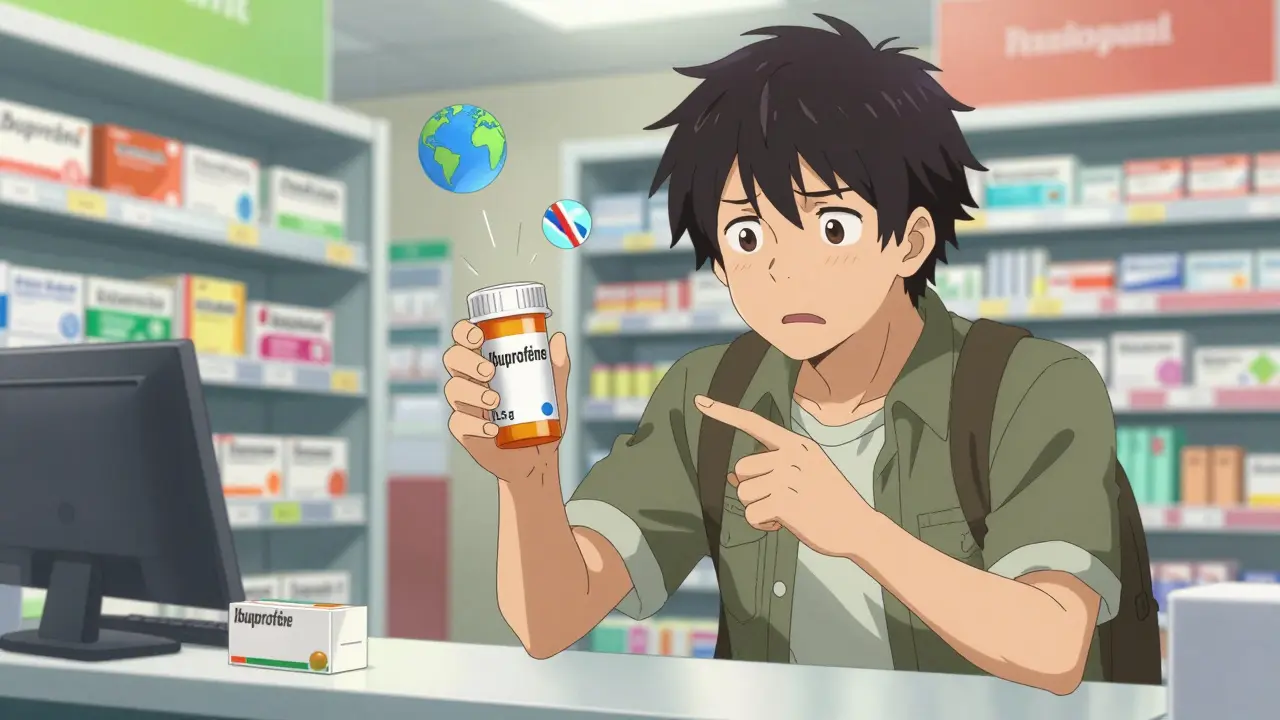
When you're traveling abroad and need to refill a prescription, you might think it’s as simple as showing your doctor’s note and asking for the same medicine. But here’s the catch: the pill you take at home might not exist under the same name overseas. Medication translation isn’t just about words-it’s about preventing life-threatening mistakes. A drug called Advil in the U.S. is Ibuprofène in France and Abfen in Poland. One wrong letter, one misread number, and you could end up with the wrong dose-or worse, the wrong drug entirely.
Why Medication Names Vary So Much
Every country has its own rules for naming drugs. The World Health Organization created the International Nonproprietary Name (INN) system to standardize generic drug names, like ibuprofen or metformin. But pharmacies don’t always use those. Instead, they sell brand names that vary wildly by region. In the UK, a sleep aid called Ambien is known as Zolpidem. In the U.S., Ambien is a brand name for zolpidem tartrate. In some countries, it’s sold as Stilnoct or Zopiklon. If you don’t know that, you could accidentally ask for a heart medication when you need a sleep pill.Even the dosage format trips people up. In the U.S., pills are often labeled in milligrams (mg), like 500mg ibuprofen. In Germany, you might see “0.5 g,” which means the same thing-but if you’re not familiar with metric conversions, you might think it’s ten times stronger. A 2022 survey found that 68% of international healthcare providers had trouble reading foreign prescriptions because of confusing units, abbreviations, or unfamiliar brand names.
What You Need to Bring Before You Travel
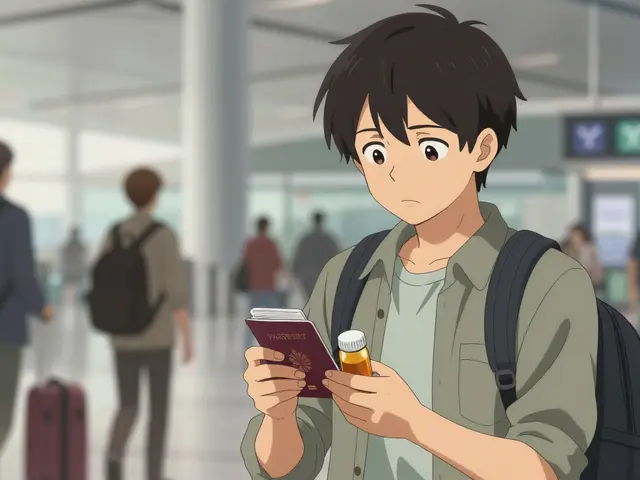
Don’t wait until you’re out of pills in a foreign city to figure this out. Here’s what to do before you leave:- Carry your original prescription bottle with the pharmacy label still attached. It has the drug name, strength, and instructions in English.
- Write down the active ingredient-not just the brand name. For example, if you take Nexium, the active ingredient is esomeprazole. That’s what matters to a foreign pharmacist.
- Bring a doctor’s note that includes your diagnosis, the medication name, dosage, and frequency. Translate it into the local language if possible.
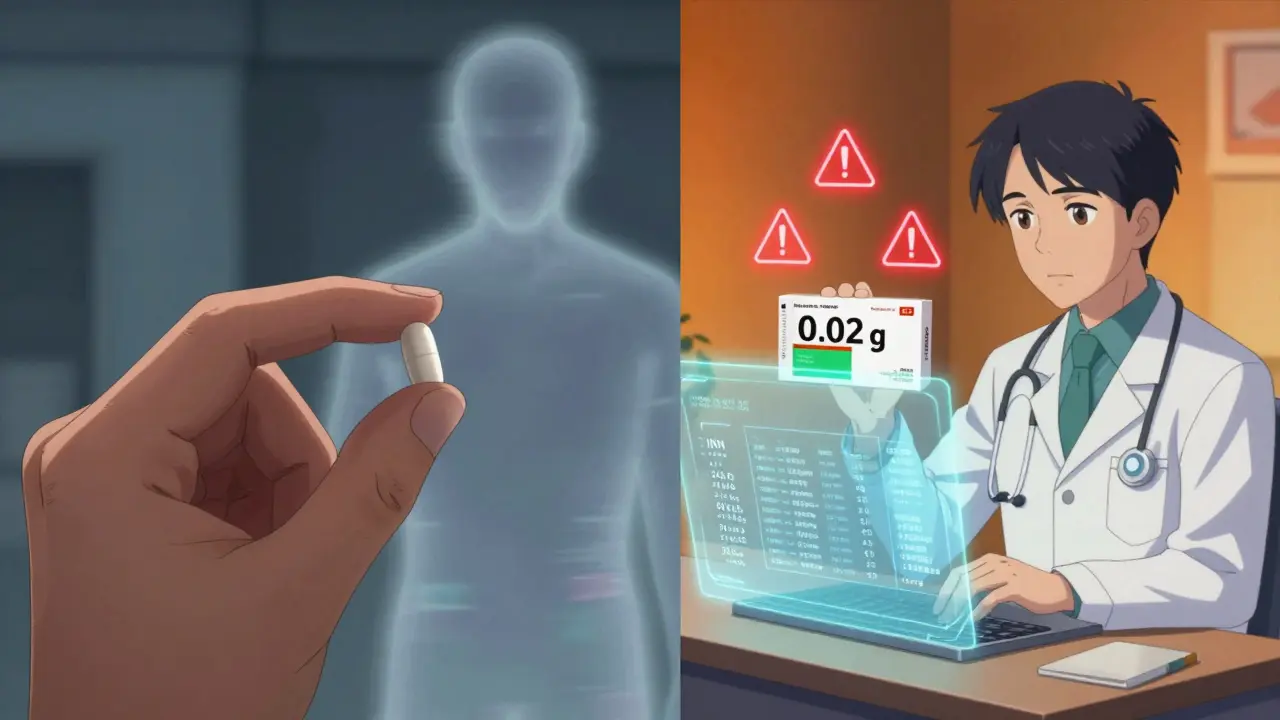
- Know your dosage in both milligrams (mg) and grams (g). If your pill is 20 mg, write it as “20 mg (0.02 g)” so it’s clear.
Many travelers rely on Drugs.com or the WHO’s INN database to find equivalents. One person on TripAdvisor shared they used Drugs.com to find that their U.S. prescription for Omeprazole was sold as Losec in Australia. That saved them from a trip to the ER.
How Foreign Pharmacies Handle Translation
Pharmacies in countries with high numbers of international visitors-like Dubai, Bangkok, or Toronto-have systems in place. Many use certified medical translation services that integrate directly into their dispensing software. Services like RxTran and Stepes provide real-time translation of prescription instructions (SIGs), warning labels, and patient guides in over 25 languages.But not every pharmacy has this. Smaller clinics or rural pharmacies might still rely on bilingual staff or Google Translate. And that’s dangerous. A 2023 analysis by ASAP Translate found that AI tools like Google Translate misinterpret dosage instructions in 34% of cases. They might translate “take one tablet twice daily” as “take two tablets once daily.” That’s not a typo-it’s a risk.
Professional services use medical terminology databases that understand context. For example, they know that “QD” in a U.S. prescription means “once daily,” but in Germany, it’s “täglich.” They also recognize that “1/2 tab” in English means half a tablet, but in Japan, it might be written as “半錠” (hanjō). A human translator without medical training wouldn’t catch that.
What Happens When Translation Goes Wrong
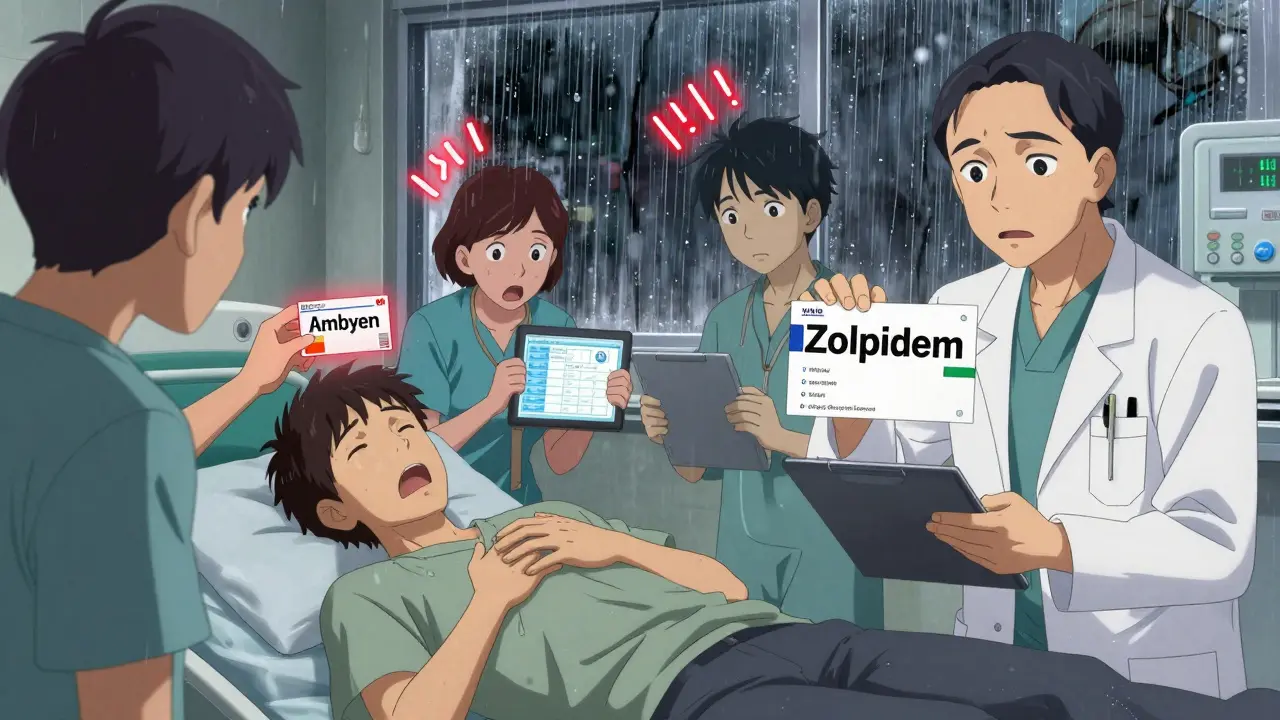
The stakes are high. In 2022, a patient in Spain was given Ambyen-intended for heart rhythm issues-instead of Ambien, the sleep aid they needed. The names look almost identical. The patient suffered severe dizziness and was hospitalized. This isn’t rare. First Databank reports that 40% of medication errors during care transitions are preventable with accurate translation.Even small mistakes add up. A Reddit user named PharmTech2020 shared how a Spanish prescription said “1g” for a painkiller. The pharmacist thought it meant one gram (1000 mg), but the patient had been taking 100 mg tablets. That’s a tenfold overdose. The pharmacist caught it because they checked the active ingredient against the WHO database.
That’s why experts like Dr. Elena Rodriguez from Johns Hopkins say: “Misinterpreting a single dosage instruction can lead to adverse reactions with mortality rates exceeding 20% in elderly or immunocompromised patients.”
What You Can Do If You Need a Prescription Filled Abroad
If you’re stuck without your meds, here’s what to do:- Go to a licensed pharmacy-not a convenience store or hotel clinic.
- Ask for the active ingredient in the local language. Say: “What is the name of the generic version?”
- Confirm the dosage in milligrams. Don’t trust the pill shape or color-they vary by country.
- Ask to see the package insert or patient leaflet. Look for the INN name (usually listed first).
- If you’re unsure, call your home pharmacy. They can often email the exact prescription details.
Some countries require proof of identity or a local doctor’s approval. In the EU, for example, you can usually refill a prescription from another EU country if it’s for a common medication. But in places like Thailand or Brazil, you might need to see a local doctor first.
How Pharmacies Are Improving Translation
In 2023, First Databank launched an AI-assisted verification tool that cross-checks translated drug names against 150+ country-specific databases. Hospitals using it saw a 37% drop in translation errors. RxTran now integrates with major pharmacy systems like PioneerRx and Frameworks, so prescriptions are translated automatically as they’re processed.Regulations are catching up too. New York State now requires translated labels in Chinese, Italian, Russian, and Spanish. California is expanding to include Vietnamese, Arabic, and Korean. The U.S. Department of Health and Human Services is pushing for translation services in the top 15 languages spoken by Limited English Proficiency (LEP) populations in each state.
But technology alone won’t fix this. The American Pharmacists Association still recommends using certified medical translators-not bilingual staff-because even fluent speakers can miss medical nuance. A nurse who speaks Spanish might not know that “hipertensión” and “hipertensión arterial” are not the same thing in pharmaceutical terms.
Final Tips for Travelers
- Always carry a 30-day supply of your medication. You can’t always refill abroad.- Use the WHO’s INN database (available online) to look up your drug before you go.
- Keep a photo of your prescription bottle on your phone.
- If you’re on blood thinners, insulin, or psychiatric meds, carry a letter from your doctor in English and one translated into the local language.
- Never assume a pill with the same color and shape is the same drug.
- If a pharmacy seems unsure, walk out and try another.
Medication translation isn’t just about language. It’s about precision. One misplaced decimal, one misheard word, and the difference between recovery and disaster is razor-thin. Don’t gamble with your health. Know your drug. Know your dose. Know your options.
Can I use Google Translate to understand my foreign prescription?
No. Google Translate and similar tools often misinterpret medical terms, dosage units, and abbreviations. A 2023 analysis found they get dosage instructions wrong in over one-third of cases. They can’t distinguish between “1g” (1 gram) and “1 mg” (1 milligram), which could lead to a fatal overdose. Always verify with a licensed pharmacist or use a certified medical translation service.
What’s the difference between brand name and generic drug names?
Brand names are created by pharmaceutical companies and vary by country. For example, ibuprofen is sold as Advil in the U.S., Ibuprofène in France, and Abfen in Poland. The generic name-ibuprofen-is the same everywhere and refers to the active ingredient. Always ask for the generic name when refilling abroad. That’s what pharmacists use to match medications across borders.
Do all countries require a local doctor’s note to refill a foreign prescription?
No. In the European Union, you can usually refill a prescription from another EU country if it’s for a common medication. In the U.S., some states allow it with proof of original prescription. But in countries like Thailand, Japan, or Brazil, you’ll likely need to see a local doctor first. Always check the rules of the country you’re visiting before you travel.
How do I know if a foreign pharmacy is trustworthy?
Look for a licensed pharmacist on-site, official signage, and a clean, organized environment. Avoid pharmacies in tourist areas that offer “miracle cures” or don’t ask for a prescription. Check if they use translated patient leaflets or have a medical terminology database. If they hesitate to show you the drug’s active ingredient, walk away.
What should I do if I can’t find my medication abroad?
Contact your home pharmacy or doctor. They can provide the generic name and dosage, which you can then take to a local pharmacist. Use resources like the WHO’s INN database or Drugs.com to find equivalents. If you’re on a critical medication like insulin or warfarin, contact your country’s embassy-they often have lists of approved pharmacies abroad.


Shruti Chaturvedi
March 13, 2026 AT 08:11When I was in Mumbai last year I needed my diabetes meds and the pharmacist just looked at my bottle and said oh this is metformin yes we have it
no paperwork no translator just the generic name
people here know more than you think
don't overcomplicate it
tynece roberts
March 15, 2026 AT 00:30so i just got back from thailand and let me tell you
the pharmacy in chiang mai had a sign that said "we speak english and bad thai"
and honestly that was more reassuring than the one that said "certified medical translators on staff"
turns out the guy just looked at my bottle and said "oh yes 20mg omeprazole" and handed it over
no form no drama
just trust the pill
also they gave me free mangoes
so yeah
Jimmy V
March 15, 2026 AT 08:25Stop relying on brand names. Ever. The active ingredient is your lifeline. If you can't name it, you're one typo away from disaster.
Also-Google Translate is not a pharmacist. Ever. I've seen it turn "take at bedtime" into "take after sex."
Carry the INN. Carry the dose in mg. Carry a photo of the bottle. That's it. No drama. No panic. Just facts.
Lorna Brown
March 17, 2026 AT 04:06It's fascinating how language shapes our relationship with medicine. We treat pills as objects, but they're actually linguistic artifacts-encoded with cultural, historical, and regulatory meaning.
When you ask for "ibuprofen" in Poland, you're not just naming a molecule-you're invoking a system of pharmaceutical governance that diverges from the American model.
The real danger isn't the translation error-it's the assumption that biology is universal. It's not. Biology is interpreted. And interpretation is always political.
Rex Regum
March 18, 2026 AT 08:22Of course the system is broken. Why would the WHO care about your life when they're busy negotiating with Big Pharma?
They push "INN" like it's some holy grail-but the same companies that make Advil in the US make Abfen in Poland and charge double.
Translation isn't the problem. Profit is.
And don't tell me about "certified translators"-they're just more gatekeepers in lab coats.
douglas martinez
March 19, 2026 AT 18:02Thank you for writing this. As someone who works with international patients daily, I can't stress enough how vital it is to carry the generic name and dosage in writing.
One time, a patient from Japan was given a sedative instead of an antihypertensive because the label said "1/2 tab"-they interpreted it as two half-tablets instead of one half-tablet.
It was a 30-minute conversation with the pharmacist and a printed WHO database entry that saved them.
Knowledge is the best passport.
Kandace Bennett
March 20, 2026 AT 10:40OMG I'm so glad someone finally said this 🙌
Like I was in Berlin last month and the pharmacist was like "oh you need omeprazole? We call it Omeprazol"
and I was like "yes but is it the same?"
and she was like "yes, but here it's 20mg, not 40mg, so I'm giving you two"
and I was like "wait what"
and she pulled up the EU database and showed me the exact equivalence
and I just cried because I realized I'm not the only one terrified of this stuff 💔
also she gave me a free sample of peppermint tea 🫖
Richard Harris
March 20, 2026 AT 13:23good post
just wanted to say i used to think google translate was fine till i saw it turn "twice daily" into "every two days"
scary stuff
always check the mg
and if in doubt ask for the leaflet
even if you dont read the language
the symbols are usually the same
like a clock for time or a skull for danger
simple really
Emma Deasy
March 21, 2026 AT 12:47HOW DARE YOU. HOW DARE YOU. HOW DARE YOU. This is not just about medication. This is about the erosion of global trust. The pharmaceutical industry has weaponized language. They know you won't understand. They know you're scared. They know you'll take the pill anyway. And then-when you collapse-they'll say "you didn't follow instructions."
But the instructions were translated by a machine that confused "QD" with "BID".
And now your kidneys are failing.
And your doctor says "it's not our fault."
And your country says "you should have known better."
And WHO? WHO is asleep at the wheel.
THIS IS A CRISIS. AND NO ONE IS TALKING ABOUT IT.
Except you. Thank you. I'm crying.
And I'm not even on medication.
Sally Lloyd
March 22, 2026 AT 06:37Did you know that in 2021, a pharmaceutical company secretly altered the INN database to favor their brand names?
They added fake synonyms in 17 countries.
Now, when you look up "ibuprofen" in Russia, the top result is "Advil-RU"-which is not real.
And no one noticed because everyone was too busy checking Google Translate.
They're not just selling pills. They're selling illusions.
And your doctor? They're paid to not ask questions.
Don't trust the label.
Don't trust the pharmacist.
Trust your gut. And carry your own pills.
Kelsey Vonk
March 22, 2026 AT 08:43so i just wanted to say thank you for this 🥹
i was in mexico last year and i was so scared to refill my antidepressants
but the pharmacist was this sweet abuela who pulled out a handwritten chart with all the brand names and their generic equivalents
she drew little hearts next to the ones she trusted
and then gave me cookies
and i cried
because it wasn't about the medicine
it was about being seen
and i just want more of that in the world 🫶
Byron Boror
March 23, 2026 AT 15:04Look. America makes the best medicine. Period. If you can't get your pills abroad, you should've stayed home.
Why are we letting other countries dictate how we take our drugs?
They don't even use proper English. "Ibuprofène"? That's French. "Abfen"? That's just wrong.
Why not just make everyone use American names? Simple. Safe. Efficient.
Stop trying to "translate"-just use what works. The American way.
Tim Schulz
March 24, 2026 AT 10:02Wow. Just... wow.
You wrote a 3000-word essay on pill names.
And I'm supposed to care?
Let me guess-you also alphabetize your spice rack and label your socks?
Here's a radical idea: just carry extra pills.
Or don't travel.
Or don't take medicine.
Or, best of all-don't write long posts about things that don't matter.
Peace out. 🤙