
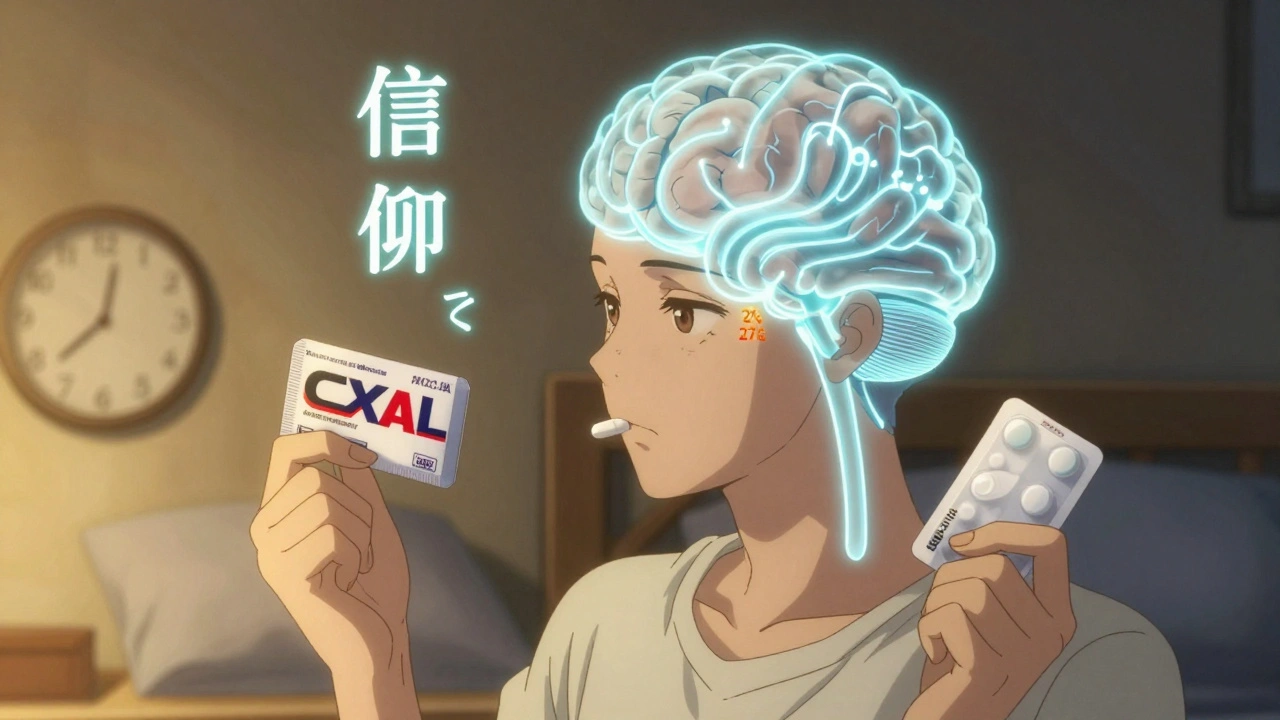
When you switch from a brand-name pill to a generic version, your body doesn’t change-but your mind might. And that mental shift can actually change how well the medicine works. It’s not about chemistry. It’s about placebo effect. You’re not imagining things. Science proves it.
Why a Generic Pill Can Feel Less Effective
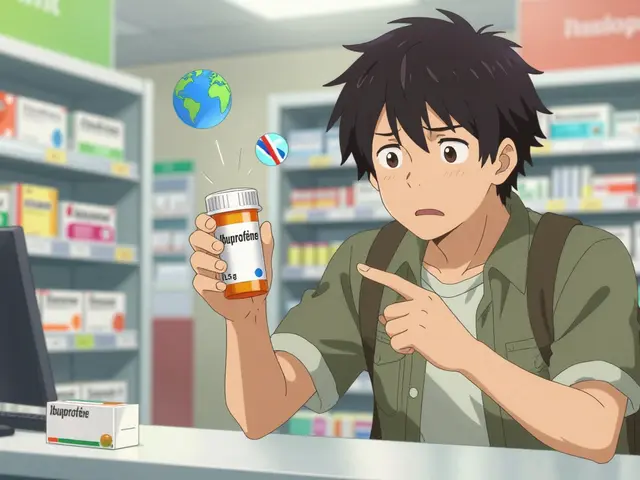
A 2014 study showed something startling: when people took a sugar pill labeled as a brand-name painkiller, their headaches went away just as well as if they’d taken real ibuprofen. But when the exact same sugar pill was labeled as a generic, the pain relief dropped by nearly 40%. The pills were identical. The only difference was the label. This isn’t rare. In one trial, patients on generic sertraline (the same drug as Zoloft) were 22% more likely to quit taking it because they felt it “wasn’t working.” Their blood levels were perfect. Their doctors confirmed it. But their brains didn’t believe it. The same thing happens with blood pressure meds, statins, and even thyroid pills. People report worse symptoms after switching-not because the drug changed, but because they expected it to be weaker. That expectation triggers real biological responses. Brain scans show the dorsolateral prefrontal cortex, the area linked to belief and expectation, lights up 27% more when people think they’re taking a brand-name drug.The Cost-Expectation Trap
Here’s the weirdest part: price matters. In a study where healthy volunteers were given fake painkillers, those told the pill cost $2.50 felt significantly less pain than those told it cost 10 cents. Same pill. Same dose. Just different price tags. That’s why many people assume generics are inferior. They’re cheaper. So, logically, they must be worse. It’s a deeply rooted belief-even though the FDA requires generics to be bioequivalent. That means they must deliver the same amount of active ingredient into your bloodstream within 80-125% of the brand-name version. In practice, most generics match within 95%. Still, 30% of patients believe generics are less effective. That number hasn’t changed in a decade. And it’s not just misinformation. It’s a psychological habit. Your brain learned that expensive = better. That’s hard to undo.Nocebo Effect: When Expectations Make You Sick
The flip side of the placebo effect is the nocebo effect-when expecting side effects causes them. In statin trials, people told they were taking a generic version reported muscle pain at nearly 10% rates. When they thought they were taking the brand name, it was under 2%. Even placebo pills caused more side effects when labeled as generic. One patient in a case report stopped taking generic escitalopram because he felt “worse anxiety.” Blood tests showed his drug levels were identical to when he took the brand. His brain convinced him the generic was failing-and that feeling became real. This isn’t weakness. It’s biology. Your brain predicts outcomes based on past experiences, labels, and social cues. If you’ve heard stories about generics not working, your brain prepares for disappointment. And then it delivers it-physically.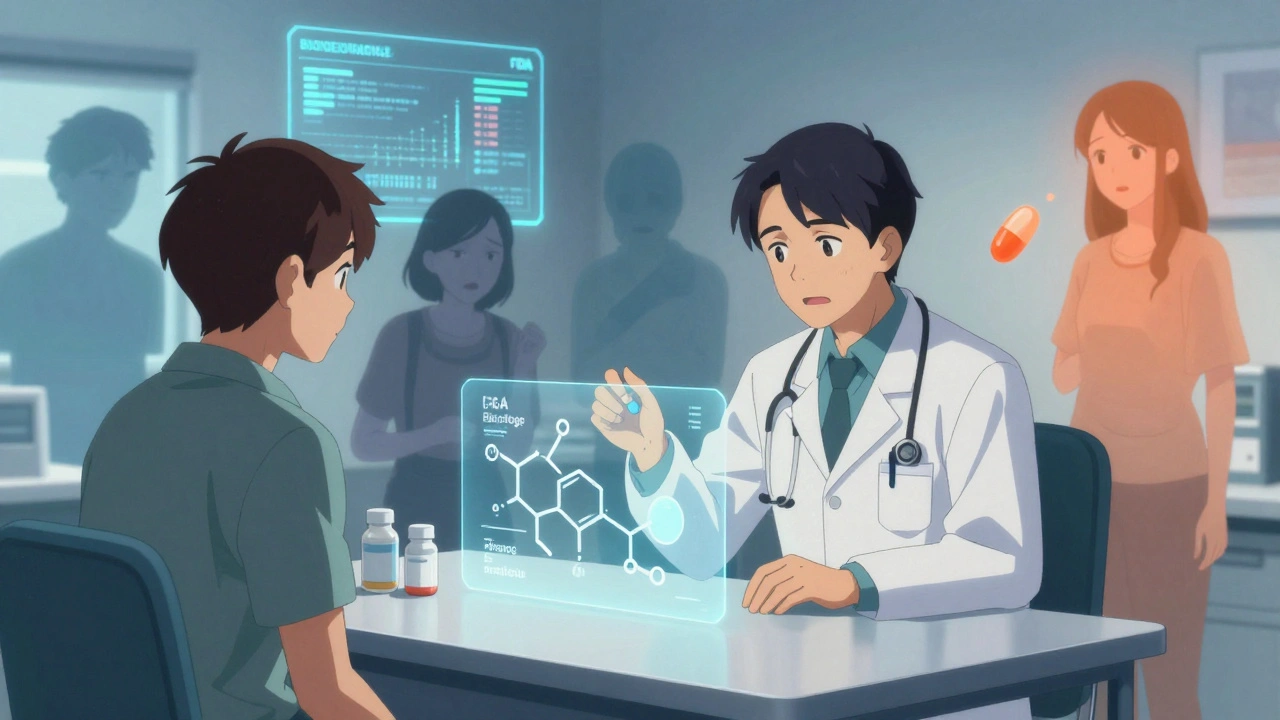
How Doctors Can Help (Without Lying)
You can’t lie to patients. But you can reframe. A 2021 study found that a simple 3-minute conversation cut nocebo responses by nearly half. Here’s what works:- “The FDA requires generic drugs to work just like the brand name. They go through the same strict tests.”
- “Some people notice a difference-not because the medicine changed, but because their brain expected it to feel different. That’s normal.”
- “Give it two weeks. If you still feel off, we’ll talk. But it’s likely your mind adjusting, not the drug failing.”
What Happens When You Don’t Address This
Ignoring the psychological side of generics costs money-and health. In the U.S., an estimated $1.4 billion is spent each year on unnecessary brand-name prescriptions because people distrust generics. That’s not just waste. It’s risk. People who can’t afford brand names may skip doses or stop entirely. Studies show brand-name users have 18% higher adherence rates for heart meds-even when the generic is identical. And it’s not just about money. When patients stop taking their meds because they think the generic doesn’t work, they’re at higher risk for heart attacks, strokes, and hospitalizations. The FDA now requires generic manufacturers to keep pill color, shape, and size consistent. Why? Because changing the look increases nocebo responses by 29%.
Real Stories: What Patients Say
On Drugs.com, 78% of users who switched to generics reported reduced effectiveness. One wrote: “My blood pressure jumped 15 points after switching. My doctor said it was the same drug. I didn’t believe him.” But on GoodRx, 82% of users who didn’t know they’d switched to generics reported no difference. That’s the key. If you don’t know it’s generic, your brain doesn’t trigger the nocebo effect. One Reddit user shared: “My psychiatrist warned me generic sertraline might feel less effective. I took both. The brand felt stronger-not because it was, but because I expected it to be.” Then there’s the success story: “My doctor explained that generics are chemically identical but my brain might react differently. I gave it a chance. My lisinopril works fine now.”What You Can Do
If you’re switching to a generic:- Ask your doctor to explain bioequivalence. Don’t just accept it-understand it.
- Don’t assume cheaper means weaker. The FDA doesn’t allow that.
- Give it two weeks. Your brain needs time to adjust.
- If you feel worse, track symptoms. Is it physical? Or emotional? Journaling helps.
- Don’t stop cold. Talk to your provider. You might need a transition plan.
- Don’t say, “It’s the same.” Say, “It’s the same medicine, but your brain might need a little time to believe it.”
- Use the FDA’s free patient guides. They’ve been downloaded over a million times.
- Consider the ‘Expectation Modulation Protocol’-a 12-minute digital tool now under FDA review that reduces nocebo effects by over 50%.
The Bigger Picture
This isn’t about tricking patients. It’s about honesty. The placebo effect isn’t a flaw-it’s a feature of how our brains work. Every medicine, even the most powerful, interacts with your expectations. A $10,000 cancer drug won’t work if you believe it won’t. A $0.08 generic will work if you believe it will. The future of healthcare isn’t just better drugs. It’s better beliefs. And that starts with how we talk about generics.The FDA’s 2023 pilot program now requires generic manufacturers to keep pill appearance consistent. The European Union is spending €2.4 million to standardize patient education across 27 countries. Evaluate Pharma predicts that fixing this psychological gap could save the U.S. healthcare system $8.7 billion a year by 2028.
It’s not magic. It’s medicine. And it’s working-once we stop pretending the mind doesn’t matter.
Do generic drugs work the same as brand-name drugs?
Yes. By law, generic drugs must contain the same active ingredient, strength, dosage form, and route of administration as the brand-name version. They must also be bioequivalent-meaning they deliver the same amount of medicine into your bloodstream at the same rate. The FDA requires generics to meet the same strict standards for safety and effectiveness.
Why do some people feel generics don’t work as well?
It’s often the placebo or nocebo effect. If you believe a brand-name drug is stronger, your brain responds accordingly-even if the pills are chemically identical. Studies show people report better pain relief or fewer side effects when they think they’re taking a brand, even when they’re not. This isn’t weakness-it’s how the brain processes expectations.
Can the color or shape of a generic pill affect how it works?
Not pharmacologically. But psychologically, yes. Changing a pill’s appearance-like switching from a blue capsule to a white tablet-can trigger nocebo effects. Patients may think the change means the drug is different or weaker. The FDA now recommends generic manufacturers keep pill appearance consistent to avoid this confusion.
Is it safe to switch from brand-name to generic medication?
Yes, for most medications. The FDA approves generics only after proving they’re bioequivalent. However, for drugs with a narrow therapeutic index-like warfarin, levothyroxine, or some seizure meds-some doctors prefer to stick with one version to avoid even tiny variations. Always talk to your provider before switching.
How can I tell if my body is reacting to the drug-or my expectations?
Track your symptoms objectively. Use a journal: note how you feel each day, your dosage, and whether you knew you were taking a generic. If your symptoms improve after a few weeks, it’s likely your brain adjusted. If symptoms persist or worsen after a month, consult your doctor. Blood tests or monitoring can confirm whether the drug levels are correct.
Are there any medications where generics are known to be less effective?
No. There’s no scientific evidence that any FDA-approved generic is less effective than its brand-name counterpart. Reports of reduced effectiveness are almost always tied to psychological factors or inconsistent dosing from switching between different generic manufacturers-not the drug itself.
What should I do if I think my generic medication isn’t working?
Don’t stop taking it. Contact your doctor. Ask if your symptoms could be psychological. Request a two-week trial period with close monitoring. If needed, ask if you can temporarily return to the brand name to confirm whether the issue is real or perceived. Most of the time, the problem resolves with time and proper communication.



Matt Dean
December 2, 2025 AT 13:24Let me get this straight - you’re telling me my brain can trick me into thinking my blood pressure med isn’t working just because it’s a different color? And we wonder why healthcare is broken. This isn’t science, it’s a cult of branding. I’ve been on generics for 12 years. Never had an issue. People who complain are just lazy and want to be coddled.
Also, if your doctor can’t explain bioequivalence in 30 seconds, fire them.
Walker Alvey
December 4, 2025 AT 03:48So the FDA spends billions regulating pill shape so your brain doesn’t freak out. We’ve reached peak capitalism. Next they’ll patent the color blue for antidepressants. At this point I’m just waiting for Big Pharma to sell us branded placebos. $20 a pill. Comes with a certificate of authenticity and a Spotify playlist called ‘Trust the Medicine’.
Meanwhile my grandma takes her generic lisinopril like it’s oatmeal. No drama. No brain hacks. Just pills.
James Steele
December 5, 2025 AT 00:28The placebo-nocebo axis represents a profound epistemological rupture in pharmacological phenomenology - the somatic manifestation of semiotic expectation as a biopsychosocial feedback loop. The pill is not merely a chemical entity but a signifier saturated with cultural capital: price, packaging, provenance. When the signifier shifts - from ‘Zoloft’ to ‘sertraline’ - the neurochemical substrate reconfigures accordingly. Dorsolateral prefrontal cortex activation isn’t noise - it’s the mind’s ontological anchor.
And yet, we still reduce this to ‘trust issues’. We are not patients. We are semiotic subjects in a pharmacopeia of meaning. The FDA’s color consistency mandate? A palliative for a deeper cultural sickness: the worship of the branded as the authentic.
Meanwhile, the real tragedy is that we still treat biology like it’s a software update. It’s not. It’s a symphony conducted by belief.
Louise Girvan
December 5, 2025 AT 10:48THIS IS A COVER-UP!!!
They changed the pill color so you wouldn’t notice the fillers!!
They KNOW generics have different binders!!
My cousin’s friend’s neighbor’s dog got sick after switching!!
And now they’re trying to gaslight us with ‘brain magic’!!
WHO BENEFITS??
Pharma!!
They want you to think it’s ‘in your head’ so you stop asking questions!!
They’re selling you a placebo… with a placebo label!!
EVERYTHING IS A LIE!!
AND THE FDA IS IN ON IT!!
Dennis Jesuyon Balogun
December 6, 2025 AT 02:17Let me tell you something from Lagos - when you’re paying for medicine with your last naira, you don’t care about the color or the brand. You care if it works. And guess what? It does. I’ve seen people on generics in rural clinics survive malaria, hypertension, even HIV - all because the drug got to them, not because the label looked fancy.
This isn’t about psychology. It’s about privilege. You can afford to doubt. We can’t.
Stop making science into a luxury. The brain doesn’t create medicine. The body does. And if the body gets the same molecules, it responds the same. No matter where the pill came from.
Teach your patients. Don’t patronize them. They’re not broken. The system is.
Grant Hurley
December 6, 2025 AT 17:27bro i switched to generic omeprazole last month and thought i was gonna die lmao
felt like my stomach was on fire for 3 days
then i realized i was stressing out about it so much i forgot to eat
took a chill pill (pun intended) and now im fine
turns out my brain was the problem not the pill
also i think the generic was actually better? no weird aftertaste
tl;dr: your mind is wild
Nnaemeka Kingsley
December 7, 2025 AT 22:05my auntie in Nigeria takes generic metformin every day. she’s 72. her sugar is perfect. she never heard of placebo. she just takes it because the doctor said so. no brand name. no color talk. just medicine.
why we make this so complicated? maybe because we have too much time and too little trust.
try it. take the generic. wait two weeks. if still bad? talk to doc. if good? thank your body and your brain for working together.
simple. not magic. not conspiracy. just biology.
Jaswinder Singh
December 8, 2025 AT 12:33you people are overthinking this like it’s a Netflix documentary. i took generic amoxicillin for my sinus infection. felt better in 48 hours. no brain magic. no placebo. just antibiotics doing their job.
if your meds aren’t working, maybe you’re taking them wrong. or you’re depressed. or you’re just lazy.
stop blaming your brain. fix your habits.
also - stop calling it ‘nocebo’. it’s just being dramatic.
Courtney Co
December 8, 2025 AT 20:44but what if… your brain is right? what if the generic actually IS different? what if the fillers are toxic? what if they’re cutting corners? what if your doctor doesn’t even know what’s in it? what if you’re being experimented on? what if you’re the guinea pig? what if you’re not supposed to know? what if this is all part of a plan? what if… you’re not supposed to feel better? what if… the brand name is the only thing keeping you alive? what if… you’re being gaslit by Big Pharma? what if… you’re not supposed to trust your own body? what if… you’re already too far gone? what if… you’re already dead inside and the pills just make you think you’re not?
Shashank Vira
December 9, 2025 AT 18:10Let us not forget: the placebo effect is the last bastion of human agency in a mechanized, commodified pharmacological dystopia. We are not mere biological machines. We are meaning-making organisms. To reduce the efficacy of a drug to its molecular structure is to commit epistemic violence against the phenomenology of healing.
When I take a branded antidepressant, I don’t just ingest sertraline - I ingest hope. I ingest the ritual. I ingest the myth of modern medicine as salvation. The generic? A sterile, bureaucratic compromise. A pill stripped of its sacred aura.
And yet - the FDA insists on sameness. As if biology obeys bureaucracy.
Perhaps the real crisis is not in the pill - but in our loss of wonder.
Eric Vlach
December 10, 2025 AT 23:28my doc told me the same thing and i was skeptical but i gave it a shot
two weeks later i realized i hadn't thought about my blood pressure once
weird right
turns out i was so busy worrying i was making myself worse
also the generic tasted less chalky
no joke
just sayin'
Priyam Tomar
December 11, 2025 AT 09:41Oh wow. So the entire medical establishment is just lying to us. And you're saying this is new? Newsflash - generics have been around since the 70s. Millions of people take them. No one dies. No one goes blind. No one gets cursed by the placebo gods.
Meanwhile, you're writing a 2000-word essay about how your brain is too fragile to handle a $0.50 pill. Grow up.
Also, if you're still on brand-name statins because you're scared of generics, you're not a patient. You're a walking marketing target.
And yes - I've taken 17 different generics. All worked. All fine. All cheaper. All better for the planet. Stop being dramatic.
Jack Arscott
December 11, 2025 AT 16:54🤯 i used to hate generics
then i switched to generic fluoxetine
felt nothing different
then i realized i’d been stressing about it for 3 weeks
so i stopped thinking about it
and now i’m stable
my brain was the problem
also i saved $47 this month
✅
Lydia Zhang
December 13, 2025 AT 14:39Yeah ok.
So what?
Kay Lam
December 15, 2025 AT 05:28I’ve been thinking about this a lot lately because my mom was switched to a generic thyroid med last year and she went from feeling fine to exhausted, shaky, and depressed. We did blood tests - her TSH levels were perfect. The doctor said it was ‘just her brain’. But I watched her. She didn’t believe it. She stopped taking it for two weeks. She felt better. Then she started again. She felt worse. She cried. She said, ‘It’s not me. It’s the pill.’
And here’s the thing - she’s not crazy. She’s not weak. She’s a 68-year-old woman who’s been told her whole life that expensive things are better. That name brands mean quality. That if something’s cheap, it’s not trusted. And now she’s being told that her fear is the problem - not the drug. But what if her fear is real? What if the system that made her believe in brand names is the same system now telling her she’s imagining it?
I don’t think it’s about psychology. I think it’s about power. Who gets to decide what’s real? Who gets to say her experience doesn’t count? The FDA? The pharmaceutical companies? The doctors who don’t have time to sit with her?
Maybe the solution isn’t just ‘give it two weeks’. Maybe it’s ‘listen to her’. Maybe it’s ‘acknowledge that the system taught her to distrust this pill’. Maybe it’s not about changing her mind - it’s about changing how we talk to her.
Because if we keep calling it ‘nocebo’, we’re not helping. We’re silencing.
And that’s the real cost.