
Have you ever caught your reflection and noticed a strange bulge at the base of your neck? It might not be weight gain. It could be a goiter, which is an abnormal enlargement of the thyroid gland that creates a visible swelling in the front of the neck. While it often looks harmless, this condition signals that your body’s metabolic control center is struggling. For millions of people worldwide, the root cause is simple: a lack of iodine. But for others, especially in developed nations like the UK or US, the culprit is an autoimmune attack on the gland itself.
Understanding why your thyroid swells is the first step to fixing it. The good news? In many cases, correcting the underlying imbalance-whether through diet, medication, or supplements-can shrink the goiter and restore normal function. Let’s break down what causes this enlargement, how iodine plays a role, and when you need more than just a dietary tweak.
What Exactly Is a Goiter?
Your thyroid is a small, butterfly-shaped gland sitting right at the front of your throat, just below your Adam’s apple. In a healthy adult, it weighs about 15 to 20 grams. When doctors measure it via ultrasound, anything over 25 milliliters (mL) is considered enlarged. That’s the clinical definition of a goiter.
This isn’t just a cosmetic issue. As the gland grows, it can press against nearby structures. You might start feeling tightness in your chest, have trouble swallowing solid foods, or notice your voice becoming hoarse. In severe cases, where the volume exceeds 80 to 100 mL, it can even compress the windpipe, making breathing difficult. These symptoms are documented by the National Institutes of Health (NIH) as key indicators that medical intervention is needed beyond simple observation.
Interestingly, women are much more likely to develop this condition than men. Data from the Merck Manual shows that about 7.5% of women will experience a goiter compared to only 2.5% of men. Age also plays a part; incidence rates climb significantly after age 40. If you’re noticing changes in your neck profile during midlife, it’s worth getting checked out.
The Iodine Connection: Why Deficiency Causes Swelling
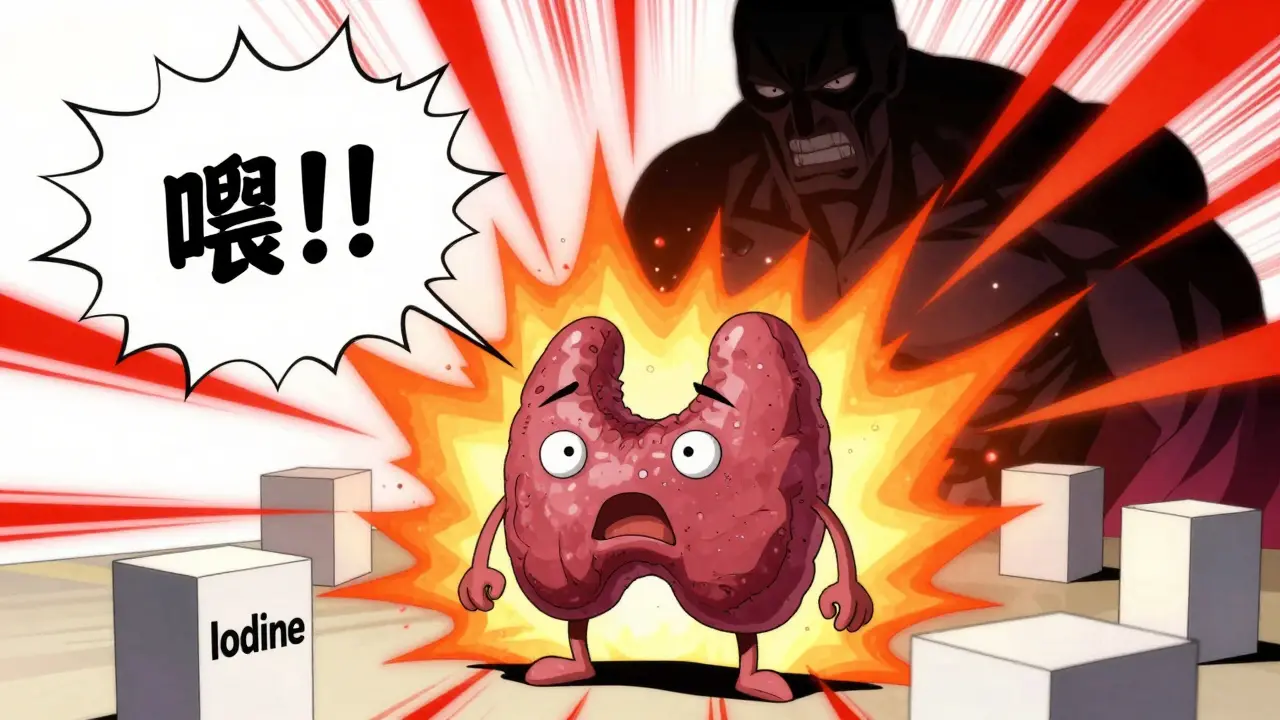
To understand goiters, you have to understand iodine. Your thyroid uses iodine to make hormones that regulate your metabolism. Think of iodine as the raw material. If the factory (your thyroid) doesn’t get enough raw material, it panics. The pituitary gland sends out Thyroid-Stimulating Hormone (TSH) to yell at the thyroid to work harder. This constant stimulation causes the cells to multiply and swell, creating a goiter.
Globally, this is still the biggest problem. According to the Mayo Clinic, iodine deficiency accounts for roughly 90% of goiter cases in regions without universal salt iodization programs. The World Health Organization (WHO) reports that despite massive public health efforts since the 1990s, nearly 1.9 billion people remain at risk of iodine deficiency disorders. In these areas, the solution is straightforward: add iodine back into the system.
Public health interventions typically involve adding potassium iodide to salt at concentrations of 20 to 40 parts per million. For individuals, WHO recommends daily supplements of 90-150 micrograms (mcg) for children and 150-250 mcg for adults and pregnant women. Studies show that consistent supplementation can reduce thyroid volume by 30-40% within 6 to 12 months. In fact, simple iodine-deficient goiters resolve completely in 70-85% of cases within two years of treatment.
Autoimmune Disorders: The Leading Cause in Developed Nations
If you live in the United States or the United Kingdom, iodine deficiency is rarely the issue. We’ve had iodized table salt since the 1920s. So why do we still see goiters? The answer lies in our immune systems. In these regions, autoimmune diseases are the primary drivers of thyroid enlargement.
The most common offender is Hashimoto's thyroiditis, which is an autoimmune disorder where the body's immune system mistakenly attacks the thyroid gland, leading to chronic inflammation and eventual hypothyroidism. According to the American Thyroid Association, this is the top cause of goiter in the US. Your immune system produces antibodies that damage thyroid tissue. The gland swells as it tries to repair itself, but over time, scar tissue (fibrosis) forms.
Another possibility is Graves' disease, which causes hyperthyroidism (overactive thyroid). Here, the immune system stimulates the thyroid to produce too much hormone, causing it to grow rapidly. This type of goiter is often called "toxic" because it floods the body with excess thyroid hormone, leading to symptoms like rapid heartbeat, anxiety, and weight loss.
Treatment Options: From Supplements to Surgery
How you treat a goiter depends entirely on what caused it. There is no one-size-fits-all pill. Here is how different scenarios are managed based on current clinical guidelines.
| Cause | Primary Treatment | Expected Outcome | Timeframe |
|---|---|---|---|
| Iodine Deficiency | Iodine Supplementation (150 mcg/day) | Volume reduction by 30-40%; resolution in 70-85% of cases | 6-12 months for initial shrinkage; 1-2 years for full resolution |
| Hashimoto's Thyroiditis | Levothyroxine (1.6 mcg/kg/day) | Normalizes hormone levels; reduces size by only 10-20% | Lifelong management; fibrotic changes may persist |
| Graves' Disease | Methimazole (5-30 mg/day) | Reduces volume by 40-60% | 12-18 months |
| Large/Compressive Goiter | Surgery (Total Thyroidectomy) | Removes 30-40g of tissue; eliminates compression | Immediate relief; requires lifelong hormone replacement |
| Toxic Goiter | Radioactive Iodine (5-15 mCi) | Reduces volume by 50-60% | 6-12 months; 75-80% risk of permanent hypothyroidism |
For Hashimoto’s patients, the standard treatment is levothyroxine, which is a synthetic form of thyroxine (T4) used to replace deficient thyroid hormone in hypothyroid patients. While this drug fixes your hormone levels and makes you feel better, it often doesn’t shrink the goiter much-only about 10-20%. That’s because the swelling is partly due to scar tissue that won’t reverse. About 60% of Hashimoto’s cases progress to atrophic thyroiditis over 10-15 years, meaning the gland eventually shrinks on its own after being destroyed by the immune system.
If the goiter is massive or causing breathing issues, surgery becomes necessary. A total thyroidectomy removes the entire gland. Yale Medicine data indicates this removes an average of 30-40 grams of tissue. However, patient satisfaction surveys reveal mixed feelings: while 78% are happy with non-surgical treatments, only 42% report high satisfaction with surgery due to risks like voice changes (15% incidence) and low calcium levels (8% incidence).

Navigating Iodine Supplementation Safely
Because iodine deficiency is such a famous cause of goiter, many people assume they should just take iodine supplements. Be careful. Too much iodine can actually trigger or worsen autoimmune thyroid disease. This is known as the Wolff-Chaikoff effect, where excess iodine temporarily shuts down hormone production.
In the US, the Recommended Dietary Allowance (RDA) is 150 mcg for adults. Pregnant women need 220 mcg, and breastfeeding mothers need 290 mcg. One gram of iodized table salt provides about 45 mcg. Most people get enough from their diet unless they avoid salt entirely or follow a strict vegan diet without fortified foods.
If you suspect a deficiency, don’t self-prescribe high-dose kelp or iodine pills. Get a urine test. A spot urine iodine concentration below 100 mcg/L suggests deficiency. Above 300 mcg/L might indicate excess intake, which can be harmful. Always consult an endocrinologist before starting any new supplement regimen, especially if you have a family history of thyroid cancer or autoimmune conditions.
Future Directions and Genetic Factors
Science is moving beyond just iodine and autoimmunity. Researchers are now looking at genetics. The NIH-funded TRIPOD study, launched in 2023, is tracking 5,000 participants across 10 countries. Preliminary data has identified 37 genetic loci linked to thyroid volume regulation. This means some people are simply born with a predisposition to larger thyroids, regardless of their diet or immune status.
There’s also debate around selenium. Some European guidelines suggest selenium helps reduce inflammation in autoimmune thyroiditis. However, a 2021 Cochrane Review found no significant benefit for goiter reduction overall. Until more specific data emerges, selenium remains a secondary consideration rather than a primary treatment.
Can a goiter go away on its own?
It depends on the cause. Simple goiters caused by mild iodine deficiency may shrink or disappear once adequate iodine is introduced into the diet. However, goiters caused by nodules, cysts, or autoimmune diseases like Hashimoto's usually require medical treatment and rarely resolve without intervention.
Is iodized salt enough to prevent goiter?
For most people in countries with mandatory salt iodization, yes. Consuming regular amounts of iodized salt meets the daily recommended allowance of 150 mcg for adults. However, if you have an autoimmune thyroid condition, additional iodine may not help and could potentially worsen inflammation.
What are the signs that a goiter is becoming dangerous?
Watch for compressive symptoms. If you experience difficulty breathing, persistent hoarseness, trouble swallowing, or a feeling of tightness in your throat, seek medical attention immediately. These signs indicate the goiter is pressing on your airway or esophagus.
Does levothyroxine shrink a goiter?
Levothyroxine primarily restores normal hormone levels. In cases of Hashimoto's thyroiditis, it may reduce goiter size by only 10-20% because much of the enlargement is due to irreversible scarring. It is effective for managing hypothyroidism symptoms but is not a strong shrinking agent for large goiters.
Who is most at risk for developing a goiter?
Women are three times more likely to develop a goiter than men. Risk increases with age, particularly after 40. People living in areas with low soil iodine, those with a family history of thyroid disease, and individuals with autoimmune disorders are also at higher risk.