
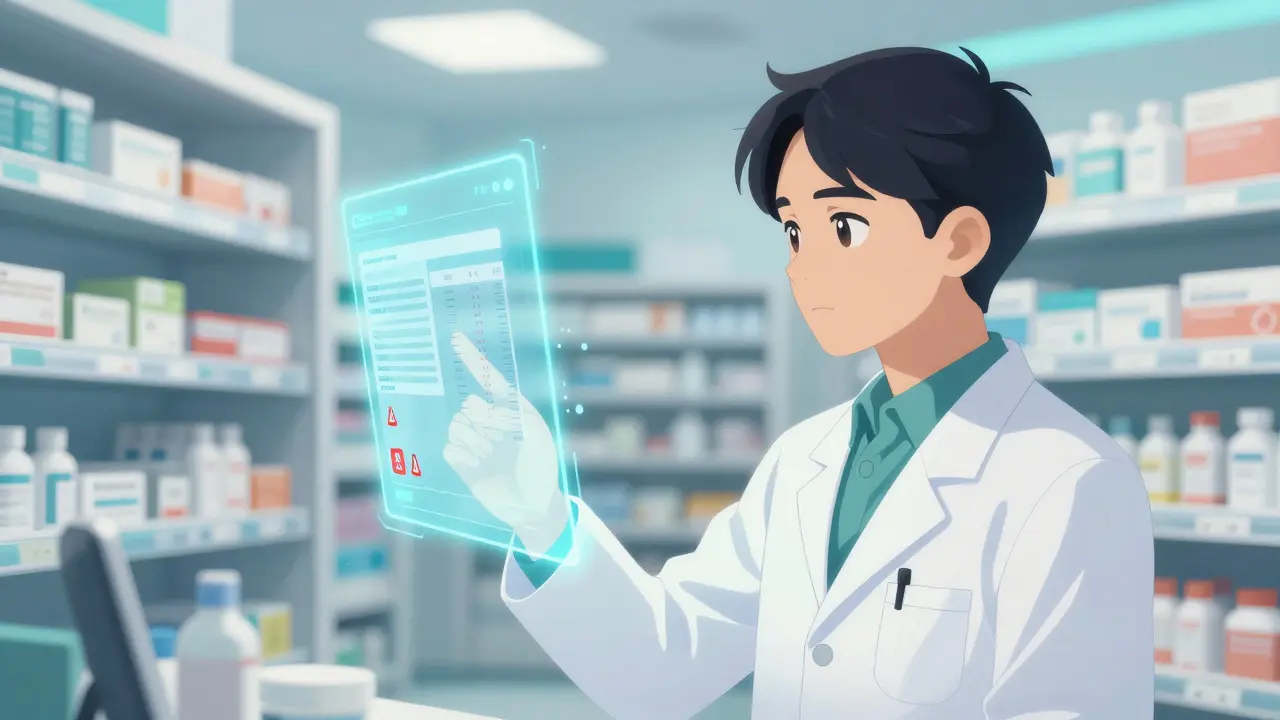
Imagine a pharmacist spotting a dangerous drug interaction not because of a generic software alert, but because they can see a patient's real-time kidney function labs from a clinic visit that happened two hours ago. For a long time, pharmacies have been the "black hole" of healthcare data-they receive prescriptions but rarely send clinical insights back to the doctor. This gap often leads to medication errors, missed doses, and frustrating phone tags between offices. EHR integration is the bidirectional exchange of patient health information between medical providers' electronic health records and pharmacy management systems. By closing this loop, we move from a world of simple transactional dispensing to a coordinated system where the pharmacist acts as a therapeutic consultant.
The Tech Behind the Connection
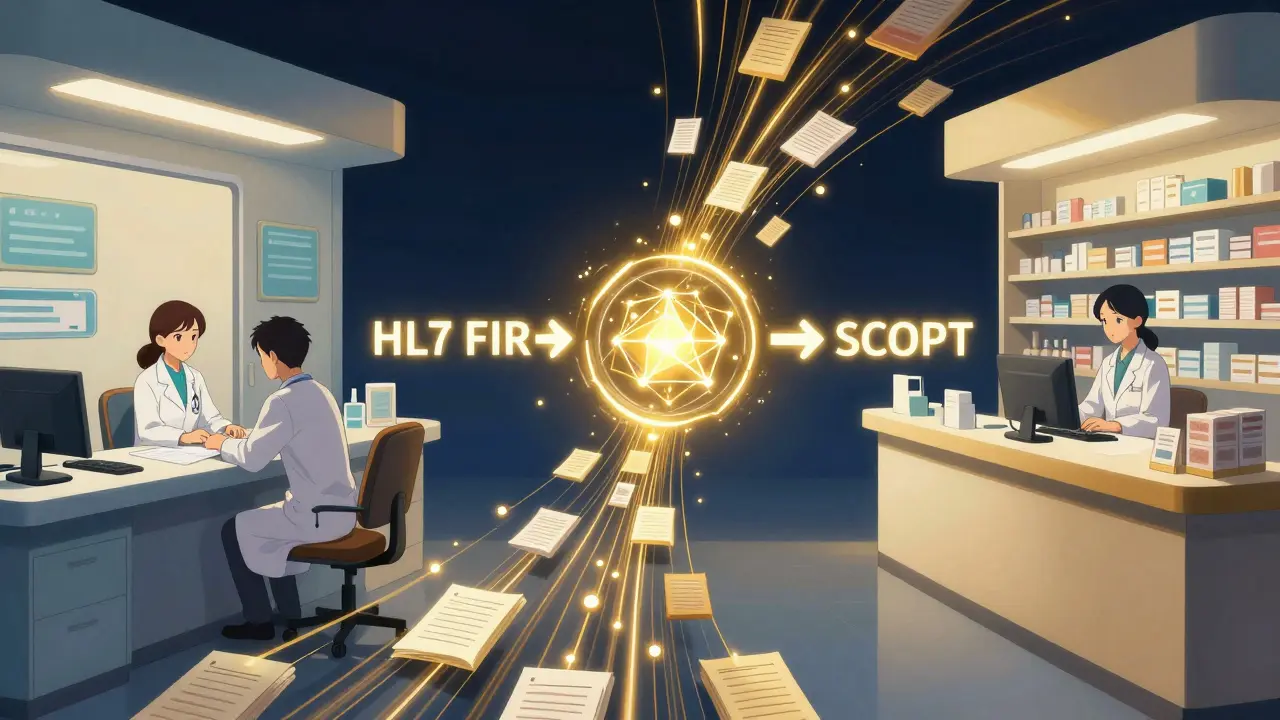
You can't just plug a pharmacy system into a hospital database; they speak different languages. To make this work, the industry relies on two primary "translators." First, there is the NCPDP SCRIPT standard, which handles the actual transmission of prescriptions. If you've ever had a prescription sent electronically, this is the plumbing making it happen. As of the 2017071 version, it remains the gold standard for getting a script from a doctor's desk to the pharmacy counter.
However, a prescription is just a request. To share the why and the how-like medication histories or care plans-the industry uses HL7 FHIR (Fast Healthcare Interoperability Resources). Think of FHIR as the modern API for healthcare. It allows different systems to exchange specific "resources" (like a lab result or a patient's allergy list) without needing a massive, clunky file transfer. This is what enables the Pharmacist eCare Plan (PeCP), a structured way for pharmacists to document their interventions directly into a provider's EHR.
Why This Actually Matters for Patients
This isn't just about saving paper; it's about saving lives and money. When a pharmacist has full EHR access, they don't just check for drug-drug interactions; they check for drug-disease interactions. A 2020 study showed that pharmacists with EHR access identified 4.2 medication-related problems per patient encounter, compared to just 1.7 when they were flying blind. That's a massive difference in safety.
The data on outcomes is pretty striking. Research indicates that integrated systems can lead to a 23% improvement in medication adherence. When the doctor and pharmacist are on the same page, patients are less likely to stop their meds due to confusion or side effects. Even more impressive is the impact on hospitalizations. A proof-of-concept study by EnlivenHealth and the University of Tennessee saw a 31% reduction in medication-related hospital readmissions. For the patient, this often translates to an average annual saving of $1,250 through better medication therapy management.
| Metric | Without Integration | With Integration | Improvement |
|---|---|---|---|
| Prescription Processing Time | 15.2 minutes | 5.6 minutes | 63% Faster |
| Medication Errors | Baseline | -48% | 48% Reduction |
| MTM Completion Time | 45 minutes | 22 minutes | 51% Faster |
| Problems Identified per Visit | 1.7 | 4.2 | 147% Increase |
The Elephant in the Room: Barriers to Adoption
If the benefits are this clear, why isn't every pharmacy integrated? The short answer: money and time. For an independent pharmacy, the initial cost of implementation can range from $15,000 to $50,000, with annual maintenance fees adding another $5,000 to $15,000. For a small business operating on thin margins, that's a huge hurdle.
Then there's the "time poverty" problem. The average interaction a community pharmacist has with a patient is about 2.1 minutes. Most pharmacists simply don't have the time to scrub through a complex EHR record while a line of ten people is waiting for their meds. Furthermore, the technical landscape is a mess. With over 120 different EHR systems and 50+ pharmacy management systems in the US, mapping the data so it actually makes sense on the other end is a nightmare. About 73% of health information exchanges report struggling to map pharmacy data correctly.
Lastly, the reimbursement model is broken. In most states, pharmacists aren't paid for the time they spend coordinating care via the EHR. While 48 states allow pharmacists to prescribe, only 19 have established payment mechanisms for the actual work of EHR-based care coordination. Without a way to bill for this time, it remains a luxury rather than a standard.
Navigating the Solution Landscape
Depending on the size of the practice, different tools solve different problems. Surescripts is the giant in the room, processing 22 billion transactions annually. They provide the essential rails for electronic prescribing and prior authorizations. For many, their Medication History for Ambulatory service is the primary way to get a glimpse of a patient's history across different pharmacies.
For those looking for more specialized pharmacy EMRs, options like SmartClinix and DocStation offer targeted features. SmartClinix is often praised for its seamless integration with systems like Epic, while DocStation focuses more on provider network management. If you're a clinician who needs evidence-based drug info without leaving your workflow, UpToDate integrates with over 40 EHR vendors to bring that data directly to the point of care.

Looking Ahead: AI and the Future of Prescribing
We are moving toward a more patient-centric model. The 21st Century Cures Act has already made "information blocking" illegal, forcing providers to be more open with data. The next big shift is AI-enhanced medication therapy management. Pilot programs from giants like CVS Health and Walgreens are already using machine learning to analyze integrated EHR data, showing a 37% improvement in identifying necessary clinical interventions.
We're also seeing a move toward patient-mediated exchange. The CARIN Blue Button 2.0 implementation allows patients to move their own data between payers, providers, and pharmacies. This shifts the power to the patient and reduces the reliance on a single, centralized health system.
What is the main difference between NCPDP SCRIPT and HL7 FHIR?
NCPDP SCRIPT is specifically designed for the transmission of prescriptions (the order itself), while HL7 FHIR is a broader framework for exchanging various types of clinical data, such as lab results, patient demographics, and comprehensive care plans. One handles the 'transaction,' while the other handles the 'clinical context.'
How long does it typically take to integrate a pharmacy with an EHR?
For an independent pharmacy, the process usually takes between 3 and 6 months. This includes an initial readiness assessment, about 8 to 12 weeks of technical configuration and data mapping, and a final month of staff training.
Is bidirectional integration the same as electronic prescribing?
No. Electronic prescribing (e-prescribing) is mostly one-way: the doctor sends a script to the pharmacy. Bidirectional integration means the pharmacy can also send information back into the provider's EHR, such as confirmation that the patient picked up the med or a clinical note about a dosage adjustment.
What are the security requirements for these integrations?
Systems must be HIPAA compliant. This typically requires AES-256 encryption for data stored on disks and TLS 1.2 or higher for data moving across the internet. OAuth 2.0 is the standard for authenticating users to ensure only authorized personnel can access sensitive patient records.
Why is it so expensive for independent pharmacies to integrate?
Costs stem from the lack of economies of scale. Unlike a large health system, a small pharmacy must pay for custom data mapping to ensure their software talks to the doctor's EHR. Implementation fees, software licenses, and the loss of productivity during the transition period contribute to the $15,000-$50,000 price tag.
Next Steps and Troubleshooting
If you're a pharmacy owner looking to start this process, don't jump straight into software. Start with a readiness assessment. Determine which EHRs your top 20% of referring providers use. If most use Epic or Cerner, you'll have an easier time finding compatible middleware.
If you're experiencing "alert fatigue" (where the system flags too many insignificant things), work with your vendor to tune the clinical decision support rules. Too many alerts lead to clinicians ignoring the ones that actually matter. Finally, check your state's latest regulations on pharmacist prescribing and reimbursement-you might be eligible for payments that make the integration costs easier to swallow.





Del Bourne
April 9, 2026 AT 21:50The mention of FHIR is spot on. Many people don't realize that moving away from those massive CCDA documents to granular resource exchange is what actually makes real-time updates possible. It's the difference between reading a whole book to find one sentence and just getting a text message with the info you need.
Vivek Hattangadi
April 10, 2026 AT 19:38Totally agree! This kind of integration is exactly what we need to stop the endless game of phone tag. Imagine how much more confident patients would feel knowing their pharmacist and doctor are actually talking in real-time. It's a win-win for everyone involved!
Grace Lottering
April 11, 2026 AT 09:51Just another way for them to track our every move through a centralized digital grid. No thanks.
Darius Prorok
April 12, 2026 AT 06:50Actually, Surescripts isn't the only way. There are plenty of other networks, but most people just use them because they're the biggest. It's basic market dominance.
GOPESH KUMAR
April 12, 2026 AT 12:10The tragedy here is that we're trying to solve a systemic failure with software. You can map all the data you want, but if the healthcare philosophy remains transactional, you're just putting a shiny new coat of paint on a crumbling building. We focus on the 'how' of the data transfer while ignoring the 'why' of the broken provider relationship. It is almost comical that we think an API can fix a lack of basic human coordination in medicine. The costs mentioned are just a symptom of a larger greed-driven industry that refuses to standardize for the sake of the patient. We'll probably just end up with another layer of bureaucracy disguised as 'interoperability' while the independent pharmacies go extinct. It is all very predictable in the grand scheme of late-stage capitalism.
Srikanth Makineni
April 13, 2026 AT 04:43too expensive for small shops. never gonna happen for everyone
Nathan Kreider
April 14, 2026 AT 21:03It sounds like a lot of work to set up, but that 31% reduction in hospital stays is huge. I really hope more small pharmacies find a way to make it work.
Victoria Gregory
April 15, 2026 AT 19:29Omg yes!! 🌟 Imagine the stress leaving the pharmacist's shoulders when they don't have to guess about the labs!! ✨ It's all about that harmony between providers!! 🌈
Laurie Iten
April 16, 2026 AT 02:58the concept of the pharmacist as a consultant is the only way this survives. if we just treat them as pill dispensers we are missing the point of the profession entirely
Benjamin cusden
April 17, 2026 AT 06:09The author's simplification of the mapping process is almost quaint. Anyone with a rudimentary understanding of semantic interoperability knows that "mapping" is a polite term for a chaotic struggle against non-standardized local codes.
Ruth Swansburg
April 18, 2026 AT 00:47This is a critical advancement for patient safety!
Windy Phillips
April 19, 2026 AT 21:07Of course the reimbursement model is broken... it's almost as if the system is designed to burn out the professionals!! Truly heartbreaking that patients suffer for these corporate gaps!!
Michael Flückiger
April 20, 2026 AT 17:08This is the way forward!!! We just need to push the legislators harder to fix the payment mechanisms!!! Let's get it done!!!
Kathleen Painter
April 22, 2026 AT 00:46I've spent years mentoring new staff and the biggest hurdle is always that 'alert fatigue' mentioned at the end. When the software screams at you for everything, you start to subconsciously tune out the actual dangers, which is why taking the time to customize those rules isn't just a technical step but a safety imperative for the whole team. We really need to move toward a more supportive environment where the tech assists the human rather than overwhelming them, and that starts with proper training and a willingness to admit that the first version of any integration is going to be a bit messy before it gets efficient.
Dhriti Chhabra
April 23, 2026 AT 23:36It would be most beneficial if the government provided subsidies for independent pharmacies to implement these standards.