

Corticosteroid Infection Risk Assessor
Your Assessment
Based on current clinical guidelines:
There is a quiet danger hiding in plain sight for millions of people taking corticosteroids. These powerful drugs are the backbone of treatment for autoimmune diseases, severe allergies, and inflammatory conditions. They work fast. But they also strip away your body’s natural defenses. When you take steroids like prednisone or dexamethasone, you are not just reducing inflammation; you are suppressing your immune system. This creates a specific window of vulnerability where infections can take hold quickly, often without the usual warning signs.
If you are starting a course of steroids, or if you have been on them for months, understanding this risk is not optional-it is essential for staying safe. The goal here is simple: keep your disease under control while keeping dangerous bugs at bay. We will look at how these drugs change your immunity, what infections to watch for, and exactly how to prevent them before they start.
How Corticosteroids Quiet Your Immune System
To understand the risk, you first need to see what the drug does inside your body. Glucocorticoids, the class of steroids used in medicine, mimic your body’s natural cortisol hormone. But when taken as medication, they hit your immune cells with far more force than normal physiological levels.
The primary target is your T cells. Think of T cells as the generals of your immune army. They coordinate the attack against invaders. Glucocorticoids bind to receptors on these cells and stop them from producing cytokines-the chemical signals that rally other immune troops. Without these signals, the immune response stalls. Research published in Frontiers in Immunology (2019) highlights a crucial detail: steroids barely touch B cells, which produce antibodies. This means your humoral immunity remains relatively intact, but your cellular immunity-the part that fights viruses and intracellular bacteria-takes a massive hit.
This imbalance creates a specific vulnerability profile. You might still make antibodies, but your body struggles to mount an effective defense against pathogens that hide inside cells. Additionally, steroids cause lymphocytopenia, a drop in the number of circulating lymphocytes. They do this by pushing lymphocytes out of the blood and into storage areas like bone marrow and lymph nodes, making them unavailable to fight infection in the tissues where you need them most.
Dose and Duration: Calculating Your Risk
Not all steroid use carries the same weight. The risk of infection is directly tied to two factors: how much you take and for how long. A quick burst of low-dose steroids for a mild asthma flare is very different from months of high-dose therapy for lupus.
Clinical data provides a clear threshold. Patients receiving ≥20 mg/day of prednisone equivalent for more than three to four weeks face significantly elevated risks. A 2022 meta-analysis in the Annals of the Rheumatic Diseases found that every 10 mg/day increase in prednisone equivalent correlates with a 32% higher risk of serious infection. This is a dose-dependent relationship. The higher the dose, the deeper the suppression.
Duration matters equally. Short-term use allows your immune system to recover quickly once you stop. Long-term use keeps the door open for opportunistic pathogens. If you are on >15 mg/day of prednisone for more than a month, your risk of tuberculosis reactivation jumps up to 7.7-fold in endemic areas, according to the American Thoracic Society. Understanding where you sit on this spectrum helps you and your doctor decide on the right level of vigilance.
The Silent Threats: Common Infections in Steroid Users
When your immune system is dampened, common germs become serious threats, and rare germs become common ones. Here are the specific infections that require your attention.
- Pneumocystis jirovecii pneumonia (PJP): This fungal-like infection is rare in healthy people but strikes 1.5-5% of high-dose steroid users. It can be fatal if missed early. Symptoms include dry cough, fever, and shortness of breath.
- Tuberculosis (TB): Steroids can reactivate latent TB sleeping in your lungs. The risk increases sharply with doses above 15 mg/day of prednisone for over a month.
- Herpes Zoster (Shingles): The virus that causes chickenpox hides in your nerves. Steroids lower the barrier keeping it dormant. Incidence rates jump to 2.8-6.5 cases per 100 person-years in steroid patients, compared to 1.2-2.0 in the general population.
- Invasive Fungal Infections: Candida and Aspergillus species can invade deeper tissues when T cell surveillance fails. These are harder to treat and require aggressive antifungal therapy.
A critical point to remember is that steroids mask symptoms. Dr. Robert Simon of Johns Hopkins notes that classic inflammatory signs like redness, swelling, and even fever may be absent in 40% of serious infections during high-dose steroid therapy. You might feel "fine" while an infection progresses silently. This makes proactive monitoring non-negotiable.

Building Your Defense: Prevention Strategies
You cannot avoid steroids if you need them, but you can build a robust shield around yourself. Prevention is not about luck; it is about following evidence-based protocols.
Prophylaxis Medications
If you are on ≥20 mg/day of prednisone for more than four weeks, guidelines from the Infectious Diseases Society of America (IDSA) recommend prophylaxis against PJP. The standard drug is trimethoprim-sulfamethoxazole (TMP-SMX). This simple daily pill reduces PJP incidence from 5.1% to just 0.3%. Do not skip this if prescribed. It is one of the most effective safety nets available.
Tuberculosis Screening
Before starting high-dose steroids, you must be screened for latent TB. This involves an interferon-gamma release assay or a tuberculin skin test. If positive, treating latent TB before starting steroids reduces reactivation risk by 90%, according to the WHO. This step saves lives by preventing a potentially devastating lung infection.
Vaccination Timing
Your vaccination strategy changes when you are immunosuppressed. Live vaccines, such as the nasal flu spray or MMR vaccine, are contraindicated because the weakened virus could replicate unchecked in your suppressed system. Instead, focus on inactivated vaccines. The CDC recommends completing all age-appropriate inactivated vaccines-including pneumococcal, influenza, and SARS-CoV-2-at least two weeks before starting steroids. Note that high-dose steroids can blunt your antibody response; a 2023 study showed only 42% seroconversion to the flu vaccine in patients on >20 mg/day prednisone, versus 78% in controls. Timing is everything.
| Risk Factor | Recommended Action | Target Pathogen |
|---|---|---|
| ≥20 mg/day prednisone for >4 weeks | Start TMP-SMX prophylaxis | Pneumocystis jirovecii |
| ≥15 mg/day prednisone for >1 month | Screen for Latent TB (IGRA/TST) | Mycobacterium tuberculosis |
| Any dose initiating therapy | Complete inactivated vaccines 2 weeks prior | Influenza, Pneumococcus, SARS-CoV-2 |
| History of Herpes Zoster | Antiviral prophylaxis consideration | Varicella-Zoster Virus |
Monitoring and Daily Habits
Medication is only half the battle. Your daily habits and regular monitoring complete the picture. The Cleveland Clinic recommends checking your complete blood count every 2-4 weeks during high-dose therapy. Specifically, look for lymphopenia. An absolute lymphocyte count below 1000 cells/μL indicates significant immunosuppression and warrants extra caution.
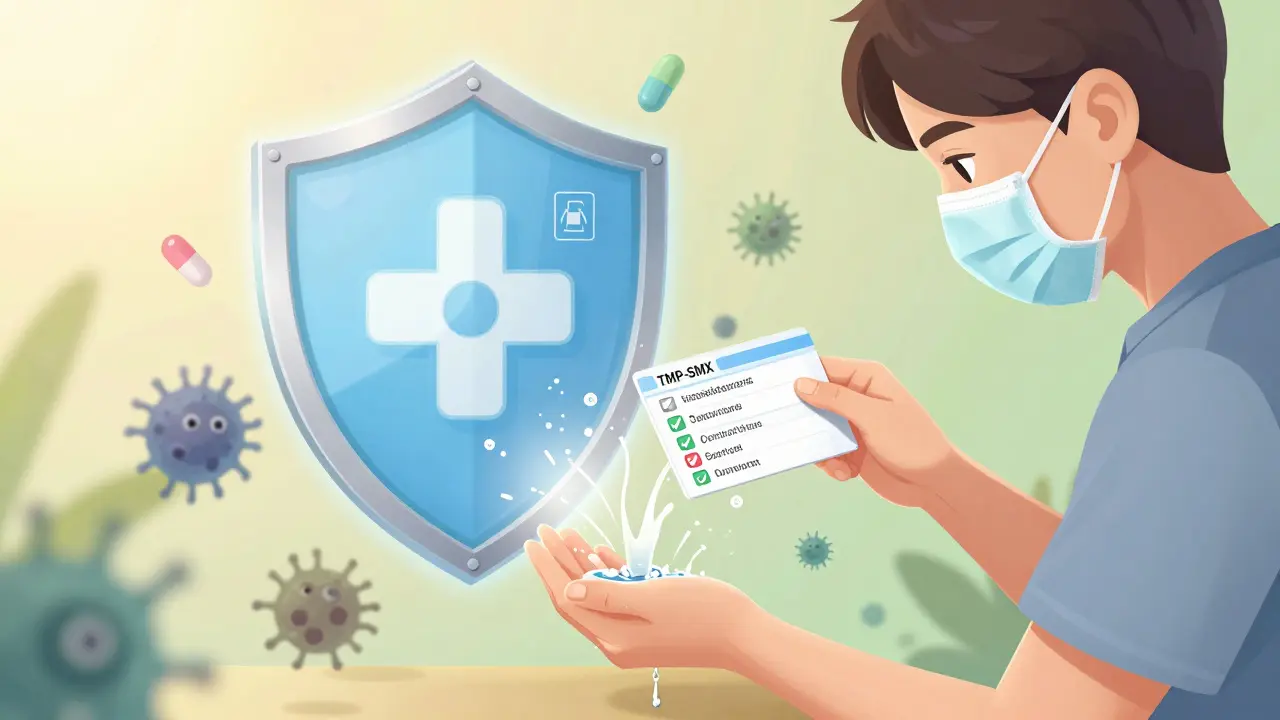
For patients in TB-endemic areas on >15 mg/day for more than three months, monthly chest X-rays are advised to catch pulmonary issues early. Beyond clinical tests, your behavior matters. Wash your hands frequently. Avoid close contact with sick individuals. Wear a mask in crowded indoor spaces during flu season. These basic hygiene measures become critical lifelines when your immune system is offline.
Education is also a preventive tool. A 2022 multicenter study found that patients who received structured education about infection symptoms had 28% fewer hospitalizations. Know the signs: unexplained fatigue, persistent cough, skin lesions, or urinary changes. Report them immediately. Do not wait for a scheduled appointment.
Reducing Dependency: Steroid-Sparing Strategies
The single most effective way to reduce infection risk is to lower your steroid dose. Dr. Mary Crow of the Hospital for Special Surgery emphasizes that using the lowest possible dose for the shortest duration is key. Rapid tapering protocols can reduce infection risk by 37% compared to slow tapers.
Work with your rheumatologist or specialist to introduce steroid-sparing agents. Drugs like methotrexate or biologic therapies can control your underlying autoimmune condition without suppressing your immune system as broadly. The European League Against Rheumatism (EULAR) recommends introducing these agents within four weeks of starting steroids. This approach allows you to taper off the steroids faster, closing the window of vulnerability sooner.
Emerging research offers hope for the future. Selective glucocorticoid receptor modulators (SEGRMs), such as vamorolone, are being tested in Phase II trials. Early data suggests they provide anti-inflammatory benefits with 47% fewer infections than traditional prednisone. While not yet widely available, these developments signal a shift toward precision medicine where we can treat inflammation without sacrificing immunity.
Your Action Plan
Take charge of your safety today. Review your current steroid dose and duration with your doctor. Ask specifically about PJP prophylaxis if you qualify. Check your vaccination records and ensure you are up to date on inactivated vaccines. If you haven’t been screened for latent TB, request the test. Finally, commit to a plan for tapering. Every milligram less of steroid is a step toward restoring your body’s natural defenses.
Can I get a live flu vaccine while on corticosteroids?
No. Live vaccines, including the nasal influenza spray, are generally contraindicated during immunosuppressive therapy. The weakened virus in the vaccine could replicate uncontrollably in your suppressed immune system, causing the actual disease. Stick to inactivated injectable vaccines instead.
At what dose of prednisone is infection risk considered high?
Risk increases significantly at doses of ≥20 mg/day of prednisone equivalent when taken for more than three to four weeks. However, any dose above 15 mg/day for longer than a month elevates the risk for specific infections like tuberculosis reactivation.
Why don't steroids affect B cells as much as T cells?
Glucocorticoids primarily inhibit the production of cytokines and effector molecules required for T cell activation and function. B cells, which produce antibodies, rely less on these specific signaling pathways for their immediate function, leaving humoral immunity relatively preserved compared to cellular immunity.
What is PJP prophylaxis and who needs it?
PJP prophylaxis is the preventive use of antibiotics, typically trimethoprim-sulfamethoxazole (TMP-SMX), to prevent Pneumocystis jirovecii pneumonia. It is recommended for patients taking ≥20 mg/day of prednisone equivalent for more than four weeks.
How can I tell if I have an infection if steroids mask the symptoms?
Since steroids can suppress fever and inflammation, you must rely on subtle signs. Watch for unexplained fatigue, mild shortness of breath, persistent dry cough, new skin rashes, or general malaise. Regular blood tests to monitor lymphocyte counts are also crucial for early detection.