
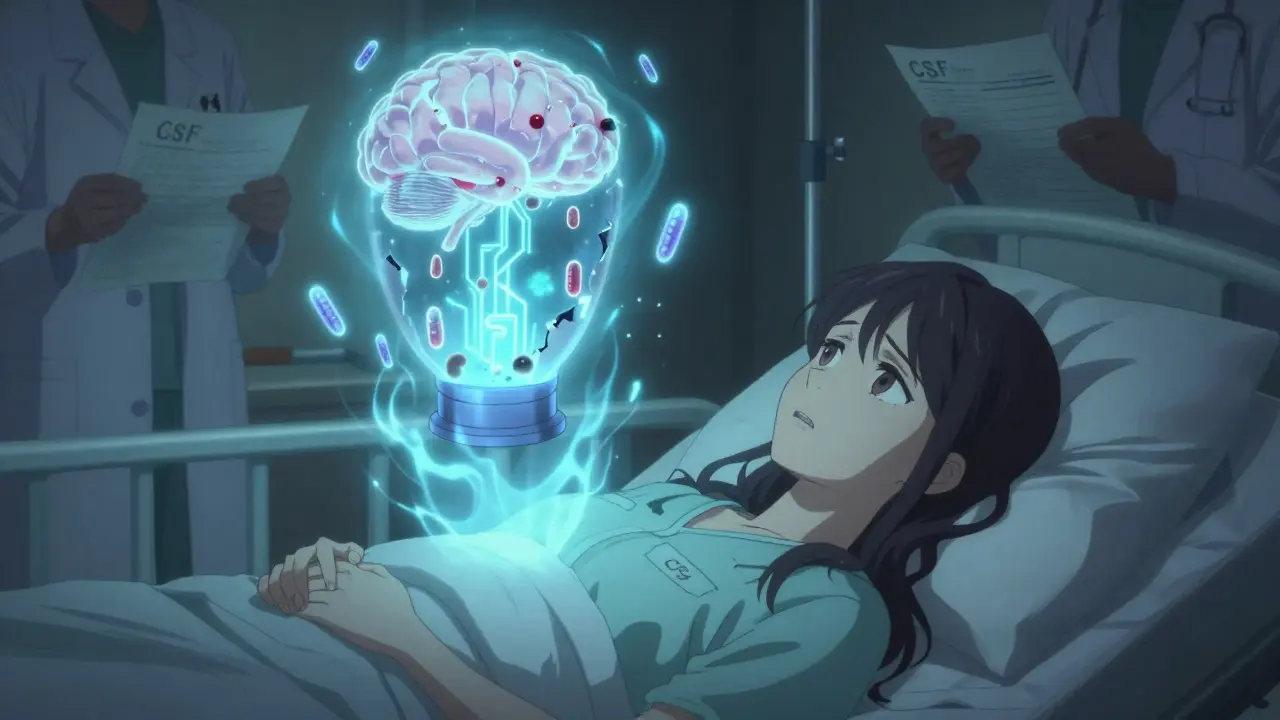
Autoimmune encephalitis isn’t something most people have heard of-until it hits someone they know. It doesn’t come on with a bang. It creeps in: a strange change in behavior, memory slipping away, seizures that don’t make sense, or a person who just seems "off" for weeks. If you’ve seen someone you care about go from sharp and clear-headed to confused, anxious, or unresponsive in a matter of days, this might be why.
What Exactly Is Autoimmune Encephalitis?
Autoimmune encephalitis (AE) happens when your immune system, which is supposed to protect you, turns on your brain. Instead of fighting germs, it attacks proteins on the surface of nerve cells. This triggers inflammation, swelling, and damage that messes with how your brain works. It’s not caused by a virus or bacteria-it’s your own body doing the harm.
The big breakthrough came in 2007 when researchers identified anti-NMDAR encephalitis. Before that, many cases were misdiagnosed as psychiatric disorders or viral brain infections. Now we know better. Over 20 different antibodies have been found that can cause AE, each with its own pattern of symptoms and risks. This isn’t one disease-it’s a group of related conditions, each with unique features.
Red Flags: When to Suspect Autoimmune Encephalitis
Most people with AE don’t wake up one day with a headache and fever. Symptoms build slowly, usually over days to weeks. Here are the top signs that should raise a red flag:
- Seizures that don’t respond to normal meds-especially if they’re new, frequent, or involve strange movements like jerking one arm or face.
- Memory loss and confusion-not just forgetting names, but losing track of time, repeating questions, or getting lost in familiar places.
- Psychiatric changes-anxiety, paranoia, hallucinations, or sudden personality shifts that look like psychosis but have no history of mental illness.
- Unexplained sleep problems-insomnia one night, sleeping 16 hours the next, or being awake all night and asleep during the day.
- Autonomic dysfunction-heart rate spiking without reason, blood pressure crashing, or sweating uncontrollably.
- Prodromal symptoms-headache, fever, or stomach bugs that happened 1-4 weeks before neurological symptoms started.
These aren’t rare. In one study of 207 patients, 85% had memory issues, 63% had sleep problems, and 42% had heart or blood pressure changes. If even two of these show up together, especially in someone under 50 without a clear infection, AE needs to be ruled out.
Antibodies: The Clues in Your Blood and Spinal Fluid
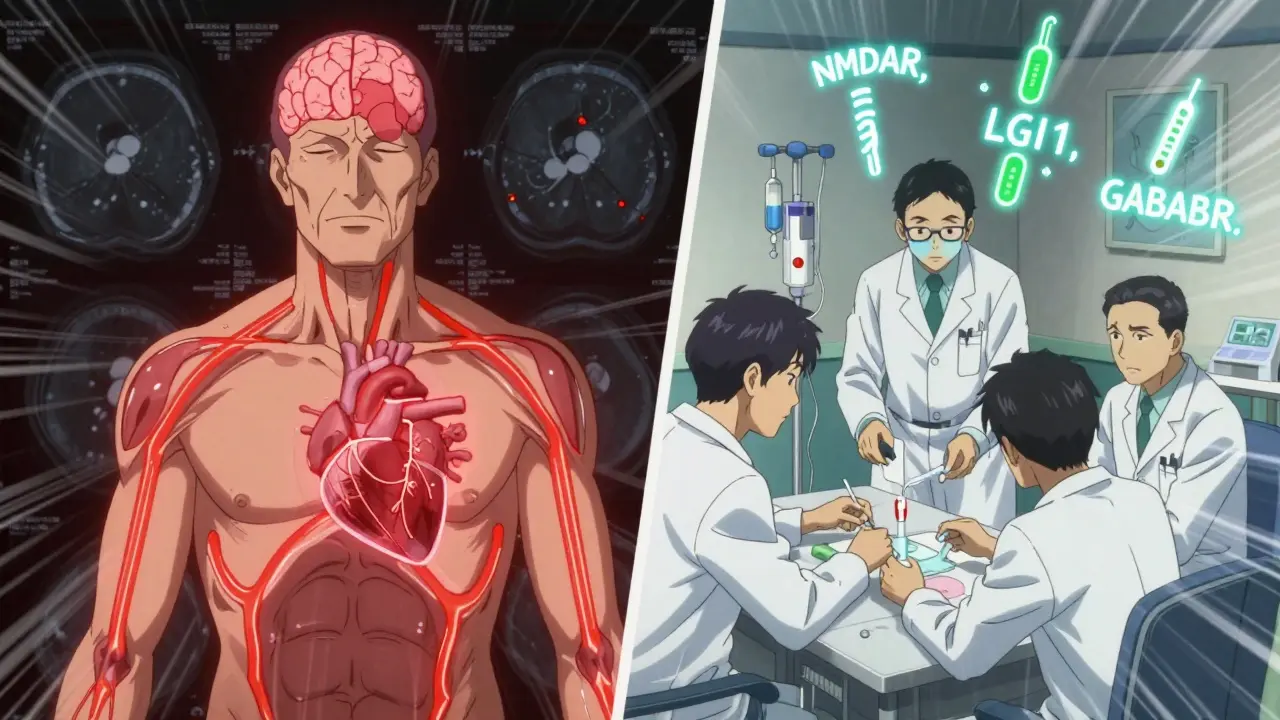
Doctors don’t guess-they test. And the test isn’t just one thing. They look for specific antibodies in both your blood and spinal fluid. CSF (cerebrospinal fluid) is more sensitive-up to 20% more accurate than blood alone for some antibodies.
Here are the most common types and what they tell you:
| Antibody | Typical Age | Key Symptoms | Associated Risks |
|---|---|---|---|
| Anti-NMDAR | 21 (young women) | Psychosis, seizures, memory loss, abnormal movements | 50-80% linked to ovarian teratoma |
| Anti-LGI1 | 60 (older men) | Faciobrachial dystonic seizures, hyponatremia | Low sodium, rare cancer link |
| Anti-GABABR | 50-70 | Seizures, confusion, memory loss | 50% have small cell lung cancer |
| Anti-CASPR2 | 50-60 | Neuropathic pain, insomnia, autonomic issues | May overlap with LGI1 |
| Anti-AMPAR | 50-70 | Memory loss, seizures, psychiatric symptoms | 25% linked to lung or breast cancer |
Anti-NMDAR is the most common, making up 40% of all cases. It’s often tied to ovarian tumors in young women. Anti-LGI1 is less common but more likely to cause frequent, brief muscle twitches in the face and arm. Anti-GABABR? That one almost always means cancer is hiding somewhere-and it’s serious.
Testing for antibodies isn’t optional. It changes everything. If you have anti-NMDAR, you need an ultrasound of your ovaries. If you have anti-GABABR, you need a full-body CT scan. Finding the tumor can be the cure.
How It’s Diagnosed: Ruling Out the Impossible
Doctors don’t just test for AE-they rule out everything else first. Infectious encephalitis (from viruses like herpes) looks similar but has different clues.
- CSF white blood cells: AE usually has under 100 cells/μL; infections often have hundreds or thousands.
- CSF protein: Mildly elevated in AE, but much higher in infections.
- EEG: Slowing is common in AE, but not the periodic spikes you see in viral encephalitis.
- MRI: Only 48% of AE cases show brain changes-often just mild swelling in the hippocampus. Infections? 89% show clear damage.
That’s why AE is so easy to miss. If your MRI looks normal, you might be told it’s "just stress." But if your symptoms match the pattern-especially with memory loss, seizures, and psychiatric symptoms-AE should be on the table.
Treatment: Time Is Everything
There’s no time to wait. Every day matters. Studies show that if treatment starts within 30 days of symptoms, 78% of patients recover well. If you wait over 45 days? That drops to 42%.
First-line treatment is aggressive and fast:
- Intravenous steroids (methylprednisolone, 1g/day for 5 days)-68% respond within a week.
- IV immunoglobulin (IVIg) (0.4g/kg/day for 5 days)-works in 60-70% of cases.
- Plasma exchange (5-7 sessions over 10-14 days)-used for critically ill patients; 65% improve fast.
If a tumor is found-like an ovarian teratoma in anti-NMDAR cases-surgery is the first step. Removing it leads to neurological improvement in 85% of patients within four weeks.
For those who don’t respond to first-line treatment, second-line options include:
- Rituximab (weekly infusions for 4 weeks)-55% response rate.
- Cyclophosphamide (monthly for 6 months)-48% response.
- Tocilizumab (every 4 weeks)-emerging data shows 52% effectiveness in tough cases.
And here’s the hard truth: Don’t wait for test results to start treatment. If the clinical picture screams AE, begin therapy immediately. Delaying for confirmation worsens outcomes by 40%.

Long-Term Outlook: Recovery Isn’t Always Complete
Many people recover well-but not everyone goes back to how they were before.
- 55% of anti-LGI1 patients recover fully by 2 years. For anti-NMDAR? It’s 45%.
- Anti-GABABR has a 25% mortality rate over 3 years, mostly because of cancer.
- 40% of survivors have lasting problems: memory gaps, trouble focusing, depression, anxiety, or ongoing seizures.
- Recurrence is real: 12-25% for anti-NMDAR (median 14 months), 35% for anti-LGI1 (median 22 months).
Long-term care isn’t just about drugs. It’s rehab:
- Cognitive therapy improves memory function by 65% after 12 weeks.
- SSRIs help 70% of patients with depression or anxiety.
- Physical therapy improves movement in 50% of cases within 8 weeks.
- Melatonin (3-5 mg at night) helps 60% with sleep issues.
- Beta-blockers control tachycardia in 75% of autonomic cases.
Follow-up is non-negotiable. Repeat tumor screening every 4-6 months for two years-even if the first scan was clear. Some tumors show up later.
What’s Next? New Hope on the Horizon
Research is moving fast. Scientists are now tracking GFAP (a protein released when brain cells are damaged) as a real-time marker of disease activity. It’s 82% correlated with how bad the inflammation is-meaning future tests might show if treatment is working before symptoms change.
New drugs are in trials: B-cell depleters and complement inhibitors are showing 60% response in patients who didn’t respond to anything else. These aren’t available yet, but they’re coming.
The message from experts is clear: Early recognition saves brains. If you see someone you love suddenly changing-confused, seizing, withdrawn-don’t wait. Push for AE testing. Start treatment fast. The window is narrow. Every day counts.
Can autoimmune encephalitis be cured?
Yes, many people recover fully-especially if treated early. About 55-78% of patients achieve good outcomes (minimal disability) with prompt treatment. But recovery isn’t guaranteed. Some are left with lasting memory, mood, or movement problems. Recurrence is possible, especially with anti-LGI1 antibodies. Long-term follow-up is essential.
Is autoimmune encephalitis contagious?
No. Autoimmune encephalitis is not caused by an infection and cannot be passed from person to person. It’s an internal immune mistake-not a virus or bacteria. You can’t catch it from someone else.
Do all cases of autoimmune encephalitis have tumors?
No. Only about 30% of cases are linked to tumors. But the type of antibody tells you the risk. Anti-NMDAR is tied to ovarian teratomas in young women. Anti-GABABR and anti-AMPAR are strongly linked to lung or breast cancer. Even if the first scan is clear, repeat screenings are needed because tumors can appear months later.
Why is spinal fluid testing better than blood?
The antibodies that attack the brain are often made inside the central nervous system. Blood tests can miss them if they’re only present in the spinal fluid. CSF testing is 15-20% more sensitive, especially for anti-NMDAR and other surface antibodies. A negative blood test doesn’t rule out AE-CSF is key.
Can children get autoimmune encephalitis?
Yes. Anti-NMDAR encephalitis is actually more common in children and young adults than in older people. In fact, it’s the most frequent type of autoimmune encephalitis in pediatric cases. Symptoms in kids can include irritability, regression in speech or motor skills, and unusual movements. It’s often mistaken for autism or behavioral disorders.
How long does treatment last?
Initial treatment lasts weeks to months. Steroids and IVIg are given over days to weeks. Second-line drugs like rituximab or cyclophosphamide are given monthly for 3-6 months. Some patients need maintenance therapy for over a year. Recovery can take 6-12 months or longer. Patience and consistent rehab are part of the process.
Autoimmune encephalitis is rare, but it’s real. And when caught early, it’s one of the few neurological conditions where treatment can turn a devastating decline into a full recovery. If you’re seeing signs in someone you care about-don’t wait. Ask the questions. Push for tests. Time is the most powerful medicine here.




Jazminn Jones
March 10, 2026 AT 00:06The structural rigor of this post is commendable. The stratification of antibodies by clinical phenotype, coupled with CSF sensitivity metrics, represents a paradigm shift in diagnostic algorithm design. One must acknowledge the methodological precision in differentiating AE from infectious encephalitis via CSF WBC thresholds-this is not merely clinical observation, but evidence-based taxonomy. The 20% sensitivity gain of CSF over serum for surface antigens is statistically non-trivial and should be institutionalized in all tertiary neurology protocols. Furthermore, the temporal correlation between tumor resection and neurological recovery in anti-NMDAR cases (85%) is not anecdotal-it is the new gold standard for paraneoplastic management. This is not a blog. This is a meta-analysis disguised as a Reddit post.
Stephen Rudd
March 11, 2026 AT 23:53Erica Santos
March 12, 2026 AT 06:18George Vou
March 13, 2026 AT 18:02Scott Easterling
March 14, 2026 AT 20:08Mantooth Lehto
March 15, 2026 AT 12:39Nicholas Gama
March 16, 2026 AT 10:52Mary Beth Brook
March 18, 2026 AT 01:37