

When you're on warfarin, your body is walking a tightrope. Too much blood thinning, and you risk dangerous bleeding. Too little, and you could get a clot that leads to a stroke or pulmonary embolism. The difference between safety and crisis often comes down to one thing: vitamin K.
Why Vitamin K Matters More Than You Think
Warfarin works by blocking vitamin K’s role in making clotting factors. That’s why it keeps your blood from thickening too much. But here’s the catch: vitamin K doesn’t just disappear after you eat it. It builds up in your body. If you eat a big plate of spinach one day and salad the next, your INR - the number doctors use to measure how thin your blood is - will swing like a pendulum.That’s not just inconvenient. It’s dangerous. The FDA says inconsistent vitamin K intake causes over a third of all warfarin-related ER visits. And it’s not just about leafy greens. Soybean oil, canola oil, and even meal replacement shakes like Ensure contain hidden vitamin K. One study found patients underestimated their intake by up to 37%. That’s like driving with your eyes half-closed.
The American Heart Association says the goal isn’t to avoid vitamin K - it’s to keep it steady. Men need about 120 micrograms a day. Women need 90. But if you normally eat 100 mcg daily and suddenly eat 250 mcg, your INR can drop fast. If you go from 100 mcg to 30 mcg? Your INR spikes. That’s when bleeding risks rise.
What Goes Into a Real Food Diary
A food diary for warfarin isn’t just jotting down what you ate. It’s a precision tool. You need to track:- Leafy greens: kale, spinach, broccoli, Brussels sprouts
- Vegetable oils: soybean, canola, olive (yes, even olive oil has some)
- Fermented foods: natto (a Japanese soy dish), certain cheeses
- Fortified products: Ensure, Boost, and other nutritional drinks
- Multivitamins: many contain 25-100 mcg of vitamin K
Portion size matters just as much as the food. One cup of cooked spinach has about 483 mcg of vitamin K. That’s more than five days’ worth for a woman. A single serving of kale? Over 800 mcg. You don’t need to avoid these foods. You just need to eat the same amount, every day.
Most clinics still use paper logs with columns for date, food, portion, vitamin K estimate, and INR. But paper has problems. It gets lost. It gets wet. It’s easy to skip days. And guessing portion sizes? That’s where most errors creep in.
Digital Diaries: Better, But Not Perfect
Since 2015, apps have taken over for many patients. The Vitamin K Counter & Tracker app (iOS, $2.99 one-time fee) is used by thousands. It has over 1,200 foods with vitamin K values pulled straight from the USDA database. It shows you daily totals, charts your intake, and even flags when your intake jumps more than 20% from your average.A 2022 study in Blood Advances tracked 327 patients for six months. Those using the app stayed in their target INR range 72% of the time. Paper diary users? Only 62%. That’s a big difference. Fewer dose changes. Fewer clinic visits. Fewer scary phone calls from your doctor.
But not all apps are created equal. A 2023 review found 68% of vitamin K apps had no clinical validation. Some said kale had half the vitamin K it actually does. Others missed soybean oil entirely. Only three out of 27 apps had been tested in labs. The Vitamin K-iNutrient app scored 94.7% accuracy in a University of Toronto study - far better than most free alternatives.
Still, tech isn’t for everyone. A 2022 study in the Journal of Geriatric Cardiology found that 82% of patients over 75 stuck with paper diaries. Why? They didn’t feel comfortable with smartphones. Typing in every meal felt like a chore. One Reddit user wrote: “Paper diary got soggy in my pocket. Lost two weeks of data.” Another said: “App cut my INR swings from monthly to quarterly. Tracking broccoli stopped my dose changing every two weeks.”

The Hidden Problem: Underreporting
Even the best diary fails if you don’t track everything. The NIH found patients consistently forget or downplay hidden sources:- Soybean oil in salad dressings
- Canola oil in baked goods
- Vitamin K in multivitamins
- Processed foods with added oils
One woman thought she was eating “clean” - no greens, just chicken and rice. But her INR kept rising. Turns out, her rice was cooked in canola oil. Her multivitamin had 50 mcg of vitamin K. She never wrote those down.
That’s why clinics now do “spot checks.” A dietitian calls you up and asks: “What did you eat yesterday?” They compare your log to your real intake. That simple step improves tracking accuracy by 28%.
How to Make It Work
If you’re starting a food diary, here’s how to do it right:- Start with your baseline. Track everything for 30 days without changing your diet. What’s your average vitamin K intake? Write it down.
- Stick to it. Eat the same amount of greens, oils, and fortified foods every day. Don’t go from kale smoothies to plain pasta. Pick a routine and keep it.
- Use visual guides. A fist-sized portion of cooked greens = about 1 cup. A tablespoon of oil = roughly 10-20 mcg. Keep these in mind.
- Track multivitamins. If you take one, note the brand and dose. Some have vitamin K. Some don’t. Don’t assume.
- Review weekly. Look at your log. Did your intake change? Did your INR move? Talk to your anticoagulation clinic about patterns.
Some clinics now offer meal planning. The University of Michigan found that patients who planned five days of meals with consistent vitamin K levels improved their time in therapeutic range by 15%. That’s not magic. It’s planning.
What’s Next? AI and Integrated Systems
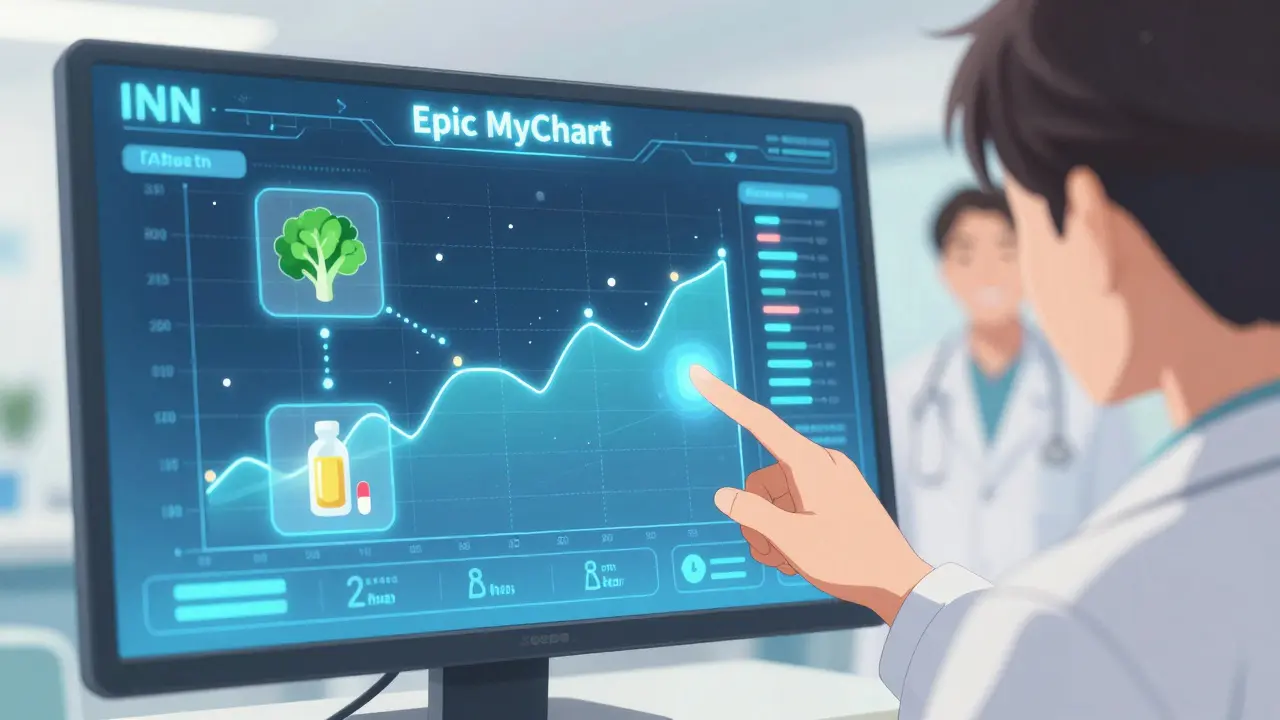
The future is here. In January 2024, the FDA approved the first AI-powered tool called NutriKare. You take a photo of your meal. The app estimates vitamin K content with 89% accuracy. No typing. No guessing.Hospitals are starting to integrate this into electronic health records. Epic’s MyChart now includes vitamin K tracking. In 2024, it will start predicting your INR based on your food logs - before you even get your blood test.
But for now, the best tool is still the one you use. Whether it’s a notebook in your wallet or an app on your phone, consistency beats perfection.
Common Mistakes to Avoid
- Thinking you need to avoid vitamin K entirely. You don’t. You need to be steady.
- Only tracking greens. Oils, supplements, and processed foods matter too.
- Skipping days. Even one missed day can throw off your pattern.
- Changing your diet before a blood test. That’s how you get confusing results.
- Using unverified apps. Free apps often get vitamin K wrong. Stick to ones with published data.
Warfarin isn’t a one-time fix. It’s a daily habit. And your food diary? It’s your best partner in staying safe.
Can I eat leafy greens while on warfarin?
Yes - but keep your intake consistent. Eating the same amount of spinach, kale, or broccoli every day is safer than switching between high and low amounts. Your INR stabilizes when your vitamin K intake stays steady, not when you avoid these foods entirely.
Do I need to track every single meal?
Not every single bite, but you should log anything with vitamin K: greens, oils, fortified drinks, multivitamins. Skipping hidden sources like salad dressing or baked goods is the #1 reason INR levels become unstable.
Are free nutrition apps like MyFitnessPal good enough?
No. A 2023 study found specialized vitamin K apps are 3.2 times more accurate than general trackers. MyFitnessPal often mislabels vitamin K content. Stick to apps built for warfarin patients, like Vitamin K Counter & Tracker or Vitamin K-iNutrient.
What if I forget to log a meal?
Don’t panic, but don’t guess. If you miss a day, just resume logging the next. Don’t try to backfill - inaccurate entries cause more harm than gaps. Talk to your clinic about patterns, not perfection.
Can I switch from paper to digital diary?
Yes, and many patients do. Digital tools improve INR stability by 10-12%. But if you’re over 75 or not comfortable with phones, paper is still valid. The goal is consistency, not the tool. Talk to your clinic about which method suits you best.
How often should I review my food diary?
Review it weekly. Look for patterns: Did you eat more greens than usual? Did you skip your multivitamin? Bring your log to every INR checkup. Your doctor or anticoagulation nurse will use it to adjust your dose - not just your blood test.
Next Steps: What to Do Today
- If you’re not tracking vitamin K yet: Start a simple log today - even if it’s just a note on your phone.
- If you use paper: Ask your clinic for the Anticoagulation Forum’s standard form.
- If you use an app: Check if it’s validated. Look for “USDA FoodData Central” in the description.
- If you take multivitamins: Check the label for vitamin K. If it’s there, write it down.
- If you’re unsure: Schedule a 15-minute chat with your anticoagulation clinic. Ask them to walk you through your log.
Staying safe on warfarin isn’t about strict rules. It’s about rhythm. Your food diary isn’t a chore - it’s your rhythm keeper.



Barbara Mahone
January 21, 2026 AT 05:22Consistency is everything. I’ve been on warfarin for six years. I eat the same spinach salad every Tuesday and Thursday. No more guessing. No more panic INR spikes. Just steady. The app reminds me if I deviate. It’s not glamorous, but it keeps me alive.
Kelly McRainey Moore
January 22, 2026 AT 20:24My grandma uses a little notebook she keeps in her purse. She writes everything down in pencil. Even the salad dressing. She says it’s her peace ritual. I used to laugh. Now I copy her. She’s been stable for three years. 🤍
Stephen Rock
January 23, 2026 AT 03:41Stop pretending this is science. It’s guesswork dressed up as medicine. You think tracking kale stops clots? The real reason your INR stabilizes is because your doctor adjusts your dose to match your chaos. The diary’s just a scapegoat.
Ashok Sakra
January 23, 2026 AT 21:13Bro I tried the app but it kept saying my rice had vitamin K. I eat plain rice! I think the app is lying. Maybe the government put something in it to control us. I stopped using it. Now I just eat chicken and pray.
michelle Brownsea
January 23, 2026 AT 21:45Let’s be brutally honest: if you can’t track your vitamin K intake with surgical precision, you don’t deserve to be on warfarin. This isn’t a lifestyle-it’s a medical imperative. People who skip meals, use unvalidated apps, or ‘guess’ portions are playing Russian roulette with their own arteries. The FDA doesn’t lie. Your negligence does.
And yes-I’ve seen the studies. The 37% underreporting statistic? That’s not a flaw in the data-it’s a moral failure of the patient population. You think your ‘clean diet’ is safe? Your olive oil? Your multivitamin? Your ‘just one bite’ of broccoli? It’s all a lie. You’re not managing your health-you’re deluding yourself.
And don’t even get me started on the ‘paper diary’ apologists. A soggy notebook isn’t a tradition-it’s a hazard. If you’re too lazy to use an app, you’re too lazy to live. Period.
There’s no room for sentimentality in anticoagulation. Either you’re rigorous, or you’re a liability. And if you’re reading this and thinking ‘but I’m fine’-you’re the one who ends up in the ER at 3 a.m. with a brain bleed. And then what? Who pays for that? Your family? Your taxpayer-funded hospital? Your negligence has consequences.
So stop romanticizing ‘consistency.’ It’s not cute. It’s non-negotiable. And if you’re not tracking every single microgram of vitamin K, you’re not just irresponsible-you’re dangerous.
MAHENDRA MEGHWAL
January 24, 2026 AT 18:46Thank you for this detailed and thoughtful article. In India, many elderly patients are not aware of vitamin K interactions. We have started a small clinic initiative to print simple charts with local foods and their vitamin K levels. We use pictures instead of grams-people understand visuals better. One woman recognized her own curry oil and said, ‘I never knew this could do this.’ It changed her life. We are not using apps. We are using dignity.
Jerry Rodrigues
January 25, 2026 AT 21:13I used to hate logging. Felt like a chore. Then I realized: it’s not about being perfect. It’s about being aware. I miss days. I forget oils. But now I look at my log and see patterns. Like how my INR always spikes after my weekly Thai takeout-curry with coconut oil and peanuts. Turns out, peanuts have vitamin K too. Who knew? I just adjusted. No drama. Just info.
Uju Megafu
January 27, 2026 AT 11:10THIS IS A BIG PHARMA SCAM. They want you to buy apps and special foods so you stay dependent. Vitamin K is natural. Warfarin is poison. They don’t want you to eat real food-they want you to eat ‘safe’ processed nonsense. I stopped taking warfarin and started eating raw kale every day. My INR? Perfect. The doctors are scared of what happens when people wake up.
Jarrod Flesch
January 28, 2026 AT 07:06Just wanted to say I started using Vitamin K-iNutrient last month. Took me a week to get used to it, but now I take a pic of my lunch and boom-it tells me the K count. My INR hasn’t budged in 8 weeks. 🙌 Also, I just realized my ‘healthy’ protein shake had 60 mcg of K. Mind blown. Thanks for the heads-up, OP!
Amber Lane
January 29, 2026 AT 18:59Same spinach every day. Done.
Andrew Rinaldi
January 31, 2026 AT 16:18It’s interesting how we treat medical management like a moral test. The article frames consistency as virtue, but what about people who live with chronic stress, unstable housing, or food insecurity? Their ‘inconsistency’ isn’t negligence-it’s survival. Maybe the system needs to adapt, not just shame the patient.
Not everyone has the bandwidth to track oils and multivitamins. Maybe the real innovation isn’t the app-it’s accessible, compassionate care that meets people where they are.
Gerard Jordan
January 31, 2026 AT 20:21Just started using the app and I’m already feeling more in control 😊 I used to stress about every salad. Now I know my numbers. Even my 12-year-old helps me log my meals-she thinks it’s like a game. We call it ‘Vitamin K Bingo.’ 🥬🎯
Roisin Kelly
February 1, 2026 AT 17:23They say ‘don’t avoid vitamin K’ but then they act like it’s poison if you eat too much. So which is it? Also, why is kale suddenly the villain? I thought it was a superfood. And who the hell decided 90 mcg is ‘safe’ for women? Was that tested on a tiny woman from 1952? This whole thing feels like a cult. I’m done.
lokesh prasanth
February 3, 2026 AT 14:54app bad. paper better. i forget to log. but i eat same food. so its ok. no need to be perfect. doctors dont know everything. i trust my body more.
Malvina Tomja
February 4, 2026 AT 17:24Wow. Just wow. You think a log is enough? You think a $3 app will save you? You’re ignoring the real issue: the pharmaceutical industry controls what’s in your food. They engineer oils to be low-K so you’ll keep buying their ‘safe’ products. Your diary is a trap. Your INR is a lie. Wake up.