
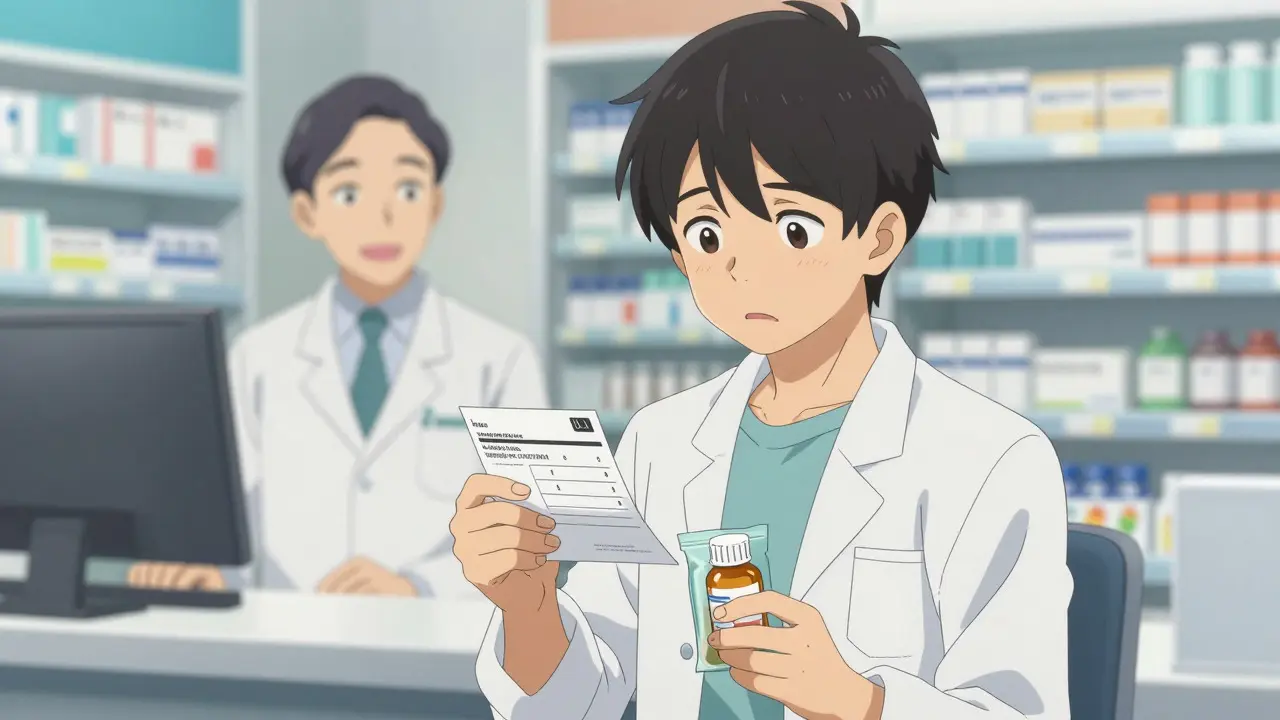
Imagine standing at the pharmacy counter with a prescription for a life-saving medication. For someone on Medicaid, the U.S. federal-state health insurance program established in 1965 under Title XIX of the Social Security Act, providing healthcare coverage for low-income individuals and families, the difference between choosing a brand-name drug and its generic counterpart isn't just about brand loyalty-it’s often the difference between filling the prescription or going without. In 2023, the average copay for a generic drug was $6.16, while the brand-name equivalent cost nearly nine times more at $56.12. That is a gap that can make or break a household budget.
Generic drugs are not just an option for Medicaid beneficiaries; they are the backbone of the system. According to the Association for Accessible Medicines (AAM), 90% to 91% of all prescriptions filled through Medicaid are for generic medications. Yet, despite making up the vast majority of pills dispensed, these generics account for only about 18% of total Medicaid prescription spending. This disparity highlights a critical reality: generics provide extraordinary value by keeping costs down for both the government programs and the patients who rely on them.
The Mechanics of Medicaid Drug Pricing
To understand why generics save so much money, you have to look behind the scenes at how Medicaid pays for drugs. It isn’t as simple as the pharmacy charging a set price. The core mechanism driving these savings is the Medicaid Drug Rebate Program (MDRP), established by the Omnibus Budget Reconciliation Act of 1990, requiring drug manufacturers to provide rebates to state Medicaid programs in exchange for having their drugs covered by Medicaid.
Here is how it works in practice. When a manufacturer wants their drug covered by Medicaid, they agree to kick back a portion of the revenue. For non-specialty generic drugs, Medicaid obtained average rebates equal to 86% of the average retail price in recent years, according to data from the Medicaid and CHIP Payment and Access Commission (MACPAC). This means if a generic drug has a retail price of $100, the manufacturer might rebate $86 back to the state. The net cost to the program is significantly lower than the sticker price suggests.
| Metric | Generic Drugs | Brand-Name Drugs |
|---|---|---|
| Average Patient Copay | $6.16 | $56.12 |
| Share of Prescriptions Filled | 90-91% | 9-10% |
| Share of Total Spending | 17.5-18.2% | 81.8-82.5% |
| Typical Rebate Rate | ~86% of retail price | ~77% of retail price |
This rebate structure ensures that Medicaid often gets the lowest net prices among all federal programs. A 2021 Congressional Budget Office study found that Medicaid obtains lower net prices than even the Department of Veterans Affairs. However, this system is complex. While rebates reduce gross spending by over 50%, the actual out-of-pocket experience for patients depends heavily on state-specific formulary designs and managed care organization (MCO) contracts.
Real-World Savings for Low-Income Families
For the patient, the theoretical savings translate into tangible relief. Data shows that 93% of generic prescriptions are dispensed for under $20 at the pharmacy counter. Compare that to brand-name drugs, where only 59% fall below that threshold. For a family living paycheck to paycheck, a $6 copay is manageable. A $56 copay can mean skipping meals or delaying other essential purchases.
Consider the case of asthma management. A common scenario involves a patient needing a daily inhaler. If the insurer covers the generic version, the monthly cost drops dramatically. One Medicaid beneficiary shared online that switching her daughter’s inhaler to a generic reduced the copay from $25 to $3. While she noted delays in getting prior authorization approval, the long-term financial impact was positive. These small savings add up over a year, potentially saving hundreds of dollars per patient.
Beyond individual budgets, the aggregate savings are staggering. From 2009 to 2019, generic drugs provided an estimated $2.2 trillion in savings across the entire U.S. healthcare system. In 2022 alone, generics and biosimilars generated a record $408 billion in savings. Dr. Douglas Hough from Johns Hopkins Bloomberg School of Public Health noted that generics represent only 1.5% of all U.S. health care spending despite filling 90% of prescriptions. This efficiency allows Medicaid programs to stretch their budgets further, covering more people and services.

The Challenge of Specialty Drugs and Rising Costs
If generics are so cheap and effective, why is Medicaid drug spending still rising? The answer lies in specialty drugs. These are high-cost medications used to treat complex conditions like cancer, rheumatoid arthritis, or multiple sclerosis. In fiscal year 2021, drugs costing over $1,000 per claim accounted for less than 2% of prescriptions but more than half of Medicaid’s total drug spending.
This trend is shifting the financial landscape. While generics keep the baseline costs low, the increasing utilization of specialty drugs is driving overall spending growth. Net spending on prescription drugs after rebates increased by 72% from $30 billion in FY 2017 to $51 billion in FY 2023. By 2024, net spending reached $60 billion. This surge has prompted new initiatives, such as the CMS GENEROUS Model launched in 2024, which aims to generate cost reductions through better utilization management and formulary design.
Furthermore, inefficiencies in the supply chain can erode some of these savings. A 2025 report by the Ohio Auditor of State revealed that Pharmacy Benefit Managers (PBMs) charged fees totaling 31% on generic drugs worth $208 million in one year. These administrative costs don’t always translate to lower prices for patients, highlighting a disconnect between manufacturer pricing, PBM fees, and final patient costs.

Navigating the System: What Patients Need to Know
For low-income patients, maximizing these savings requires understanding how your specific Medicaid plan works. Most states use Managed Care Organizations (MCOs) to deliver pharmacy benefits. These MCOs create formularies-lists of covered drugs-that typically place generics in the lowest cost tier.
- Automatic Substitution: In most cases, pharmacists will automatically substitute a generic for a brand-name drug unless your doctor specifies "Dispense as Written." Always ask if a generic is available when you fill a new prescription.
- Prior Authorization: About 15-20% of prescriptions require prior authorization, meaning your doctor must get approval from the insurer before the drug is covered. This process can cause delays, as seen in the asthma inhaler example above. Patience and follow-up are key.
- State Variations: Medicaid rules vary by state. While federal law sets minimum standards, states decide which specific drugs are covered and how copays are structured. Check your state’s Medicaid website for detailed formulary information.
Documentation quality varies, with the National Association of Medicaid Directors rating state program transparency at 7.2 out of 10 in 2024. If you face unexpected costs, contact your MCO’s member services line. They can clarify whether a higher copay is due to a formulary change, a lack of generic availability, or an error.
Future Outlook: Biosimilars and Policy Changes
Looking ahead, the role of generics in Medicaid is evolving. As more biologic drugs lose patent protection, biosimilars-generic versions of complex biological medicines-are expected to play a larger role. The AAM projects that biosimilars could contribute an additional $100 billion in annual savings by 2027. This expansion offers hope for reducing costs in areas where traditional generics cannot be used, such as insulin or monoclonal antibodies.
Policy changes may also impact pricing. The Inflation Reduction Act introduced Medicare drug price negotiations, and researchers at Stanford Medicine project that extending similar negotiated prices to Medicaid could yield an additional $15-20 billion in savings over a decade. However, challenges remain. The decline in rebate percentages-from 54% of gross spending in FY 2017 to 51% in FY 2023-suggests that manufacturers are finding ways to offset rebates with higher list prices.
Despite these headwinds, the core value proposition remains intact. Generics continue to be the most cost-effective way to deliver essential medications to low-income patients. By leveraging the Medicaid Drug Rebate Program and prioritizing generic prescribing, the system maintains accessibility for millions of Americans. For patients, staying informed about formulary changes and advocating for generic options whenever possible is the best strategy to minimize out-of-pocket costs.
What is the average copay for generic drugs in Medicaid?
The average copay for generic drugs in Medicaid is approximately $6.16, according to the 2022 and 2023 Association for Accessible Medicines (AAM) Savings Reports. This is significantly lower than the average brand-name copay of $56.12.
Do Medicaid patients always have to pay for generic drugs?
Not always. While many Medicaid enrollees pay a small copay, some categories of beneficiaries, such as children or those in certain waiver programs, may have $0 copays for generics. Additionally, 93% of generic prescriptions are dispensed for under $20, making them highly affordable for most low-income patients.
Why are Medicaid drug costs rising if generics are so cheap?
While generics are inexpensive, the increasing use of high-cost specialty drugs is driving overall spending up. In FY 2021, drugs costing over $1,000 per claim accounted for less than 2% of prescriptions but more than half of Medicaid's total drug spending. This shift toward complex treatments is outpacing the savings from generics.
How does the Medicaid Drug Rebate Program work?
The Medicaid Drug Rebate Program (MDRP) requires drug manufacturers to pay rebates to state Medicaid programs in exchange for having their drugs covered. For generic drugs, these rebates can be as high as 86% of the average retail price, significantly lowering the net cost to the program.
Can I request a brand-name drug instead of a generic on Medicaid?
Yes, but it usually requires a "medical necessity" justification from your doctor and may involve prior authorization. Without approval, you will likely be responsible for the higher brand-name copay, which averages $56.12 compared to $6.16 for generics.



Megan Crossland
July 19, 2026 AT 15:01it is absolutely shameful that we have a system where the rich get cheaper drugs through insurance loopholes while the poor are left to navigate this bureaucratic nightmare just to survive.
the fact that generics save money is not news it is basic human decency and yet we treat it like a miracle instead of a right.
look at the data provided in the post.
ninety percent of prescriptions are generic.
that means ninety percent of people are getting the deal they deserve.
but the other ten percent?
they are being screwed by big pharma greed.
we need to stop pretending that market forces will fix this because they never do for the vulnerable.
the rebate program is a band-aid on a bullet wound.
manufacturers know exactly what they are doing.
they hike the list price knowing the rebate will cover most of it but then they find ways to squeeze more out of the system.
it is predatory behavior plain and simple.
and who pays the price?
not the shareholders.
not the executives.
the single mother working two jobs trying to keep her asthma inhaler affordable.
we need moral courage in our healthcare policy.
right now we have accountants running the show.
shame on us all.
Trey Newkerk
July 19, 2026 AT 22:25You speak of 'moral courage' as if it exists in a vacuum, detached from the brutal reality of supply and demand.
The system is not broken; it is functioning precisely as designed to extract value from those with the least leverage.
To call it 'shameful' is to misunderstand the nature of power.
Power does not care about your shame.
It cares about margins.
And the margins on specialty drugs are where the real game is played.
Generics are the consolation prize for the masses, the cheap bread to keep the populace docile while the elite feast on biologic innovations priced beyond comprehension.
This article pretends there is a solution within the current framework.
There is none.
The rebate system is a dance of deception, a theater of accounting tricks that masks the true cost of life itself.
We are not saving money; we are merely delaying the inevitable collapse of a system built on the exploitation of necessity.
Medicaid is not a safety net; it is a leash.
And you are cheering because the leash has a few extra inches of slack.
How tragic.
How utterly pathetic.
You should feel less self-righteous and more terrified of the abyss staring back at you when your own health fails you.
Then you will understand that morality is a luxury item, far more expensive than any brand-name drug.
Charles PINSON
July 20, 2026 AT 22:52Your emotional outburst is entirely devoid of analytical rigor.
The inefficiencies cited in the Ohio Auditor report regarding PBM fees are not merely 'greed'; they are structural imperatives of a multi-layered distribution network that requires administrative overhead to function.
To dismiss the complexity of formulary design as mere 'bureaucratic nightmare' reveals a profound ignorance of how managed care organizations mitigate risk.
The 31% fee structure mentioned is likely an outlier or misinterpreted metric, yet you accept it as gospel without examining the underlying contractual obligations.
Furthermore, the assertion that manufacturers 'hike list prices' ignores the negotiated net prices which are often significantly lower than the gross figures suggest.
The Congressional Budget Office study referenced actually supports the efficacy of the current rebate model relative to other federal programs.
Your moralizing is tedious and intellectually bankrupt.
Stick to reading the footnotes rather than projecting your inadequacy onto the macroeconomic realities of pharmaceutical pricing.
It would be refreshing to see a comment that engages with the data rather than performing indignation for an audience that lacks the capacity to distinguish between sentiment and substance.
But I suppose that is asking too much from the average reader.
They prefer their truth wrapped in emotion rather than cold hard facts.
A pity really.
For the future of rational discourse.
John Anderson
July 22, 2026 AT 08:02you are hiding behind words to avoid the truth.
the truth is people are suffering.
your analysis does not feed them.
your analysis does not cure them.
stop talking and start listening to the people who are hurting.
they do not care about your metrics.
they care about staying alive.
get out of their way.
Patrick Plummer
July 22, 2026 AT 22:47Oh, please! Do tell us more about your 'structural imperatives'!
As if the so-called 'administrative overhead' isn't just a euphemism for siphoning off public funds into private pockets!
The audacity of suggesting that a 31% fee is 'normal' is staggering!
It is theft! Plain and simple!
And don't think I haven't noticed the subtle implication that the patients are somehow complicit in their own exploitation!
Typical elitist nonsense!
You sit in your ivory tower, parsing footnotes, while the rest of us struggle to afford insulin!
The 'net prices' you mention are a fiction created by accountants to soothe the consciences of policymakers!
The list price is what matters because it dictates the baseline for all negotiations!
By inflating the list price, manufacturers create a larger pool from which to extract rebates, effectively gaming the system!
It is a rigged game!
And you are defending the riggers!
Shame on you!
Truly!
I am sick of this pseudo-intellectual drivel!
Wake up!
The house always wins!
Unless we burn it down!
Kieran Healy
July 24, 2026 AT 02:02i think everyone here is just really passionate about making sure people get help :)
it is good to see so many different viewpoints.
maybe if we all worked together we could find a middle ground.
the savings from generics are real and that is something to celebrate.
my mom uses medicaid and she says the copays are manageable now.
so i guess the system is working for some people.
let us not forget that.
we should try to be kind to each other even when we disagree.
healthcare is complicated after all.
no one has all the answers.
but we can all hope for better outcomes for everyone.
thanks for sharing this info.
it helps to understand the basics.
keep the conversation going folks.
peace and love :)
Kevin Burke
July 25, 2026 AT 10:48The dialectic here is fascinating, though ultimately futile.
We oscillate between the materialist critique of economic structures and the idealist yearning for moral rectitude, yet neither pole offers a viable synthesis.
The 'rebate program' is merely a symptom of a deeper ontological crisis in how society values life versus capital.
When we reduce healthcare to a transaction, we lose the essence of care itself.
Yet, to ignore the transactional nature of the market is to live in delusion.
We must acknowledge that the system is both cruel and necessary, efficient and unjust.
It is a paradox that cannot be resolved by policy tweaks alone.
Perhaps the true lesson is not in the savings generated by generics, but in the realization that our dependence on external systems for survival renders us inherently vulnerable.
This vulnerability is the source of our anxiety and our anger.
Until we confront this existential insecurity, our debates over copays and rebates will remain superficial distractions.
Embrace the uncertainty.
Accept the absurdity.
And perhaps, just perhaps, find a measure of peace in the chaos.
Or do not.
It makes little difference in the grand scheme of things.
But it might make your day slightly less miserable.
If you choose to look at it that way.
Which is entirely up to you.
In the end, freedom is the only currency that truly matters.
Even if it is an illusion.
It is still worth pursuing.
Isn't it?
neal vince
July 26, 2026 AT 19:34Let us clarify the factual basis of this discussion, as it appears to have drifted significantly from the empirical data presented.
The Medicaid Drug Rebate Program (MDRP) is governed by specific statutory requirements under Section 1927 of the Social Security Act.
The rebate amount for generic drugs is calculated based on the Average Manufacturer Price (AMP) minus the Best Price offered to any purchaser.
For non-specialty generics, the rebate is set at 13% of the AMP, unless the manufacturer has offered a better price elsewhere, in which case the best price becomes the rebate.
This mechanism ensures that states receive a minimum level of return on their coverage decisions.
The claim that 'manufacturers hike list prices to offset rebates' is partially correct but oversimplified.
Manufacturers adjust list prices to maintain profit margins across various payer mixes, including commercial insurance, Medicare Part D, and cash-pay customers.
The high rebate rates for generics, often exceeding 80%, reflect the competitive nature of the generic market where multiple manufacturers produce identical products.
This competition drives down the net cost to the government, even if the list price remains elevated.
However, the role of Pharmacy Benefit Managers (PBMs) introduces additional complexity.
PBMs negotiate discounts and rebates on behalf of health plans, retaining a portion of these savings as revenue.
The transparency of these arrangements has been a subject of legislative scrutiny, with recent efforts aimed at curbing excessive PBM fees.
Therefore, while the savings from generics are substantial, the distribution of these savings among stakeholders is uneven.
Patient copays are determined by plan design and formulary tier placement, not directly by the rebate amount.
Thus, a patient may benefit from low copays even if the state receives significant rebates, or vice versa, depending on the specific contract terms.
Understanding these nuances is essential for informed policy discussions.
Without such understanding, debates devolve into rhetoric rather than productive analysis.
I trust this clarification aids in your comprehension of the subject matter.
Please refer to the MACPAC reports for further detail.
They are readily available online.
Do read them carefully.
It will save you time in the long run.
And prevent unnecessary errors in reasoning.
Which seems prevalent in this thread.
Regrettably.
But hopefully not irreparably.
Education is key.
Always.
No exceptions.
Sinead Doyle
July 28, 2026 AT 08:08u r all missing the big picture!!!
its not just about money its about control!!!
big pharma wants to track u thru ur meds!!!
generics r easy to monitor bc every batch is logged!!!
they r building a database of ur health data to sell to advertisers!!!
think about it!!!
why else would they push biosimilars so hard???
biologics r complex so they can hide the tracking tech inside the protein structure!!!
its called nanotech surveillance!!!
the fda knows but they r paid off!!!
check the patents for the new inhalers!!!
there r hidden clauses in the fine print!!!
u cant see them unless u have a decoder ring!!!
which only the elites have!!!
so when u take that generic pill u r signing away ur rights!!!
ur dna is being harvested!!!
its happening right now!!!
wake up sheeple!!!
the savings r a lie!!!
its a trap!!!
stop taking the meds!!!
eat natural foods!!!
drink distilled water!!!
avoid all 5g towers!!!
they r zapping ur brain waves!!!
connect to the earth grid!!!
grounding works!!!
i tried it!!!
my energy levels went up!!!
no more fatigue!!!
just pure vitality!!!
trust me!!!
i did the research!!!
deep web sources!!!
they dont want u to know!!!
share this before it gets deleted!!!
censorship is real!!!
stay free!!!
or die trying!!!
Samuel Friday
July 30, 2026 AT 06:13One might almost laugh at the sheer density of misinformation cascading through this thread.
From the moralistic posturing of the first commenter to the paranoid ramblings of the last, it is a masterclass in intellectual decay.
The original poster attempted to present a nuanced view of Medicaid economics, yet the responses reveal a collective inability to engage with complexity.
Instead, we see projection, deflection, and outright fabrication.
It is exhausting.
Truly.
And quite frankly, beneath my station to address in any meaningful way.
But since I am here, let me offer a single piece of advice: educate yourselves.
Read the primary sources.
Understand the regulatory frameworks.
Stop letting emotions dictate your logic.
It is embarrassing.
Really.
I expected better from this platform.
Or perhaps I expected too much.
Who knows?
Maybe I should just retreat to my library and leave the public discourse to those who enjoy shouting into the void.
Though I doubt the void appreciates it either.
It probably finds it equally tedious.
Just like I do.
Sigh.
Whatever.
Do what you will.
I have better things to do.
Literally.
Right now.
Goodbye.