
Medication Risk Checker
This tool helps you understand potential risks of combining decongestant and antihistamine medications based on your health conditions. It does not replace professional medical advice.
Safer Alternative
Emergency Warning
Many people reach for combination cold and allergy meds like Zyrtec-D or Claritin-D because they promise quick relief from runny nose, congestion, and sneezing-all in one pill. But behind that convenience is a real risk you might not be aware of. These pills mix a decongestant like pseudoephedrine with an antihistamine like cetirizine or loratadine. On paper, it makes sense: one part dries up your nose, the other stops the sneezing. But the body doesn’t work in boxes. When you combine these two, you’re not just doubling the relief-you’re doubling the chances of something going wrong.
How These Combinations Actually Work
Decongestants like pseudoephedrine shrink swollen blood vessels in your nasal passages. That’s why your nose feels clearer after taking them. But they don’t just target your nose. They tighten blood vessels everywhere, including those around your heart and brain. That’s why some people feel jittery, get a faster heartbeat, or see their blood pressure rise after taking them-even if they’ve never had high blood pressure before. Antihistamines block histamine, the chemical your body releases during allergies. First-gen ones like diphenhydramine (Benadryl) knock you out. Second-gen ones like cetirizine (Zyrtec) and loratadine (Claritin) are supposed to be non-sedating, but they’re not magic. About 1 in 7 people still feel drowsy on Zyrtec, according to clinical studies. That’s not rare. That’s common enough that the Mayo Clinic specifically warns you to find out how you react before driving or using machinery. When you put them together, the effects don’t cancel out-they pile up. You might get less congestion, but you also get dizziness on top of a racing heart. Or dry mouth and blurred vision because both drugs reduce fluid production in your body. It’s not just uncomfortable. It’s dangerous if you’re already managing a health condition.Who’s at the Highest Risk?
If you have high blood pressure, heart disease, diabetes, or an overactive thyroid, you should avoid these combinations entirely. Decongestants can spike your blood pressure by 5 to 10 points in people with existing issues. That might not sound like much, but for someone with heart disease, that small jump can trigger chest pain, irregular rhythms, or even a heart attack. Older adults are another high-risk group. As we age, our bodies process drugs slower. A dose that’s fine for a 30-year-old can build up in a 70-year-old and cause confusion, falls, or urinary retention. The American Academy of Family Physicians says there’s no solid proof these meds help kids under 12-but plenty of proof they can harm them. Even healthy people aren’t immune. Taking two antihistamines at once-say, Zyrtec in the morning and Benadryl at night-is a common mistake. People think, “I didn’t feel the first one working, so I’ll take another.” But Zyrtec lasts 24 hours. Benadryl lasts 4 to 6. Stack them, and you’re flooding your system. Poison Control has documented cases of people ending up in the ER with fast heartbeats, agitation, seizures, and worse-all from mixing these meds.What the Data Really Shows
A Cochrane review analyzed dozens of studies on these combination drugs. The results? They offer only a tiny bit more relief than a placebo for most symptoms. And for every 14 people who take them, one will have a bad reaction that wouldn’t have happened otherwise. That’s not a small risk. That’s a clear signal that the benefit barely outweighs the danger. In one study, 31% of people taking antihistamine-decongestant combos reported side effects like dizziness, nausea, or trouble sleeping. Only 13% of those taking a sugar pill did. That’s more than double. And it’s not just minor stuff. The same studies found reports of rapid heartbeat, high blood pressure spikes, and even hallucinations in rare cases. The FDA got so concerned about phenylpropanolamine-a decongestant once common in these pills-that they pulled it off the market in 2005 after it was linked to strokes. Today, pseudoephedrine is still available, but it’s kept behind the pharmacy counter because it can be used to make illegal drugs. That doesn’t mean it’s safe. It just means regulators know it’s powerful.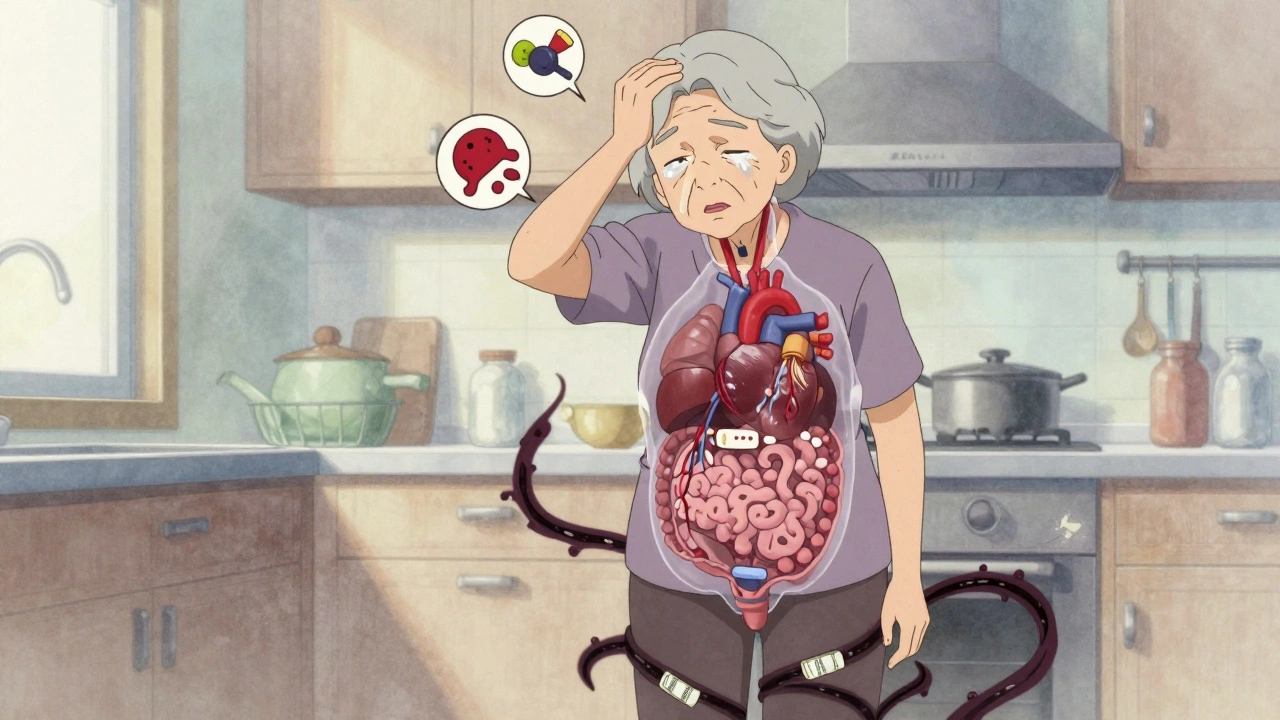
What You Should Do Instead
If you’re congested, try a saline nasal spray. It’s free of chemicals, safe for daily use, and works without raising your blood pressure. For allergies, use a single antihistamine like loratadine or fexofenadine (Allegra) on its own. If congestion lingers, add a decongestant nasal spray-but only for three days max. Long-term use can cause rebound congestion, making your nose worse than before. Don’t assume “over-the-counter” means “safe.” These are real drugs with real side effects. Read the label. Look for active ingredients. If you see “pseudoephedrine,” “phenylephrine,” “diphenhydramine,” “cetirizine,” or “loratadine,” you’re looking at a combo or a single agent that could interact. If you’re on other meds-especially for blood pressure, depression, or thyroid issues-talk to a pharmacist before taking anything new. Pharmacists see these mistakes every day. They can tell you if your cold medicine will clash with your blood pressure pill. And they’re not trying to sell you something. They’re trying to keep you out of the hospital.Red Flags You’re Overdoing It
If you’ve taken one of these combo pills and start feeling any of these, stop immediately and get help:- Rapid or pounding heartbeat
- Severe dizziness or trouble standing
- Blurred vision or dry mouth that won’t go away
- Confusion, agitation, or hallucinations
- Difficulty urinating
- High fever






Emmanuel Peter
December 4, 2025 AT 06:36This is why Big Pharma loves these combo pills-profit margins are insane and nobody reads the label. I saw a guy at the gas station buy Zyrtec-D like it was candy, then immediately chug a Red Bull. He didn’t even blink when the cashier asked if he had high blood pressure. Dude looked like he was about to levitate. We’re not talking about a little drowsiness here-we’re talking about your heart trying to escape your chest. And yet, these things are sold next to gum and batteries like they’re harmless.
It’s not even about the science anymore. It’s about convenience culture. People want a button to press and fix everything. But your body isn’t a vending machine. You don’t get a free snack when you insert cash-you get a slow-motion meltdown if you keep pressing the wrong buttons.
Ashley Elliott
December 5, 2025 AT 13:49I appreciate how thorough this post is-seriously, thank you. I used to take Claritin-D every morning during allergy season until I started having palpitations. My doctor didn’t even ask about OTC meds until I mentioned it. Turns out, my blood pressure had been creeping up for months, and it was the pseudoephedrine. Now I use saline spray, a neti pot, and a single antihistamine. It’s slower, yes-but I’m not waking up feeling like I’ve been run over by a truck.
Also, please, please, please tell your grandparents about this. My 72-year-old dad was taking Zyrtec-D because ‘it worked better than the old stuff.’ He didn’t realize it was making him confused and unsteady. He fell last winter. It was terrifying. This info needs to be screamed from the rooftops.
Chad Handy
December 6, 2025 AT 02:52Look, I get it-people are lazy and want quick fixes. But here’s the real issue: pharmaceutical companies don’t care if you live or die as long as you keep buying. They market these combos like they’re miracle cures, but the data shows they’re barely better than placebo. And the side effects? They’re not rare-they’re predictable. The FDA knew about the risks for decades. They didn’t ban pseudoephedrine because it was dangerous-they banned it because it could be turned into meth. That’s not safety-that’s criminal justice masquerading as public health.
Meanwhile, the real victims are the people who don’t know any better. Grandparents. Teens. People on multiple prescriptions. They’re not stupid-they’re just trusting a system that’s designed to exploit trust. And now we’re all paying the price in ER visits, lawsuits, and premature deaths. The system is broken. And nobody’s fixing it because the money’s too good.
Chase Brittingham
December 7, 2025 AT 02:13This is one of those posts that makes you pause and rethink everything you thought you knew. I used to think ‘OTC’ meant ‘safe.’ Turns out, it just means ‘you can buy it without a prescription.’ That’s not the same thing.
I had a friend who took Zyrtec-D for weeks straight because he ‘didn’t want to miss work.’ He ended up in the ER with atrial fibrillation. He didn’t even know he had an underlying heart issue. The doctor said if he’d waited another 12 hours, he might not have made it.
So yeah-read the label. Ask your pharmacist. Don’t assume. And if you’re feeling weird after taking one of these? Stop. Don’t tough it out. Call someone. Your body’s trying to tell you something.
Bill Wolfe
December 7, 2025 AT 22:06Oh wow. Another one of these ‘medical advice’ posts from someone who clearly doesn’t understand pharmacology. You act like these drugs are poison, but let’s be real-people have been taking them for decades without issue. The fact that you’re acting like this is some kind of public health crisis is just… dramatic.
And don’t get me started on the ‘saline spray’ solution. That’s what you give people who don’t want to take real medicine. If you’re too weak to handle a little pseudoephedrine, maybe you shouldn’t be out in the world during allergy season. It’s not rocket science. Read the label. Don’t mix drugs. Don’t be a hypochondriac.
Also, why are you so scared of pharmaceutical companies? They’re not trying to kill you-they’re trying to make you feel better. Maybe you’re just allergic to common sense.
Benjamin Sedler
December 8, 2025 AT 00:18Okay, but what if I told you the real reason these combos are still on the shelves is because the FDA is owned by Big Pharma lobbyists? You think they banned phenylpropanolamine because it caused strokes? Nah. They banned it because it was too easy to turn into meth. Pseudoephedrine stays because it’s profitable AND hard to abuse in large quantities. The science? Secondary.
And don’t even get me started on the ‘non-sedating’ antihistamines. Cetirizine? Half the people who take it feel like a zombie. The other half? They’re wide awake but can’t remember their own name. It’s not ‘non-sedating’-it’s ‘sedating but legally defensible.’
They’re not drugs. They’re psychological warfare disguised as relief. And we’re all just pawns in a $12 billion game of Russian roulette.
zac grant
December 9, 2025 AT 17:23From a clinical perspective, the risk-benefit ratio for combination decongestant-antihistamines is firmly in the red for most populations. The Cochrane data is unequivocal: minimal symptomatic improvement versus significantly elevated rates of adrenergic and anticholinergic side effects.
Moreover, the pharmacokinetic overlap-especially in elderly patients with reduced hepatic metabolism-creates a perfect storm for drug accumulation. The 1:7 sedation rate on cetirizine is underreported; real-world adherence studies show closer to 1:4 when patients aren’t self-reporting bias.
Saline irrigation and single-agent antihistamines remain first-line for good reason: predictable pharmacology, low interaction potential, and zero systemic adrenergic load. The only group that might benefit marginally are healthy adults with acute, severe rhinitis-but even then, duration-limited decongestant sprays are preferable.
Gareth Storer
December 10, 2025 AT 03:08So let me get this straight: you’re telling me that if I take a pill that makes my nose stop running, I might also give myself a heart attack? Brilliant. I’ll just go back to sniffing my own armpits. At least then I won’t be poisoned by capitalism.
Also, why is it that every time someone writes a ‘warning’ about OTC meds, they always sound like they’re about to start a cult? ‘STOP. CALL 911. YOUR HEART IS TRYING TO ESCAPE.’
Maybe people just need to stop being so dramatic. Or maybe-just maybe-they should stop taking pills they don’t understand. But no, let’s blame the medicine. Always easier than blaming the person holding the bottle.
Pavan Kankala
December 10, 2025 AT 09:21This is all a distraction. The real danger isn’t pseudoephedrine-it’s the fact that you’re being told what to believe. Who funded the Cochrane review? Who owns the FDA? Who profits when you’re scared of your own medicine?
These drugs are fine. The real problem is that you’ve been conditioned to fear your body. You think a pill is dangerous because some ‘expert’ told you so. But what if the ‘expert’ is part of the system that wants you dependent on their ‘safe’ alternatives?
Saline spray? That’s a placebo for the gullible. The truth? Your body doesn’t need fixing. It needs freedom. And freedom means taking whatever you want-without permission from a lab coat.
Wake up. The pills aren’t the enemy. The fear is.
Martyn Stuart
December 10, 2025 AT 16:21Thank you for this. Absolutely vital information.
I’m a pharmacist, and I see this exact scenario every single day. A patient comes in, buys Zyrtec-D, then says, ‘I’ve been taking this for years-I never had a problem.’
Then we check their med list: lisinopril, metoprolol, levothyroxine, sertraline. And suddenly, it’s not ‘never had a problem’-it’s ‘lucky so far.’
Pharmacists aren’t here to sell you anything. We’re here to stop you from ending up in the ER. Please, if you’re on any prescription meds-ask us. We’re trained for this. And we’re not judging you. We just want you to live.
Also-yes, saline spray works. It’s free. And it doesn’t make your heart feel like it’s running a marathon.
Yasmine Hajar
December 12, 2025 AT 04:57As a Latina woman raised by a grandmother who never trusted pills, I’m so glad this got written. My abuela used to say: ‘If it’s not in your kitchen, don’t put it in your body.’
She used steam, honey, saltwater rinses, and rest. And guess what? She lived to 94.
These combo pills? They’re not ‘modern medicine.’ They’re corporate magic tricks. And we’ve been hypnotized by marketing.
Let’s stop glorifying convenience and start honoring our bodies. We don’t need a pill for every sneeze. We need awareness. And community. And maybe, just maybe, a little patience.
Karl Barrett
December 12, 2025 AT 23:34This post touches on something deeper than pharmacology-it’s about our relationship with control. We live in a world that tells us every discomfort must be eliminated, immediately, with a pill. But the body isn’t a machine to be optimized. It’s a system to be respected.
These combo drugs represent the ultimate expression of modern alienation: we don’t want to feel, so we numb the symptoms. We don’t want to rest, so we force alertness. We don’t want to sit with discomfort, so we chemically override it.
The real cost isn’t just the heart palpitations or the dizziness. It’s the erosion of trust in our own biology. We’ve outsourced our intuition to a label. And that’s the most dangerous ingredient of all.
Jake Deeds
December 14, 2025 AT 13:45Wow. This is the most ‘woke’ medical advice I’ve ever seen. I mean, really? You’re telling people to avoid a pill because it might cause their heart to race? What’s next? Are we gonna ban caffeine because it can raise BP? Or water because it can cause hyponatremia?
Some people just need to stop being so dramatic. I’ve taken Zyrtec-D for 15 years. I’m 32, I run marathons, and I’ve never had a problem. But hey, maybe I’m just one of those reckless, irresponsible people who don’t read labels.
Also, saline spray? That’s what you recommend? That’s like saying ‘don’t use a chainsaw, use a butter knife.’
Someone’s getting paid to write this, isn’t they? It’s too perfectly moralistic to be real.
Ashley Elliott
December 16, 2025 AT 10:44To the person who said ‘just read the label’-that’s great advice, if you can read. My mom is 78, has macular degeneration, and her glasses are cracked. She doesn’t read labels. She sees ‘24-HOUR RELIEF’ and thinks, ‘Perfect.’
It’s not about personal responsibility. It’s about design. If a product is dangerous enough to warrant a warning, it shouldn’t be marketed like a snack. It should be behind the counter, with a trained person asking, ‘Do you have heart issues?’
And if you’re healthy and fine-great. But don’t act like your experience is the default for everyone. That’s not science. That’s privilege.