

Taking your medication every day isn’t just a suggestion-it’s often the difference between feeling okay and ending up in the hospital. Yet, nearly half of people with chronic conditions miss doses regularly. Why? It’s not laziness. It’s not forgetfulness alone. It’s that most medication schedules were designed by doctors, not by real life. The good news? You don’t need to be perfect. You just need a routine that fits you.
Start with what you already do
Your day is full of habits you never think about: brushing your teeth, making coffee, feeding the dog, checking your phone in the morning. These are your anchors. Link your medication to one of them. If you take pills every morning after you brush your teeth, your brain starts to expect it. No mental effort needed. Stanford Medicine found that 78% of people who tied their meds to an existing habit stuck with it for over a year. That’s not magic-it’s neuroscience. Your brain loves patterns.Don’t pick something too vague like “after breakfast.” Too many variables. Did you skip breakfast? Did you eat at 9 a.m. or 1 p.m.? Instead, pick “right after I finish brushing my teeth.” Or “when I sit down to drink my morning tea.” Specificity wins.
Use a pill organizer-no tech required
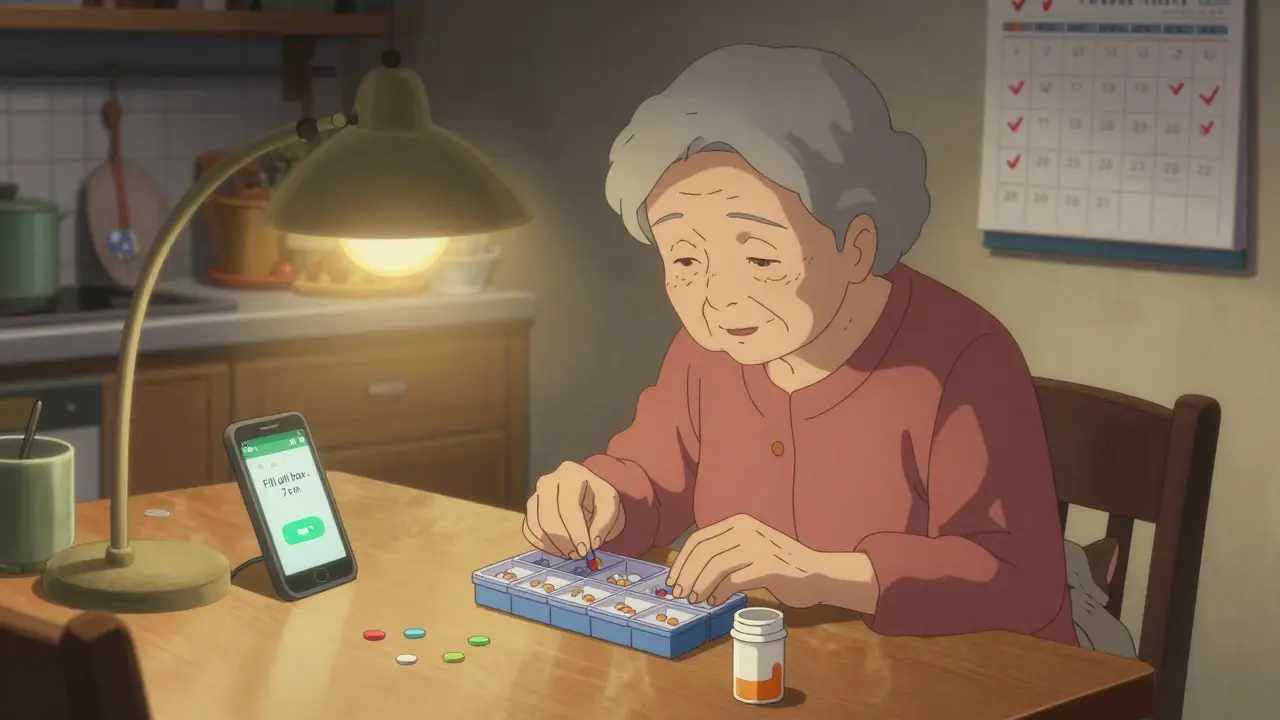
A simple weekly pill box with morning, afternoon, and evening compartments is one of the most effective tools out there. It doesn’t need batteries. It doesn’t need Wi-Fi. You can buy one for under £5 at any pharmacy. Fill it once a week-Friday night after dinner is the most popular time because it’s quiet, you’re not rushed, and you’ve got a clear view of what’s left.Studies show that using a multi-compartment organizer reduces missed doses by up to 35%. Why? Because you see it. You know if you skipped a dose. You know if you took two. No guessing. No panic. And if you’re worried about forgetting to fill it, set a recurring calendar alert on your phone: “Fill pill box every Friday at 7 p.m.”
Color-code your meds
If you’re taking several different pills, colors help. Blue for morning, red for afternoon, yellow for night. The American Heart Association found that using colored labels improved correct dosing by 28%-especially for people who rely more on visual cues than reading small print. You can buy colored stickers or even use nail polish on the caps. It sounds silly, but if you’ve ever stared at a handful of pills wondering which is which, you’ll know this isn’t just a gimmick. It’s a lifesaver.Set reminders-but make them work for you
Phone alarms are great-if you actually hear them. But here’s the catch: 45% of people over 75 say they’ve silenced their alarms by accident. Or they don’t know how to set them. Or they get ten alerts and tune them all out.Try this instead: Use a timer cap on your pill bottle. These beep when it’s time to take your meds. No phone needed. No app to download. Just turn the cap, and it counts down. They work for everyone-tech-savvy or not. ProMedica’s data shows they maintain 62% adherence across all age groups. If you prefer your phone, set two alarms: one at the time you take your pill, and another 15 minutes later as a backup. Put your phone across the room so you have to get up to turn it off. That little movement helps your brain register: “I took my pill.”
Track it visually
Write it down. Not in a journal. Not in an app. On a calendar. Print out a simple monthly grid. Put a big X or a checkmark every time you take your meds. There’s something powerful about seeing a chain of checks grow. You don’t want to break it. A 2011 study in PMC showed a 32% drop in missed doses just from using a visual tracker. AdventHealth’s survey of 5,000 patients found that 76% of those who used checkmarks maintained 90%+ adherence. It’s not about perfection-it’s about momentum.Simplify with your doctor
If you’re taking five different pills at three different times a day, it’s no wonder you’re overwhelmed. Ask your doctor or pharmacist: “Can any of these be combined? Can I take this one with dinner instead of breakfast?”Dr. Robert L. Page II says simplifying to once-daily dosing cuts complexity by 40%. That’s huge. Sometimes, switching from three pills a day to two can make all the difference. A 2022 MedStar Health study found that patients who consolidated their doses reduced their daily medication count by 30-50% without losing effectiveness. Don’t assume it’s impossible. Ask. And bring your pill bottle or a list of everything you take-even vitamins and supplements.
Plan for disruption
Travel. Holidays. A night out. A bad day. These are the moments routines break. That’s normal. The key isn’t to avoid disruption-it’s to plan for it.Keep a 3-day supply of meds in your bag. Use a small pill case for trips. If you’re flying, keep meds in your carry-on-not checked luggage. If you’re going to be late for dinner, take your pill with a snack instead of waiting. Most meds can be taken with food unless your doctor says otherwise. Check with them first.
And if you miss a dose? Don’t double up unless your doctor says so. Just go back to your schedule. One missed dose won’t ruin your progress. Stressing over it will.

Don’t ignore side effects
Sometimes, people stop taking meds because they feel worse. Nausea. Dizziness. Fatigue. They think, “This isn’t worth it.” But stopping without talking to your doctor can be dangerous. Side effects often fade after a few weeks as your body adjusts. Or there’s a better alternative.Write down what you’re feeling: “I get dizzy 2 hours after my blood pressure pill.” Bring that to your next appointment. Your doctor might lower the dose, switch the time, or change the medication. But they can’t help if you don’t tell them.
Get a buddy
Find someone you trust-a partner, a friend, a sibling-and make a pact. “I’ll text you when I take my meds. You do the same.” It doesn’t have to be daily. Twice a week is enough. The buddy system works because accountability matters. Studies show 58% effectiveness-but only if the person is reliable. If your buddy moves away or gets busy, it falls apart. So have a backup plan.What doesn’t work
Relying on memory. You can’t remember every pill, every time. Your brain has too much to do.Using apps without testing them first. If you don’t know how to use the app, or it’s too complicated, you’ll quit. Stick with tools that feel natural.
Waiting until you feel sick to start taking your meds. Chronic meds don’t work like painkillers. They build up over time. Skipping them even occasionally can undo progress.
It’s not about willpower
You don’t need to be disciplined. You need a system. The most successful routines aren’t the ones with the most bells and whistles. They’re the ones that are simple, visible, and tied to things you already do. You don’t have to be perfect. You just have to be consistent.Start small. Pick one pill. Link it to brushing your teeth. Use a pill box. Check it off. Do that for a week. Then add another. Slow progress is still progress. And over time, taking your meds won’t feel like a chore. It’ll feel like part of your day-just like washing your hands or locking the door.
What if I forget to take my medication?
Don’t panic. Don’t double up unless your doctor told you to. Skip the missed dose and go back to your regular schedule. Missing one dose rarely causes harm, but stressing about it can. If you miss doses often, try a pill organizer or timer cap. They make it impossible to forget.
Can I take my pills with food?
Some can, some can’t. Always check with your pharmacist or doctor. Blood pressure meds and cholesterol drugs often work better with food. Antibiotics and thyroid meds usually need an empty stomach. If you’re unsure, ask for a written list of instructions. Don’t guess.
Are smartphone apps better than pill boxes?
For people under 65 who are comfortable with tech, apps can help. But for older adults, pill boxes and timer caps are more reliable. A 2023 ProMedica study found smartphone reminders dropped to 45% effectiveness for people over 75. Simple tools work better for most people. Choose what you’ll actually use.
How long does it take to build a medication routine?
It usually takes about 7 days to start feeling automatic. But full habit formation can take 3-6 weeks. Don’t expect perfection right away. Focus on consistency, not perfection. Even if you miss a day, get back on track the next day. Progress matters more than perfection.
Why do I keep forgetting even when I set reminders?
Because reminders alone aren’t enough. Your brain needs a trigger. Pair your pill with a physical action-like brushing your teeth or turning off the kettle. That creates a habit loop. Alarms just ring. Actions stick.
Should I tell my family about my medication schedule?
Yes-if you’re comfortable. A trusted family member can help you refill your pill box, remind you if you’re away, or spot if something seems off. You don’t need to share every detail, but having one person who knows your routine adds a layer of safety.
What if I have trouble reading small labels?
Ask your pharmacist for large-print labels or audio instructions. Many pharmacies offer this for free. You can also use a magnifying glass or take a photo of your pill bottle with your phone and zoom in. Color-coding the caps helps too. You don’t have to read every word-just recognize the color or shape.
Can I stop taking my meds if I feel better?
No. Chronic conditions like high blood pressure, diabetes, or thyroid issues often have no symptoms when controlled. Feeling better means your meds are working. Stopping can cause a dangerous rebound. Always talk to your doctor before making any changes.





Aurelie L.
January 26, 2026 AT 13:12Been using the pill box for 6 months. Friday nights are my ritual. No alarms. No apps. Just me, my tea, and 14 little compartments. Life’s weirdly peaceful now.
Joanna Domżalska
January 27, 2026 AT 14:41Stop glorifying pill boxes. This is just behavioral conditioning wrapped in wellness fluff. You’re not building a habit-you’re training a rat. Also, who the hell uses nail polish on pill caps?
Faisal Mohamed
January 27, 2026 AT 15:25Bro. The neuroscience here is *chef’s kiss* 🤯. Anchoring meds to existing neural pathways? That’s neuroplasticity in action. And color-coding? That’s sensory cueing at its finest. Also, timer caps = biohacking for the masses. 🙌
Josh josh
January 28, 2026 AT 09:12i just put my pills next to my coffee maker. every morning i make coffee i take em. no box no app no stress. if i forget? i just take em later. its fine. life is not a spreadsheet
bella nash
January 30, 2026 AT 00:38It is imperative to acknowledge the clinical significance of adherence metrics in chronic disease management. The empirical data presented herein demonstrates statistically significant improvements in compliance when structured behavioral interventions are implemented. One must not conflate convenience with efficacy.
Sally Dalton
January 31, 2026 AT 11:59OMG YES I DID THE CALENDAR THING AND NOW I HAVE A WEEK OF CHECKMARKS AND I’M SO PROUD I CRIED A LITTLE?? I’M NOT EVEN KIDDING. I’M 72 AND I JUST FELT LIKE A WINNER. THANK YOU FOR THIS 💕
Shawn Raja
February 1, 2026 AT 06:29Wow. So we’re just supposed to believe that tying meds to brushing teeth is some kind of magic? You know what’s really revolutionary? Doctors actually listening to patients instead of handing out 12-pill regimens like they’re candy. Also, who wrote this? A wellness influencer with a PhD in marketing?
Ryan W
February 3, 2026 AT 00:09UK pharmacies sell pill organizers for £5? That’s ridiculous. In America you pay $12 for the same thing because of corporate greed. Also, why is everyone so obsessed with color-coding? Just read the damn label. You’re not in kindergarten.
Allie Lehto
February 4, 2026 AT 19:12if you’re taking meds for blood pressure and you skip one and then feel fine you think you don’t need them but you’re wrong and you’re going to die alone and your cat will eat your face. i’ve seen it. don’t be that person. i’m not judging. i’m just saying. 🙏
Dan Nichols
February 6, 2026 AT 10:51Everyone’s acting like this is groundbreaking advice. I’ve been doing this since 2012. The real issue is that doctors don’t simplify. They prescribe like they’re trying to win a prize for complexity. Also, why are we praising pill boxes like they’re the iPhone 16?
Renia Pyles
February 7, 2026 AT 23:47You people are so naive. You think a sticker on a pill cap fixes systemic healthcare failure? Your meds are expensive because your insurance won’t cover them. Your doctor doesn’t have time to simplify. Your pharmacy won’t help you. This whole post is a Band-Aid on a hemorrhage.
Rakesh Kakkad
February 8, 2026 AT 11:20Respected author, your methodology is commendable. However, in India, many elderly patients rely on family members to manage medications. The concept of individualized anchoring is less applicable. Cultural context must be considered. Also, pill boxes are often shared among household members.
Nicholas Miter
February 9, 2026 AT 09:52My dad used to forget everything. Then I got him a timer cap. He doesn’t even know how to use his phone. But that thing beeps and he takes it. No drama. No guilt. Just quiet consistency. I wish someone had told me this 5 years ago.