

When a blockbuster drug loses its patent, you might expect cheaper copies to flood the market immediately. For simple pills, that is exactly what happens. But for more intricate medicines-like inhalers, injectable gels, or liposomal formulations-the path to approval is a maze. These are known as complex generic drugs, which are generic versions of medications with complicated active ingredients, delivery systems, or manufacturing processes that make proving safety and efficacy significantly harder than for standard small-molecule generics. If you have ever wondered why some life-saving treatments remain expensive long after patents expire, the answer often lies in this regulatory bottleneck.
The Difference Between Simple and Complex Generics
To understand the delay, we first need to separate the wheat from the chaff. Most people think of a generic drug as a white pill that looks slightly different from the brand name but contains the exact same chemical ingredient. These are "small-molecule" generics. They are easy to copy because the chemistry is straightforward. The U.S. Food and Drug Administration (FDA) has a streamlined process for these, called the Abbreviated New Drug Application (ANDA). Manufacturers simply prove their version dissolves at the same rate and reaches the bloodstream similarly to the original. This is called bioequivalence.
Complex generics do not fit into this neat box. They involve:
- Peptides and polymeric compounds that require specialized handling to avoid triggering immune responses.
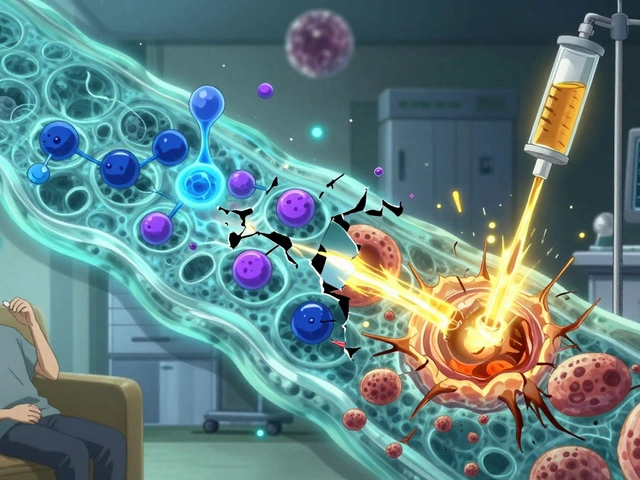
- Liposomal formulations where the drug is wrapped in microscopic fat bubbles.
- Long-acting injectables that release medicine over weeks or months.
- Drug-device combinations like inhalers, where the device itself affects how the drug enters the body.
For these products, copying the chemical formula is only half the battle. You must also replicate the delivery mechanism perfectly. A tiny change in the shape of an inhaler nozzle can alter how much medicine reaches the lungs, even if the powder inside is identical. This makes the traditional ANDA pathway inadequate, forcing manufacturers into a much slower, more expensive development cycle.
The Regulatory Hurdle: GDUFA II and Beyond
The FDA recognized this gap in 2017 with the reauthorization of the Generic Drug User Fee Amendments (GDUFA II). Before this, the agency’s review system was built almost entirely for simple pills. GDUFA II formally defined complex drug products and allocated specific resources to handle them. It introduced the Pre-ANDA Meeting Program, allowing manufacturers to discuss their plans with regulators before spending millions on development. By 2019, this program had processed over 800 meeting requests, showing high demand.
However, definitions alone do not solve scientific problems. The FDA also began issuing Product-Specific Guidances (PSGs)-detailed roadmaps for developing generics of specific branded drugs. As of July 2019, there were approximately 1,700 PSGs available, with over 160 new or revised ones published that year alone. Despite these efforts, the approval rate remains low. In Q2 2023, data showed that only 15 complex generic products had received FDA approval since 2015, compared to over 1,000 conventional generics. The disparity highlights just how steep the learning curve is for both industry and regulators.
Scientific Challenges That Stall Progress
Why is it so hard? A systematic review published in PubMed analyzed 24 studies across multiple countries and identified six major challenge categories. Formulation challenges appeared in 17 articles, while analytical and critical quality attribute challenges each appeared in 19. Let’s break down what this means in practice.
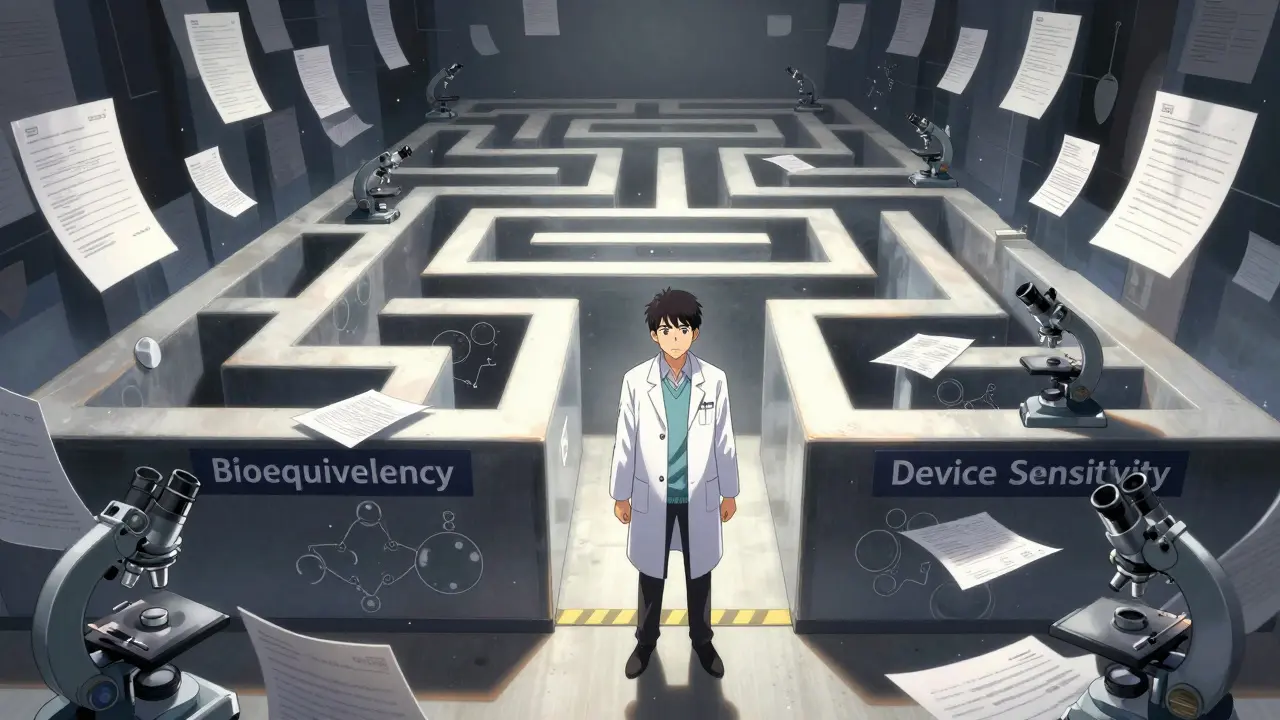
Bioequivalence Nightmares: For a long-acting injectable, proving bioequivalence isn’t about measuring blood levels once. You have to track the drug’s release profile over weeks. Small variations in manufacturing can lead to huge differences in patient exposure. The approval of bupivacaine liposome injectable in 2019 was a landmark case because it required developing a scientifically novel approach to prove equivalence. It took years of coordination between the manufacturer and the FDA.
Device Sensitivity: Consider inhalers. Patients might not notice if the mouthpiece is 2 millimeters wider, but the FDA does. Differences in device geometry can change particle size distribution, affecting lung deposition. Regulators often reject applications based on minor design deviations, even if clinical impact seems negligible. This creates a catch-22: manufacturers want to innovate or simplify devices, but regulators demand near-perfect replication of the reference product.
Immunogenicity Risks: Peptides and polymers are larger molecules that the body may recognize as foreign. This can trigger immune reactions. Proving that a generic version won’t cause unexpected allergies requires extensive testing, adding months or years to the timeline.
The Cost and Time Penalty
Complexity comes with a price tag. Developing a conventional generic typically costs $2-$3 million and takes 2-3 years. In contrast, a single complex generic program can cost between $20 million and $50 million, with timelines stretching to 5-7 years. This massive investment deters many companies, especially smaller firms. Only large pharmaceutical players with deep pockets can afford the risk of multi-year regulatory delays.
This lack of competition keeps prices high. When only one or two companies can navigate the regulatory maze, they hold significant market power. The Congressional Research Service noted that while FDA review times for all generics improved after GDUFA implementation in 2012, the backlog for complex products remained stubbornly high. The median review time for new generics in March 2012 was 31 months; today, while faster for simple drugs, complex cases still face prolonged scrutiny.

Alternative Pathways: The 505(b)(2) Route
When the ANDA path is blocked, some developers turn to Section 505(b)(2) of the Federal Food, Drug, and Cosmetic Act. This is a "hybrid" application that allows reliance on data already known to the FDA (from the original brand) while submitting new clinical data for the changes made. For many complex products, this becomes the only viable route to market. However, 505(b)(2) applications are subject to patent litigation risks and longer review periods, further complicating the landscape.
Regulatory uncertainty remains a key issue. Without clear guidance, FDA expectations can seem to shift. One expert noted that unclear guidelines lead to longer approval times, delaying access for patients who need affordable options. International variations add another layer: China’s NMPA often requires local clinical trials, while Brazil’s ANVISA imposes stringent bioequivalence standards aligned with ICH guidelines. Global harmonization is still a work in progress.
| Feature | Conventional Generic | Complex Generic |
|---|---|---|
| Average Development Cost | $2-$3 million | $20-$50 million |
| Timeline to Approval | 2-3 years | 5-7 years |
| Primary Regulatory Pathway | ANDA | ANDA (rarely), 505(b)(2) |
| Bioequivalence Proof | Simple pharmacokinetic study | Complex modeling, device testing, immunogenicity assays |
| Market Competition | High (many entrants) | Low (few entrants due to cost/risk) |
The Future: AI and Quality by Design
Is there hope for faster approvals? Industry analysts predict that artificial intelligence and machine learning could reduce complex generic development timelines by 20-30% by 2027. AI tools can model drug release profiles and predict formulation failures before physical testing begins. Additionally, Quality by Design (QbD) approaches-which emphasize understanding how every variable affects the final product-are expected to cut regulatory review cycles by 35-45% for well-characterized products.
The FDA continues to expand its support. The Pre-ANDA program now handles over 1,200 meeting requests annually, and targeted guidances keep increasing. Yet, the agency acknowledges that complex generics will remain a "high-priority, high-challenge" category. Patient advocacy groups argue for more input from advisory councils to prioritize which complex drugs are most urgently needed. After all, the goal isn’t just faster approvals-it’s better access for those who suffer when cheap alternatives don’t exist.
What makes a generic drug "complex"?
A generic drug is considered complex if it has a complicated active ingredient (like peptides), a unique delivery system (like liposomes or inhalers), or requires special manufacturing processes. Unlike simple pills, these drugs are harder to copy precisely, making proof of safety and effectiveness more difficult.
Why does FDA approval take longer for complex generics?
Approval takes longer because proving bioequivalence is scientifically challenging. For example, an inhaler’s device design affects drug delivery, and long-acting injectables require tracking release over weeks. Regulators need extensive data to ensure the generic performs identically to the brand, which involves costly and time-consuming studies.
How much does it cost to develop a complex generic?
Developing a complex generic typically costs between $20 million and $50 million, compared to $2-$3 million for a conventional generic. This high cost, combined with a 5-7 year timeline, limits the number of companies willing to enter the market.
What is the role of GDUFA II in complex generic approval?
GDUFA II, enacted in 2017, formally defined complex generics and provided funding for the FDA to hire specialists and create new review pathways. It introduced the Pre-ANDA Meeting Program and Product-Specific Guidances to help manufacturers navigate the approval process more effectively.
Can AI speed up the approval of complex generics?
Yes, industry experts predict that AI and machine learning could reduce development timelines by 20-30% by 2027. These tools can simulate drug behavior and optimize formulations early in the process, reducing the need for repeated physical trials and accelerating regulatory submissions.




Cecilia McGuinness
June 11, 2026 AT 22:03omg this is so true like why is it so hard to just make the same pill?? its literally the same ingredients but they charge us like we are buying gold or something i am so tired of paying hundreds for my inhaler when i know there is a cheaper version out there somewhere waiting to be approved by some bureaucracy that moves at the speed of a snail
shreya sinha
June 13, 2026 AT 14:28It is profoundly disheartening to observe how the regulatory apparatus, ostensibly designed to protect public health, has instead become an insurmountable barrier to equitable access for those who require these life-sustaining medications on a daily basis. The discrepancy in cost and time between conventional and complex generics is not merely a statistical anomaly but a moral failing of a system that prioritizes procedural rigidity over human welfare, thereby condemning countless individuals to financial ruin simply because their condition requires a delivery mechanism that defies the simplistic bioequivalence models established decades ago for small-molecule compounds.
Brandon Brodsky
June 15, 2026 AT 07:37Sure, let's pretend the FDA isn't just protecting Big Pharma profits with all this 'safety' nonsense. It's hilarious how suddenly 'complexity' becomes a valid excuse when it benefits the shareholders. I've seen more rigorous testing for food dyes than for these injectables. It's a scam wrapped in red tape.
Brett Webster
June 16, 2026 AT 15:50Actually, the issue isn't necessarily profit protection but rather the genuine scientific difficulty in replicating device-dependent delivery systems. When you have an inhaler, the aerodynamic particle size distribution is critical for lung deposition. If the generic nozzle is even slightly different, the drug might deposit in the throat instead of the alveoli, rendering it ineffective or causing local irritation. The FDA has to ensure that the generic performs identically in the body, which requires extensive clinical data that goes beyond simple blood concentration curves. It's a high-stakes engineering problem as much as a chemical one.
Aditya Singh
June 17, 2026 AT 10:17From a pharmaceutical development perspective, the challenge lies in the Quality by Design (QbD) framework where critical quality attributes must be tightly controlled. In India, we often see similar hurdles with NMPA equivalents requiring local trials, but the global harmonization through ICH guidelines is slowly helping. The use of AI for predictive modeling of drug release profiles is indeed a game-changer, potentially reducing the iterative cycle times significantly.
Sherry Wheeler
June 17, 2026 AT 17:04Oh my goodness, reading about the immunogenicity risks gave me chills! Imagine your body attacking the medicine meant to save you? That is terrifying! But it gives me hope that AI can help solve this puzzle faster. We need miracles now, not in 2027! Let's keep pushing for better access!
Ganesh Honikol
June 19, 2026 AT 01:45The integration of artificial intelligence into the formulation development phase represents a paradigm shift in how we approach complex generic drugs. By leveraging machine learning algorithms to predict protein folding interactions or liposomal stability under various stress conditions, researchers can significantly reduce the number of physical experiments required. This not only accelerates the timeline but also enhances the robustness of the final product, ensuring that the generic meets the stringent bioequivalence criteria without compromising on safety or efficacy. :)
Lee Coates
June 19, 2026 AT 10:45Typical. Another article blaming the FDA while ignoring that foreign manufacturers cut corners. American patients deserve safe drugs, not cheap knockoffs from who-knows-where. If it takes 7 years to prove it's safe, then so be it. Better safe than sorry. :P
Daniella Renzon
June 21, 2026 AT 04:24I totally get where everyone is coming from, it's super frustrating when prices stay high. But maybe we can look at the bright side that GDUFA II is actually trying to fix this. It's slow progress but at least they are acknowledging the problem. Let's keep supporting policies that encourage competition without sacrificing safety.
Miranda River
June 21, 2026 AT 17:19its not just about safety its about greed pure and simple the big pharma companies lobby hard to keep these patents alive and the fda is just their puppet dancing to their tune. its a tragedy really how we let corporate interests dictate who lives and who dies based on their ability to pay. pathetic.
Callie Skipper
June 22, 2026 AT 01:05i mean yeah the costs are crazy but i guess if it keeps people alive then maybe its worth it? idk seems like a lose lose situation honestly
AnneKatherine Stiekes
June 23, 2026 AT 11:21the table comparing costs is eye opening though 20 million vs 2 million is a huge gap no wonder small companies cant compete
Talilla Bailey
June 24, 2026 AT 14:08While the emotional arguments regarding affordability are valid, it is imperative to recognize the scientific rigor required for complex generics. The deviation in device geometry, as noted in the post, directly impacts therapeutic outcome. Therefore, the extended timelines and increased costs are not arbitrary barriers but necessary investments in patient safety. We must advocate for streamlined regulatory pathways that do not compromise on the essential quality attributes of these intricate formulations.